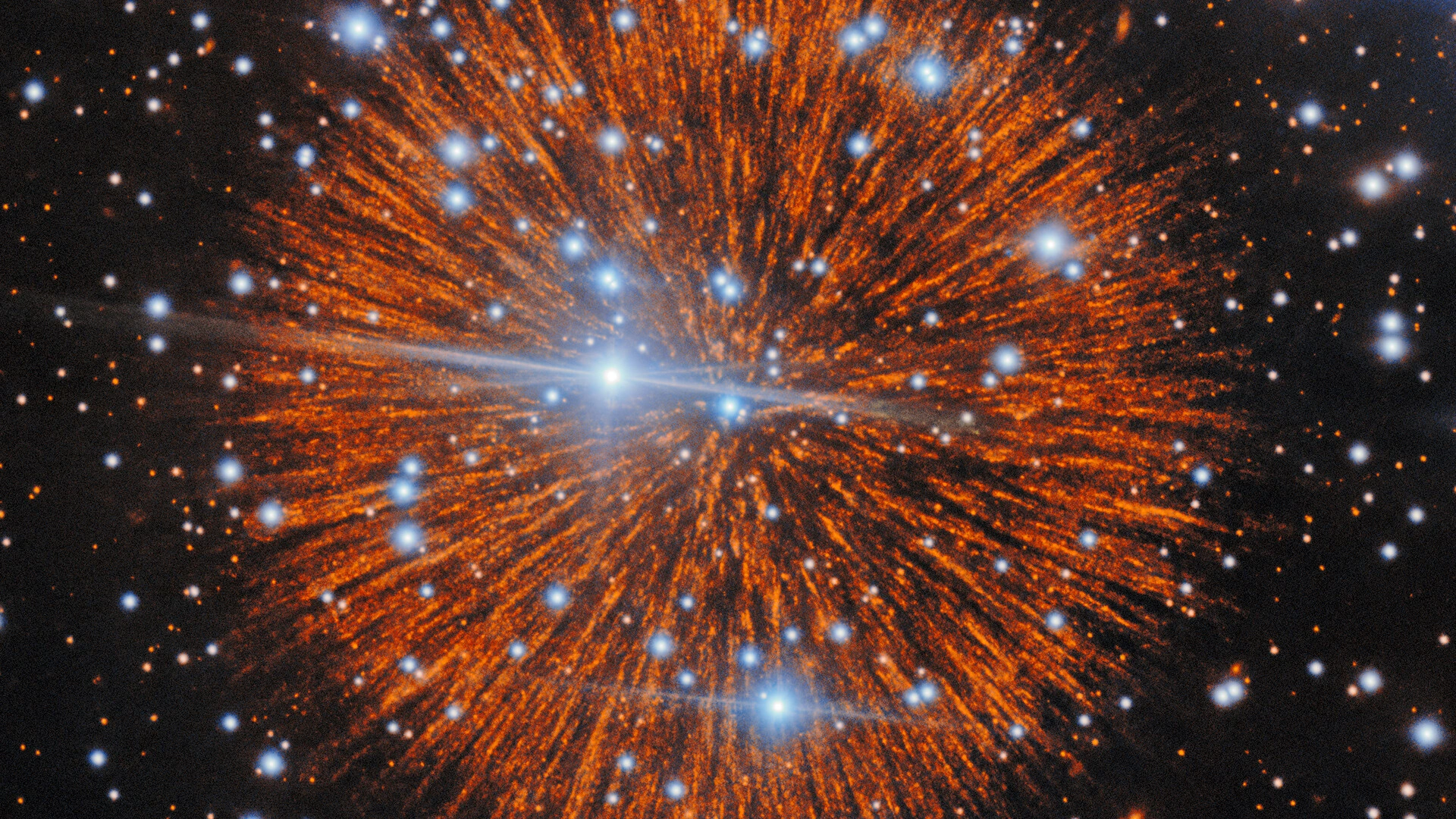
About 7,500 light-years away, Pa 30 is the leading candidate for the remnant of the guest star seen in 1181. New images resolve its firework-like filaments into chains of gas knots, helping astronomers investigate how this rare explosion left a star behind and shaped the surrounding material.
Key points
- The new images identify roughly ten times as many filaments as earlier observations and reveal chains of gas knots within them.
- A representative knot size is about 10¹⁶ centimetres; the knots are near the resolution limit, so their sizes remain estimates.
- The central star’s transverse recoil has a 3σ upper limit of 14 km/s; the three-dimensional limit also depends on assumptions about direction.
The filaments radiating from the Pa 30 nebula now reveal bead-like detail. A team co-led by Tim Cunningham and Ilaria Caiazzo used deep narrowband images from the GMOS instrument on Gemini North in Hawaiʻi to show that apparently smooth radial streaks contain strings of gas knots.
Clues from the guest star of 1181
Around 7,500 light-years from Earth, Pa 30 was discovered only in 2013, when amateur astronomer Dana Patchick spotted it in WISE infrared data. It is the leading candidate for the remnant of SN 1181, the historical guest star recorded in Chinese, Japanese and Arabic accounts.
A 2023 study had already revealed dozens of outward-reaching filaments. Spectroscopy in 2024 found ejecta velocities broadly consistent with free expansion, strengthening the link to SN 1181. A surviving central star and ejecta lacking hydrogen and helium led researchers to interpret the system as the remnant of a relatively faint Type Iax thermonuclear supernova that left a stellar survivor.
A closer look at the gas filaments
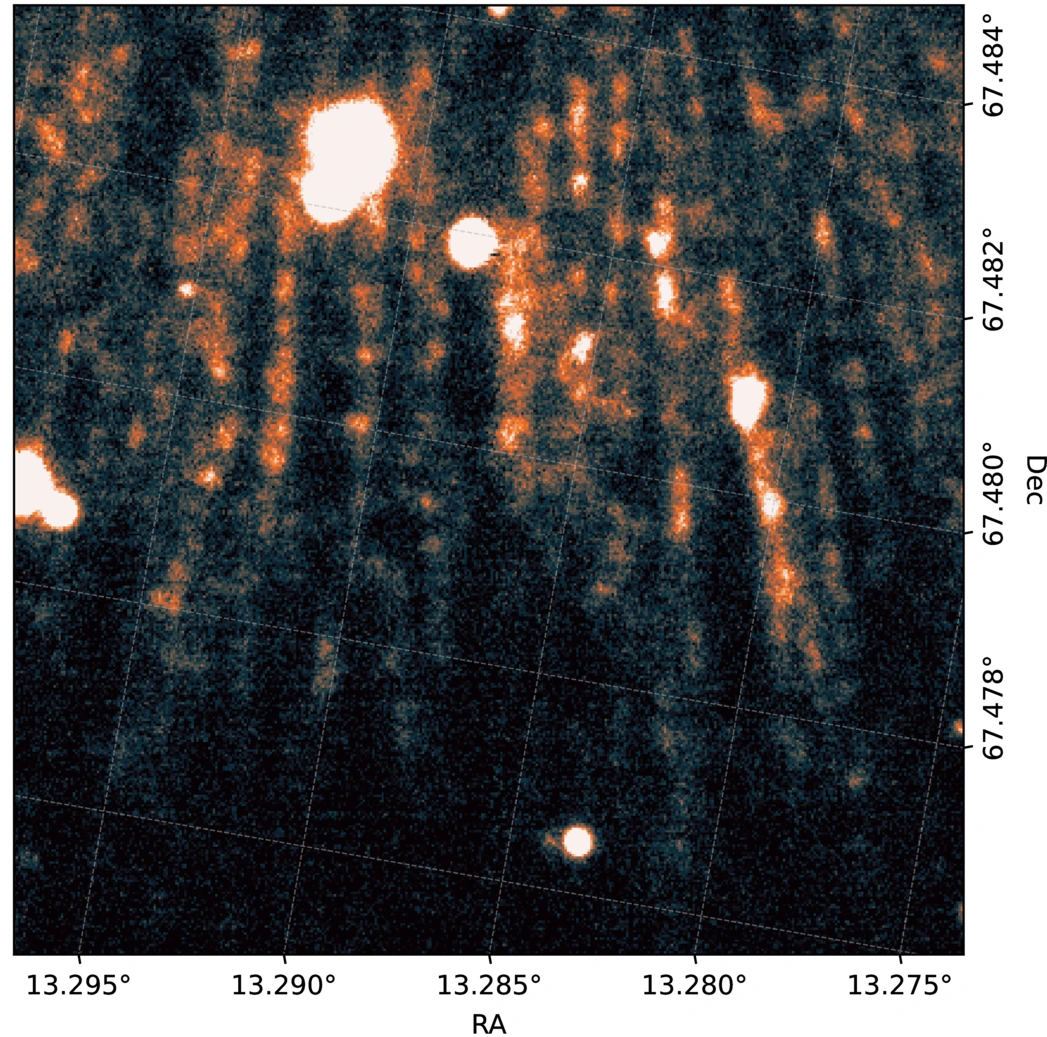
The new observations trace emission from singly ionized sulfur, [S II], and doubly ionized oxygen, [O III]. The sulfur images identify roughly ten times as many filaments as before. The oxygen images trace the same structures, giving previously more diffuse oxygen emission a clear structural counterpart.
A representative knot diameter is about 10¹⁶ centimetres, or roughly 670 astronomical units: about eleven times the diameter of Neptune’s orbit. The knots are only marginally resolved beyond the blur caused by atmospheric seeing, so their sizes remain preliminary estimates. Their apparently similar spacing along the filaments can also be affected by overlapping structures in projection.
The filaments point back to the central star
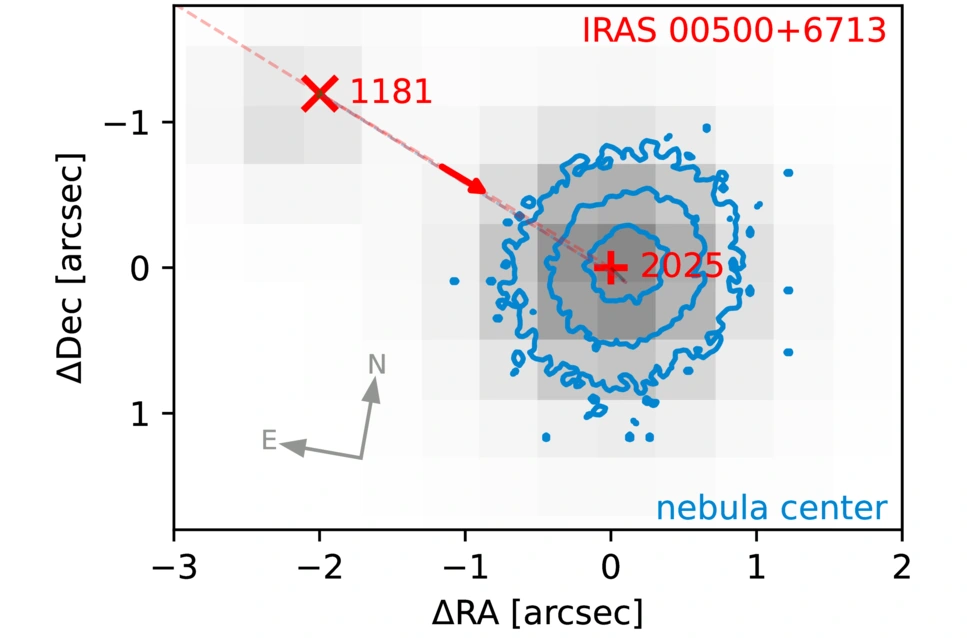
The team used the Rolling Hough Transform to measure filament orientations and infer the nebular centre toward which they converge. This location is consistent with the central star, IRAS 00500+6713, constraining the recoil that could have pushed the star away from the centre during the explosion.
In the plane of the sky, the transverse recoil speed has a 3σ upper limit of 14 km/s. Assuming that all recoil directions in three-dimensional space are equally likely gives a 3σ upper limit of 94 km/s for the total speed. The latter is a statistical constraint dependent on that directional assumption; the star’s line-of-sight velocity remains difficult to measure directly.
How did the strings of knots form?
The knots add a requirement to models of filament formation: they must explain both the thin radial structures and the concentrations of gas along them. The paper discusses instabilities driven by differences in flow speed, alongside thermal instability caused by rapid gas cooling. These processes may work together to shape the knots; the specific mechanism remains to be established.
Pa 30 offers a rare opportunity to study a Type Iax remnant at relatively close range. The team hopes its distinctive morphology will help identify similar systems in the Milky Way and nearby galaxies, extending the clues from this ancient explosion to other stellar endings.