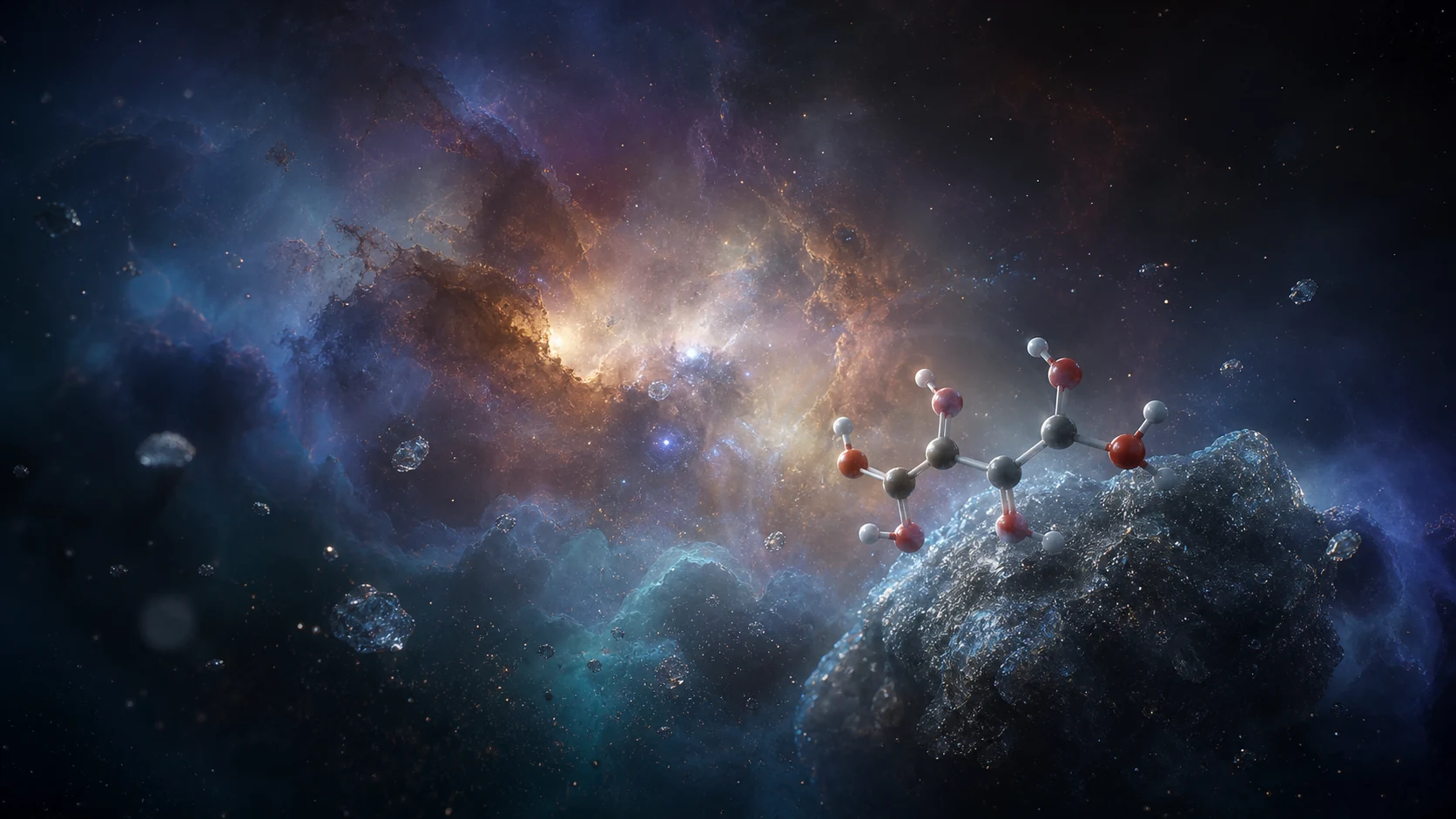
An international team led by Spain’s Centre for Astrobiology used the Yebes 40-metre and IRAM 30-metre radio telescopes to detect erythrulose in the interstellar medium for the first time, in the molecular cloud G+0.693−0.027 near the Galactic Centre. This four-carbon monosaccharide can form from simpler molecules on cold interstellar dust. The finding supports the idea that sugars could be delivered to young planets by asteroids or comets, but it does not show that life on Earth came from space.
Key points
- This is the first confirmed sugar in the interstellar medium and the first detection there of the four-carbon sugar erythrulose.
- The team identified 17 transitions across 12 groups of spectral lines. Six groups were largely free from interference by other molecules, and the estimated probability of a chance alignment was 0.2%.
- Erythrulose was at least 8 to 17 times more abundant than the upper limits for undetected three-carbon sugars, suggesting that interstellar sugars may not form simply by adding carbon atoms one at a time.
- Chemical models show that it can form from simpler two-carbon aldehydes and alcohols on cold interstellar dust grains.
- The study supports the possibility that prebiotic ingredients can be delivered by objects from space, but it does not prove that life—or life on Earth—came directly from space.
In a cloud of gas and dust near the Galactic Centre, about 8.2 kiloparsecs (roughly 26,700 light-years) from Earth, astronomers have confirmed a true sugar molecule in the interstellar medium for the first time. The team found the radio spectral fingerprint of erythrulose in the molecular cloud G+0.693−0.027. Erythrulose is a four-carbon ketose that also occurs in trace amounts in fruits such as raspberries and is used in some sunless-tanning cosmetics.
How can a sugar be recognised from tens of thousands of light-years away?
As molecules rotate, they emit or absorb radio waves at specific frequencies, producing a distinctive spectral fingerprint. The team used the 40-metre telescope at Spain’s Yebes Observatory and IRAM’s 30-metre telescope to obtain a highly sensitive spectrum spanning more than 91 GHz, then compared it with laboratory measurements of erythrulose’s rotational spectrum. They identified 17 transitions in 12 groups of lines. Six groups were largely uncontaminated by other molecules, and statistical analysis put the probability that all of them aligned by chance at about 0.2%.
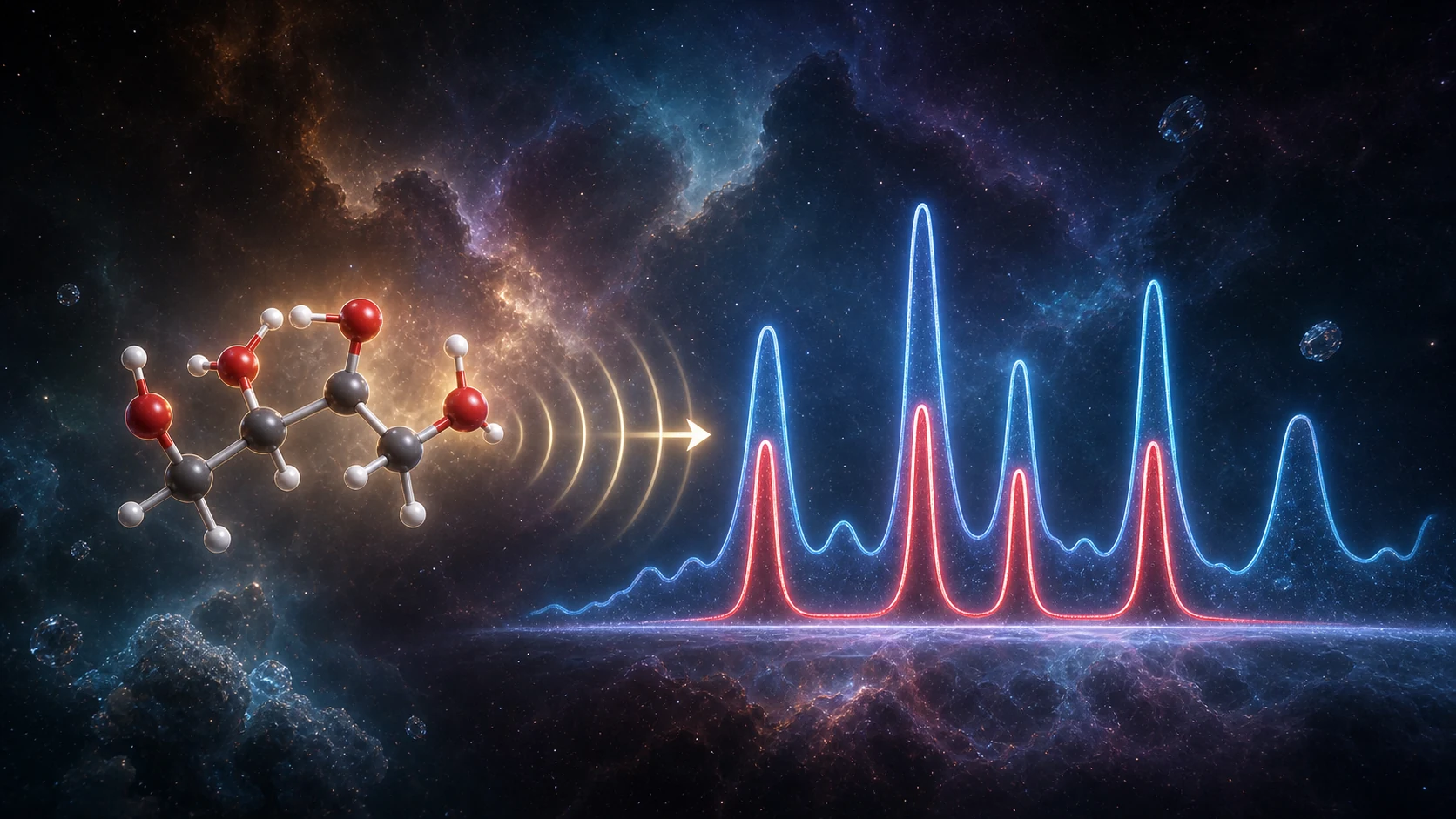
The measured excitation temperature was 11.3 ± 1.8 K, and the abundance of erythrulose relative to molecular hydrogen was about (6.4 ± 0.6) × 10⁻¹⁰. More unexpectedly, the team did not find structurally simpler three-carbon sugars in the same molecular cloud. The estimated abundance of erythrulose was at least 8 to 17 times higher than the observational upper limits for those three-carbon sugars. That ordering does not fit the intuitive idea that molecules grow only by adding carbon atoms one at a time.
Cold dust can make complex sugars too
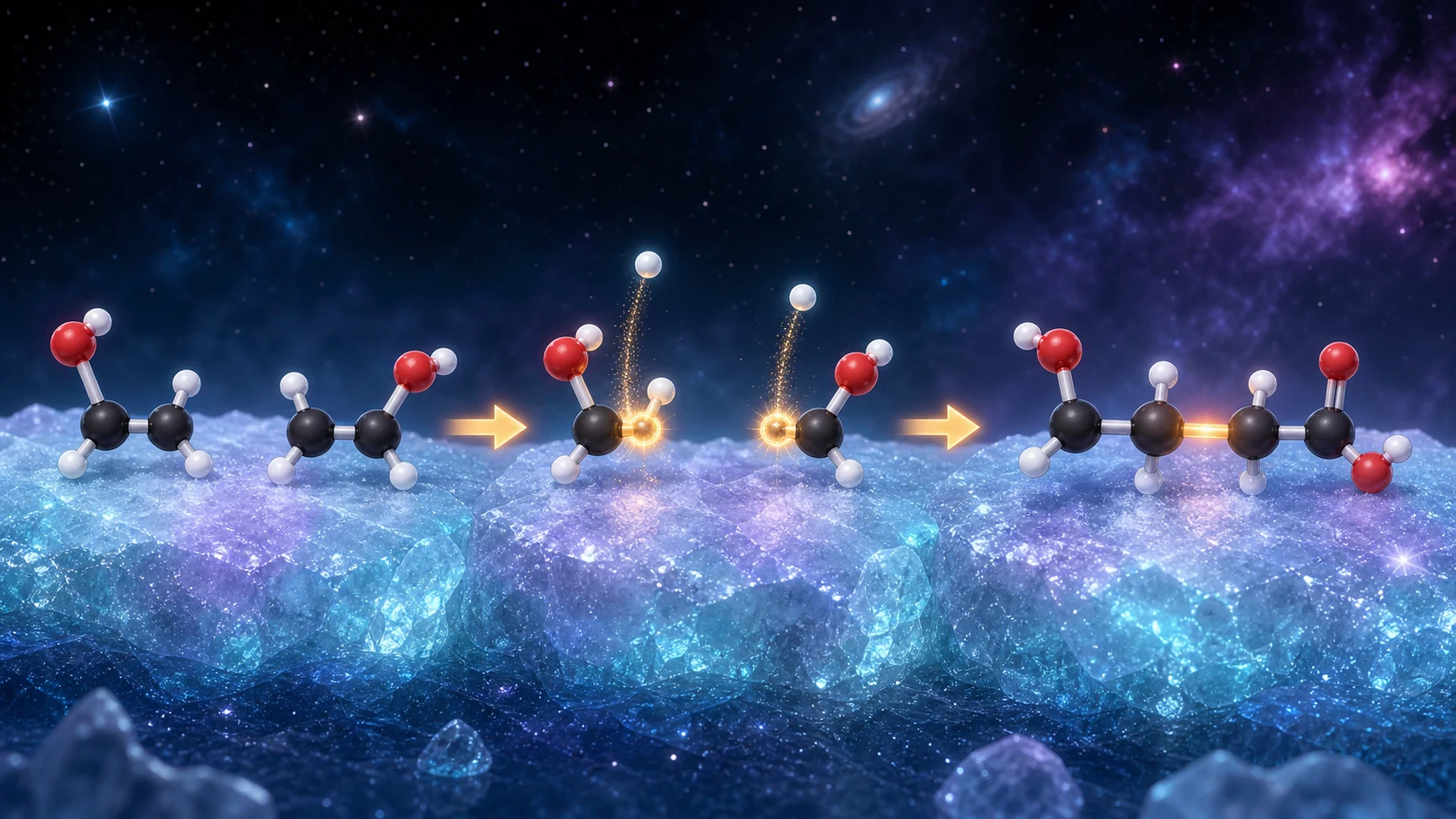
Quantum-chemical calculations and astrochemical simulations indicate that erythrulose can form when simpler two-carbon molecules, including glycolaldehyde and ethylene glycol, react in icy layers on interstellar dust at temperatures of about 20 to 30 K. Sugars therefore need not wait for stars, planets or life to appear. The molecular clouds from which stars and planets form can already host fairly complex abiotic chemistry.
What does this have to do with the origin of life?
Erythrulose is not life, nor is it ribose, the sugar in RNA. In watery environments, however, ketoses can convert into corresponding aldoses such as threose and erythrose; these reactions are relevant to research on the formation of early nucleic-acid ingredients. If sugars or their precursors formed first in molecular clouds and were later incorporated into asteroids, comets or other small bodies, impacts on young planets could have delivered raw materials for prebiotic chemistry to their surfaces.
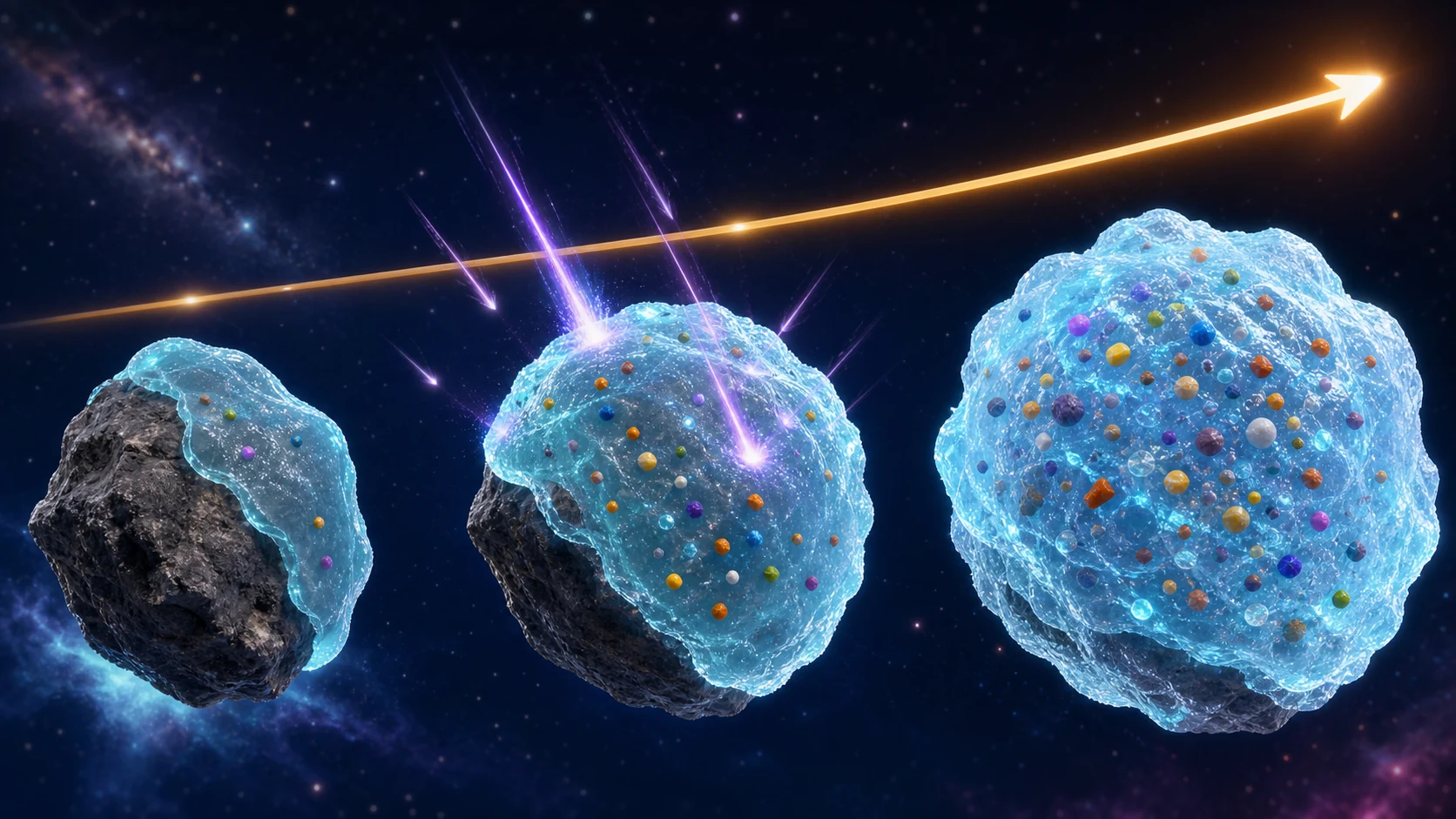
Using the observed abundance, the water content of meteorites and estimates of the total organic material delivered to the early Earth, the paper calculates that roughly 500 million to 50 billion kilograms of erythrulose may have reached Earth during the Late Heavy Bombardment about 4.1 to 3.9 billion years ago. This is an order-of-magnitude estimate that depends on several assumptions, however, and both the intensity and timing of the Late Heavy Bombardment remain debated. It should not be treated as a direct measurement.
The real breakthrough—and the questions that remain
The key result is that a complex, chiral, four-carbon sugar can be synthesised abiotically and survive under interstellar conditions. This gives scientists stronger grounds to search for sugars more directly related to RNA, including ribose, and to reassess reaction networks on interstellar dust. The most accurate conclusion for now is that the Universe can make some of life’s chemical ingredients before planets form. Whether and how life emerges from those ingredients remains a separate, unanswered question.