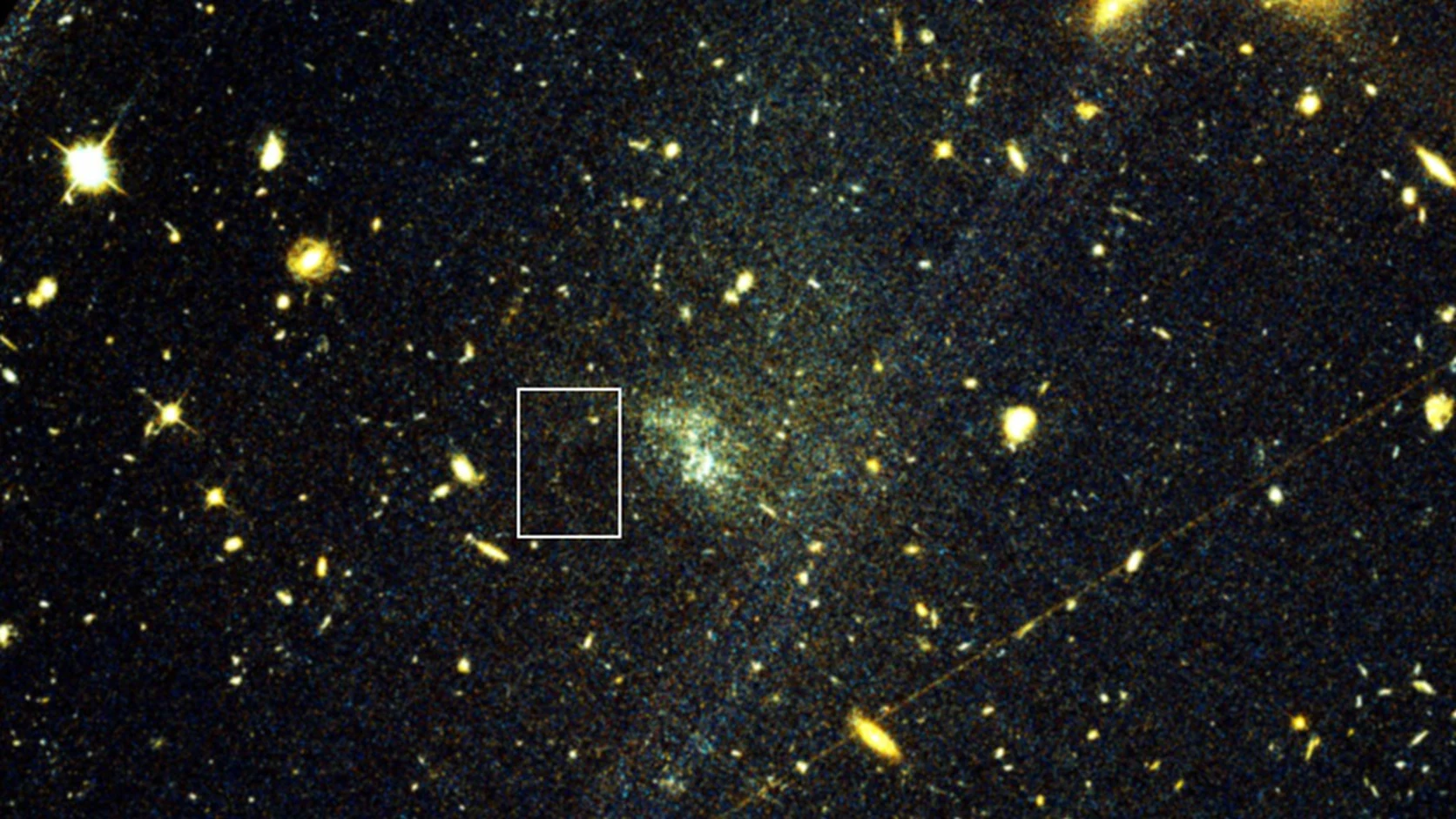
Researchers have found evidence of an extremely faint stellar stream in an ultra-diffuse galaxy about 115 million light-years away. Its shape, colour and nearby compact source point to a disrupting globular cluster, while dynamical modelling turns the faint arc into a new probe of the host galaxy’s dark matter halo.
Key points
- A study by eight authors published in Nature on 12 August 2026 reports evidence for the first globular-cluster stellar stream candidate beyond the Milky Way.
- The Oyashio stream lies in the ultra-diffuse galaxy UGC 9050-Dw1 at an estimated distance of 35.2 ± 2.5 megaparsecs; its visible arm extends about 2 kiloparsecs in projection.
- Hubble images give the stream a width of 72.3 ± 8.9 parsecs, while independent CFHT g-, r- and i-band data show the same faint feature in the same position.
- The stream and nearby globular-cluster candidate have matching colours, and dynamical models support a globular-cluster origin and favour a massive, dark-matter-dominated host halo.
- This is the first stream-based constraint on the mass and inner density slope of an ultra-diffuse galaxy’s dark matter halo, although deeper imaging or spectroscopy is still needed to confirm the candidate’s origin.
Inside a galaxy that almost disappears into the cosmic background, researchers have found a thin arc of light. Julie Kiel Holm, Sarah Pearson and six colleagues report in Nature that the feature, named Oyashio, is probably a stellar stream drawn out as the host galaxy’s tides gradually disrupt a globular cluster. If confirmed, it will be the first object of its kind beyond the Milky Way and will carry a mature dark matter measurement technique to a distance of about 115 million light-years.
Its host, UGC 9050-Dw1, is an ultra-diffuse galaxy: it spans a scale approaching that of a large galaxy but contains only about as many stars as a dwarf, so its surface brightness is exceptionally low. It is probably associated with the low-surface-brightness spiral UGC 9050 and is estimated to be 35.2 ± 2.5 megaparsecs away. The stream and globular-cluster candidates lie about 2.5 kiloparsecs from the galaxy’s light centre, while the curved visible arm reaches roughly 2 kiloparsecs—about 6,500 light-years—to one side.
One faint arc, seen by two telescopes
The team used F555W and F814W images from Hubble’s Advanced Camera for Surveys together with archival MegaCam data from the Canada–France–Hawaii Telescope (CFHT). The arc appears at the same position in both independent data sets, making an artefact from one instrument or processing pipeline less likely. The combined Hubble image gives a stream width of 72.3 ± 8.9 parsecs. CFHT’s g, r and i bands show the same feature, whereas the less sensitive u and z bands do not reveal it reliably.
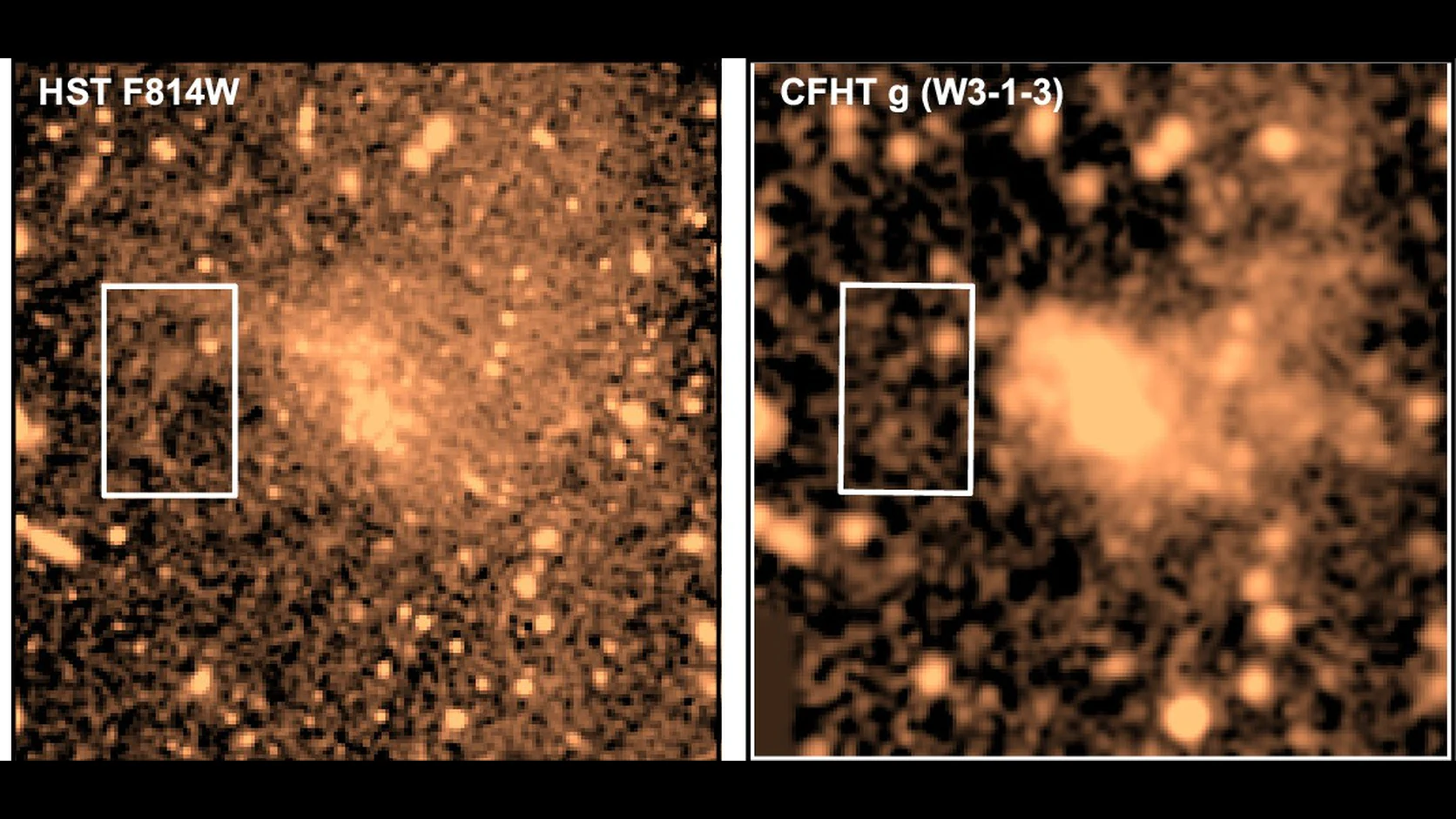
At this distance the images cannot resolve individual member stars as studies of Milky Way streams can, so the team compared the integrated colours instead. The globular-cluster candidate has an F555W−F814W colour index of 1.1 ± 0.1 and the stream 1.0 ± 0.2, consistent within the uncertainties. The stream is only tens of parsecs wide, also narrower than a typical dwarf-galaxy remnant. Its alignment with a compact source, matching colour, narrow width and agreement with simulations together support a globular-cluster origin.
Weighing dark matter from a stream’s shape
As a globular cluster travels around a galaxy, the host’s gravity gradually strips stars from its outskirts through the Lagrange points, producing leading and trailing tidal arms. A stream’s curvature, width and position record the local gravitational field. Change the cluster mass, orbit, or the mass and density profile of the dark matter halo, and a model stream follows a different path. The visible stars therefore act like a long-exposure line of test particles tracing the unseen total mass.
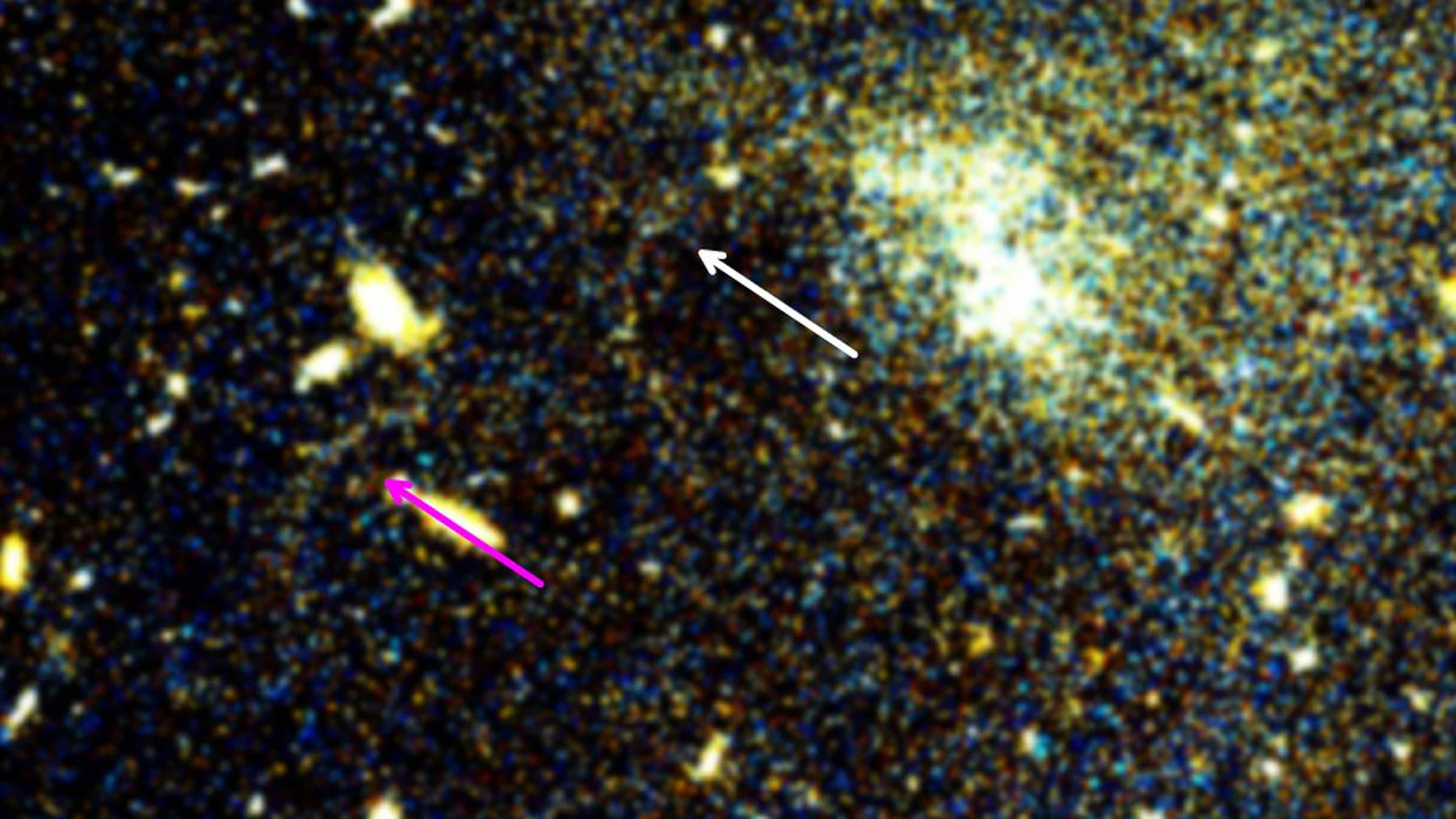
The researchers fitted Oyashio’s projected shape with the generative X-Stream model while sampling ten parameters describing the orbit, progenitor cluster and galactic halo. The model places a 95% upper limit of 2.5 million solar masses on the progenitor’s initial mass. Surface-brightness analysis shows that if the cluster is relatively young, a minimum of roughly 165,000 solar masses could already make a visible stream. The wide gap reflects remaining uncertainty in the stellar population’s age and metallicity and in how far disruption has progressed.
Models that reproduce the image favour a massive dark matter halo. One high-posterior example shown in the paper has a total M200 mass of about 1.56 × 10^11 solar masses, consistent with an earlier estimate of roughly 1.5–1.8 × 10^11 solar masses from the number of globular clusters. The full posterior is broad, however, and the model does not constrain the halo scale radius or outer density slope. The result is best viewed as a first demonstration of the method, not a final precision measurement of the halo.
A dark matter probe moves beyond the Milky Way
Within the Milky Way, cold streams such as Palomar 5 and GD-1 have already been used to map the Galaxy’s gravitational field and even to search for density gaps left by small, non-luminous dark matter subhaloes. Oyashio matters not only for its distance record but because it shows that stream-shape modelling can extend to external galaxies where individual stars cannot be resolved. Ultra-diffuse galaxies contain little ordinary matter and may present fewer complications than the Milky Way. With a large enough sample, future studies could compare dark matter density profiles across different galaxies.
The existing images still permit a few alternatives, including a chance alignment of unresolved stars or foreground and background objects. The team tested shells from a galaxy collision, a gravitationally lensed background arc, dust patches and a dwarf-galaxy stream. Those scenarios struggle to match Oyashio’s off-centre curvature, colour, narrow width and required brightness at the same time, although a chance projection cannot yet be ruled out completely. Deeper Hubble or James Webb Space Telescope imaging, and spectroscopy that directly compares the stellar populations of the stream and parent cluster, could settle its origin.
The paper predicts that wide, sensitive surveys by Euclid and the Nancy Grace Roman Space Telescope will find more such streams in nearby low-surface-brightness galaxies. A single stream provides only a starting point. If astronomers can measure these natural gravitational tracks in numbers, comparisons of dark matter haloes could expand from one Milky Way to a statistical sample spanning many galactic environments.
The Hubble observations used in this study are available from STScI/MAST under HST programme 16890, while the CFHT data can be found at the Canadian Astronomy Data Centre as MegaPipe.267.282. The authors have also released their analysis code, allowing other teams to reproduce the image and stream-modelling steps. These verifiable materials will help determine whether Oyashio develops from a rare candidate into a new yardstick for measuring dark matter beyond the Milky Way.