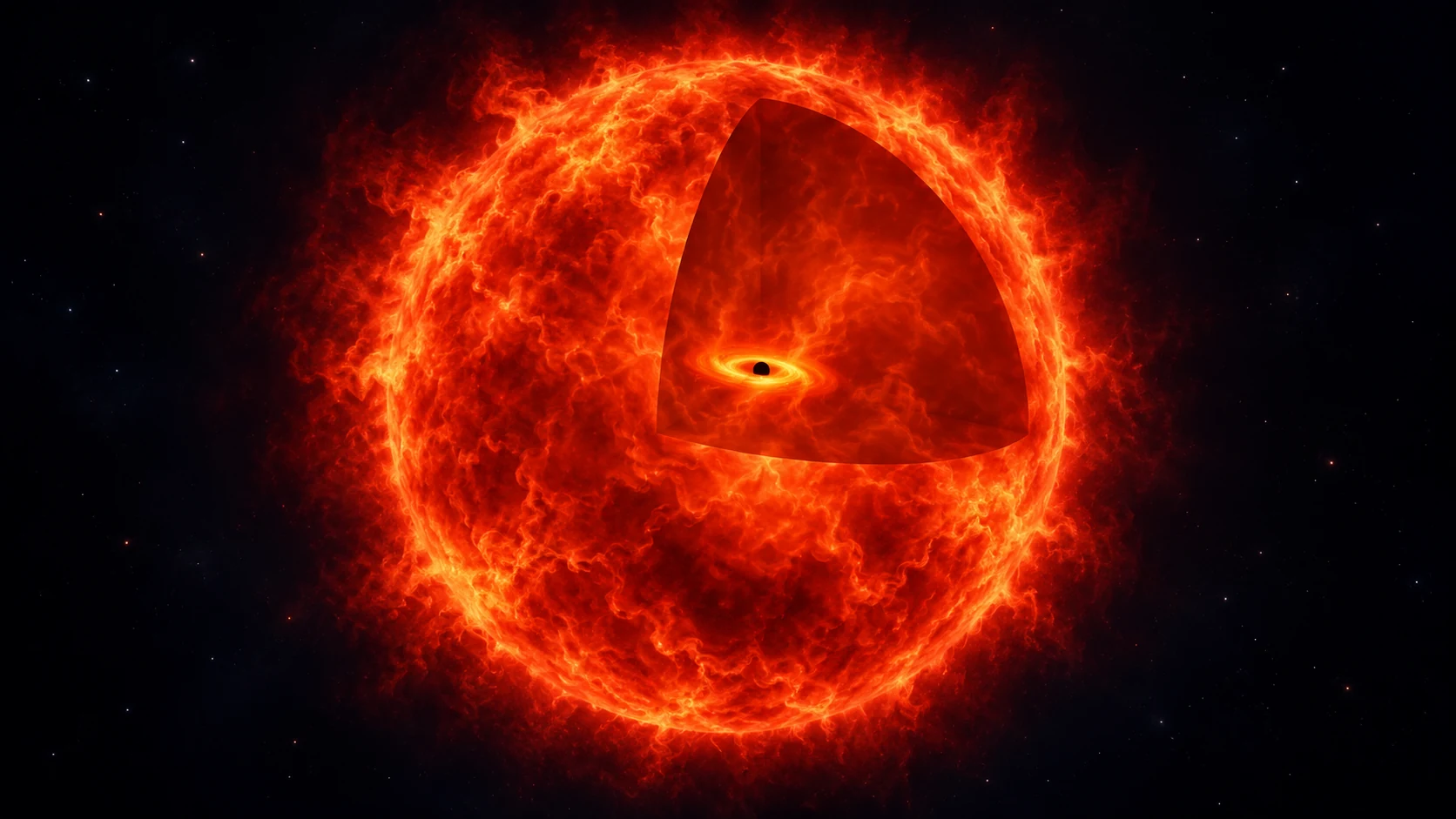
MoM-BH*-1 appears as a red dot, yet its spectrum carries unusually strong hydrogen absorption. An accreting black hole wrapped in dense gas offers an explanation, shedding light on black hole stars and the mysterious little red dots.
Key points
- The light from MoM-BH*-1 comes from just 660 million years after the Big Bang and carries unusually strong hydrogen absorption features.
- The study proposes an accreting black hole inside a dense gas envelope, combining black hole power with spectral features resembling a stellar atmosphere.
- With less contamination from its host galaxy, this source provides a template for studying other little red dots and early black hole growth.
A distant red dot may conceal an object that resembles a giant star on the outside but is powered by black hole accretion within. An international team led by Rohan P. Naidu used the James Webb Space Telescope to study MoM-BH*-1 and found exceptionally strong hydrogen absorption in its spectrum. A black hole star model offers a compelling explanation for these unusual signals. The study was published in Nature on 12 August 2026.
The light from MoM-BH*-1 comes from an era just 660 million years after the Big Bang. The candidate brings together two familiar pictures: dense surrounding gas reshapes light much as a stellar atmosphere does, while the energy deep inside may come from a black hole consuming matter.
An unusual red dot in the search for early galaxies
The team was searching for distant galaxies in the early universe through the Mirage or Miracle (MoM) survey. MoM-BH*-1 stood out as particularly red and bright in Webb images, making it a target for spectroscopic follow-up: it is clearly visible at longer infrared wavelengths but very faint at shorter ones.
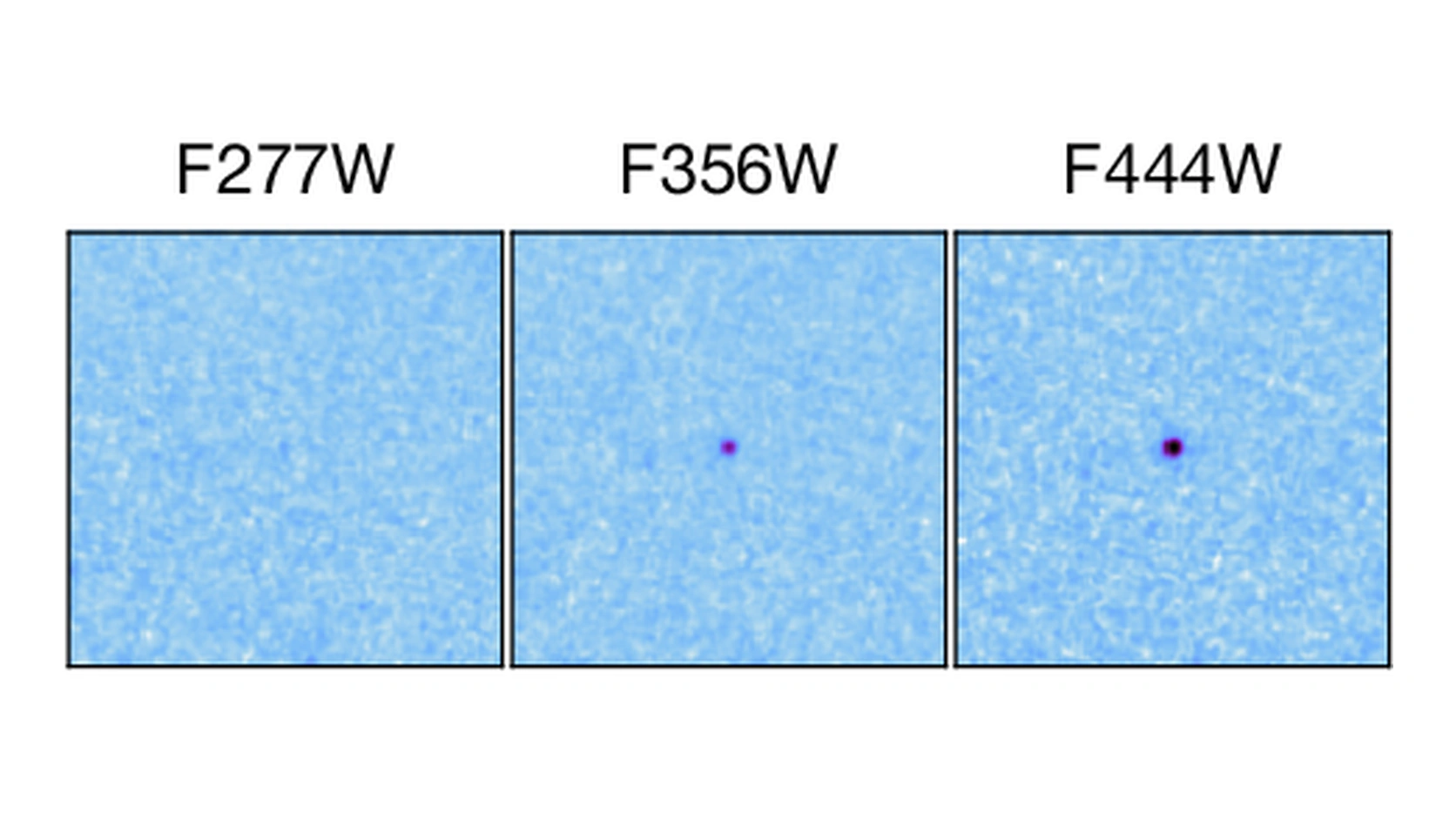
Red objects often suggest obscuring dust, much as smoke changes the color of sunlight. This source, however, also has an exceptionally deep Balmer break and absorption structure in its hydrogen lines. Together, these prompted the team to test whether dense gas itself could shape the extremely red spectrum.
Dense hydrogen leaves its spectral fingerprint
The Balmer break is a sharp change in brightness across a particular hydrogen absorption threshold in a spectrum. MoM-BH*-1 has a measured break strength of about 7.7, exceeding the ordinary dust-free stellar population models compared in the paper. Deep absorption in the Hβ and Hγ lines also points to dense, light-absorbing hydrogen. These features provide key observational evidence for the gas envelope interpretation.
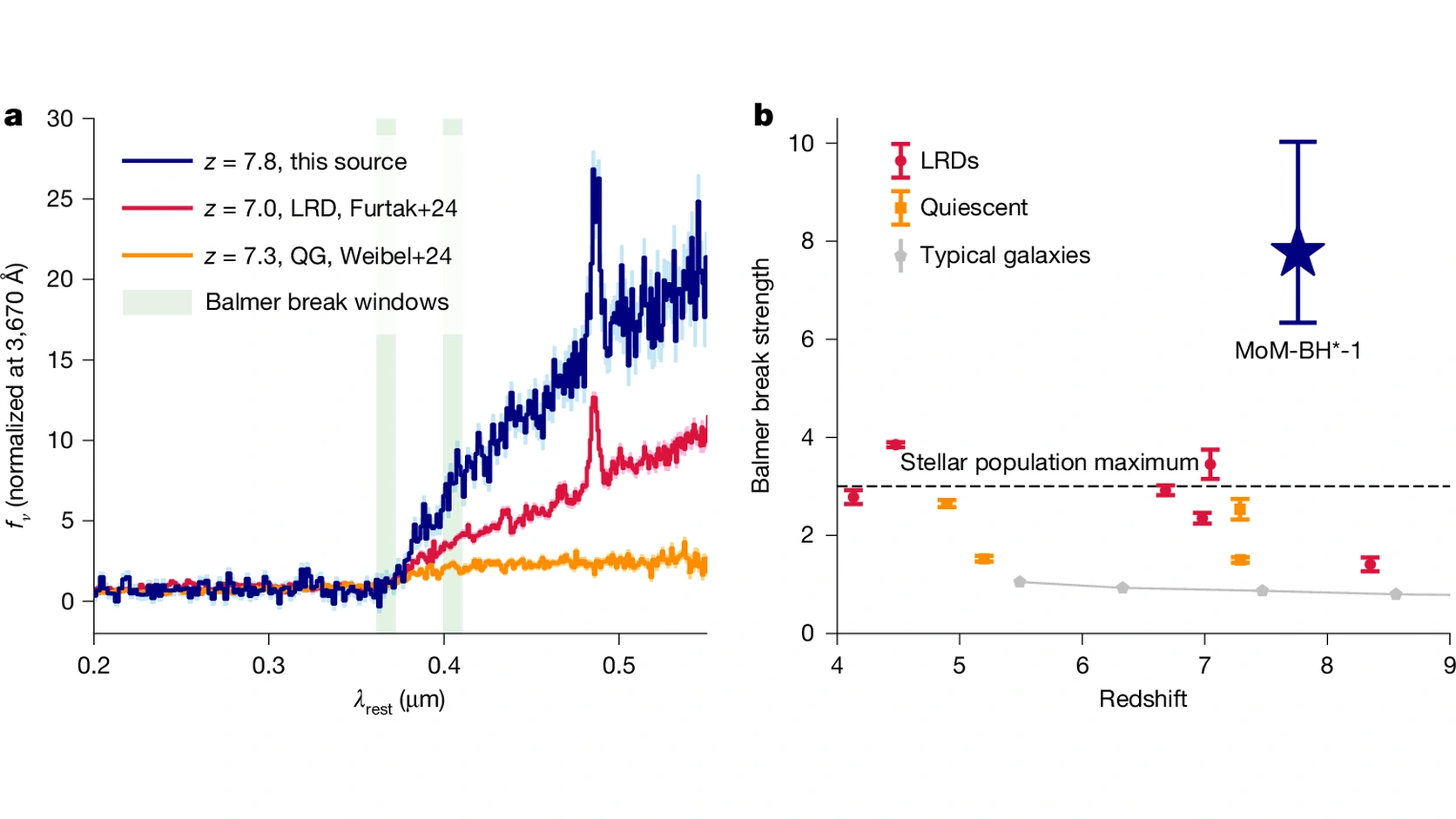
The researchers tested spectral models in which an accreting black hole sits inside extremely dense, turbulent gas. Radiation from within passes through absorption, scattering and re-emission before escaping. This arrangement reproduces the main features and requires very little dust attenuation to produce the observed red appearance.
Black hole power beneath a star-like exterior
Ordinary stars are powered by nuclear fusion in their interiors. In the black hole star picture, the central accreting black hole serves as the engine. Matter releases energy as it falls toward the black hole, and the surrounding dense gas reprocesses the radiation, giving the overall spectrum some features associated with stellar surfaces. This combination explains the name black hole star.
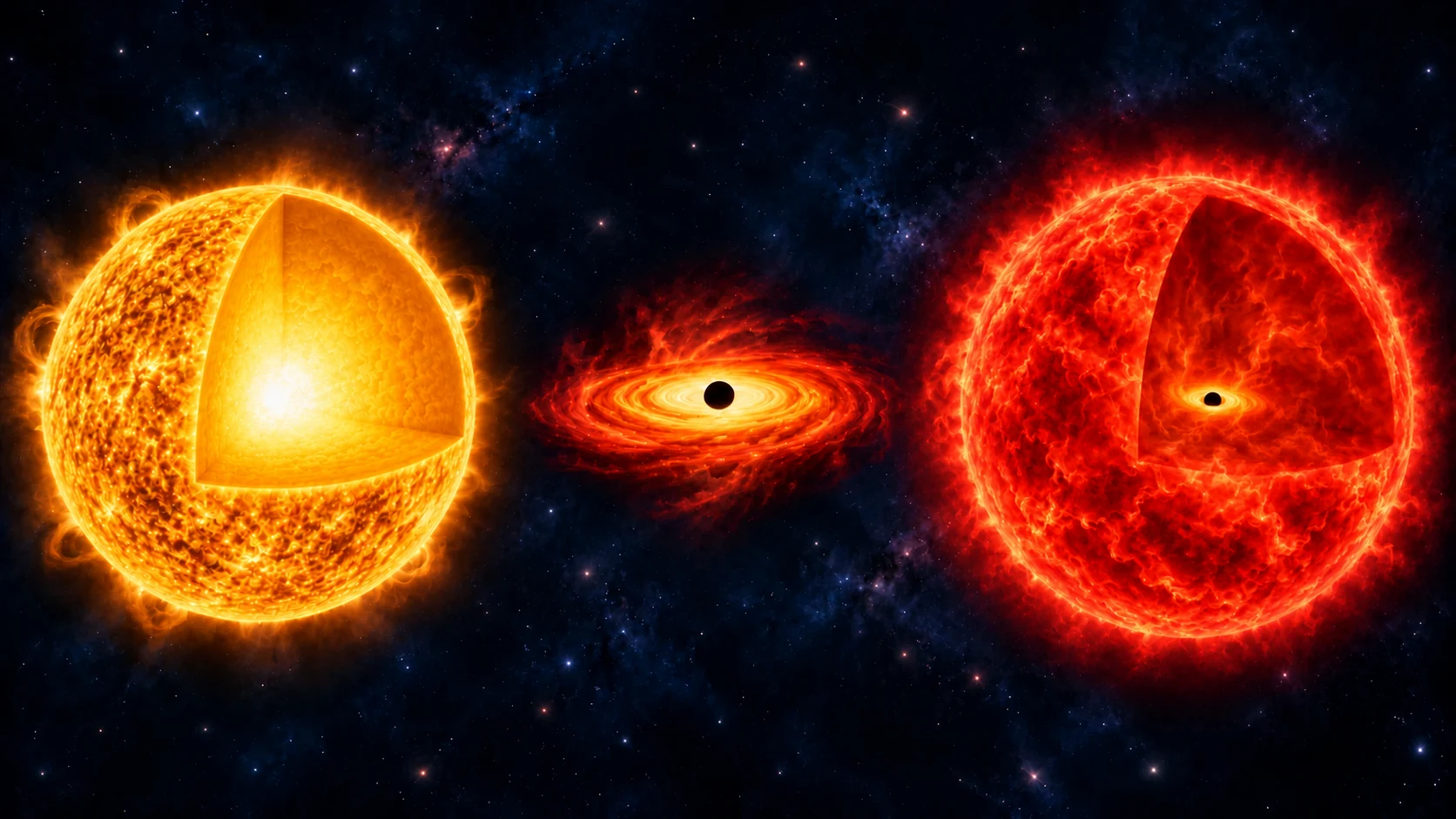
Its modeled scale is also striking. The paper's illustrative model uses a dense gas layer about 40 astronomical units thick, roughly 40 times the Earth–Sun distance and comparable to planetary orbit scales in our Solar System. This is a model scale for the gas layer. In Webb images, the source remains an unresolved point of light, and its internal structure still needs further verification.
A possible common engine behind little red dots
Many of Webb's little red dots blend light from the central source with light from its host galaxy, making the two hard to separate. In MoM-BH*-1, the central source appears to dominate the host's light, offering a cleaner spectral template. Combining its spectrum with that of a brighter neighboring galaxy yields a shape resembling typical little red dots, supporting the idea that gas-enshrouded black holes may be their central engines.
If dense gas traps or redistributes radiation released by accretion, a black hole may be able to draw in matter more rapidly, helping explain fast black hole growth in the early universe. For now, the black hole mass, accretion rate and gas structure depend on model assumptions. Further spectroscopy and follow-up observations will test how common this growth phase is.