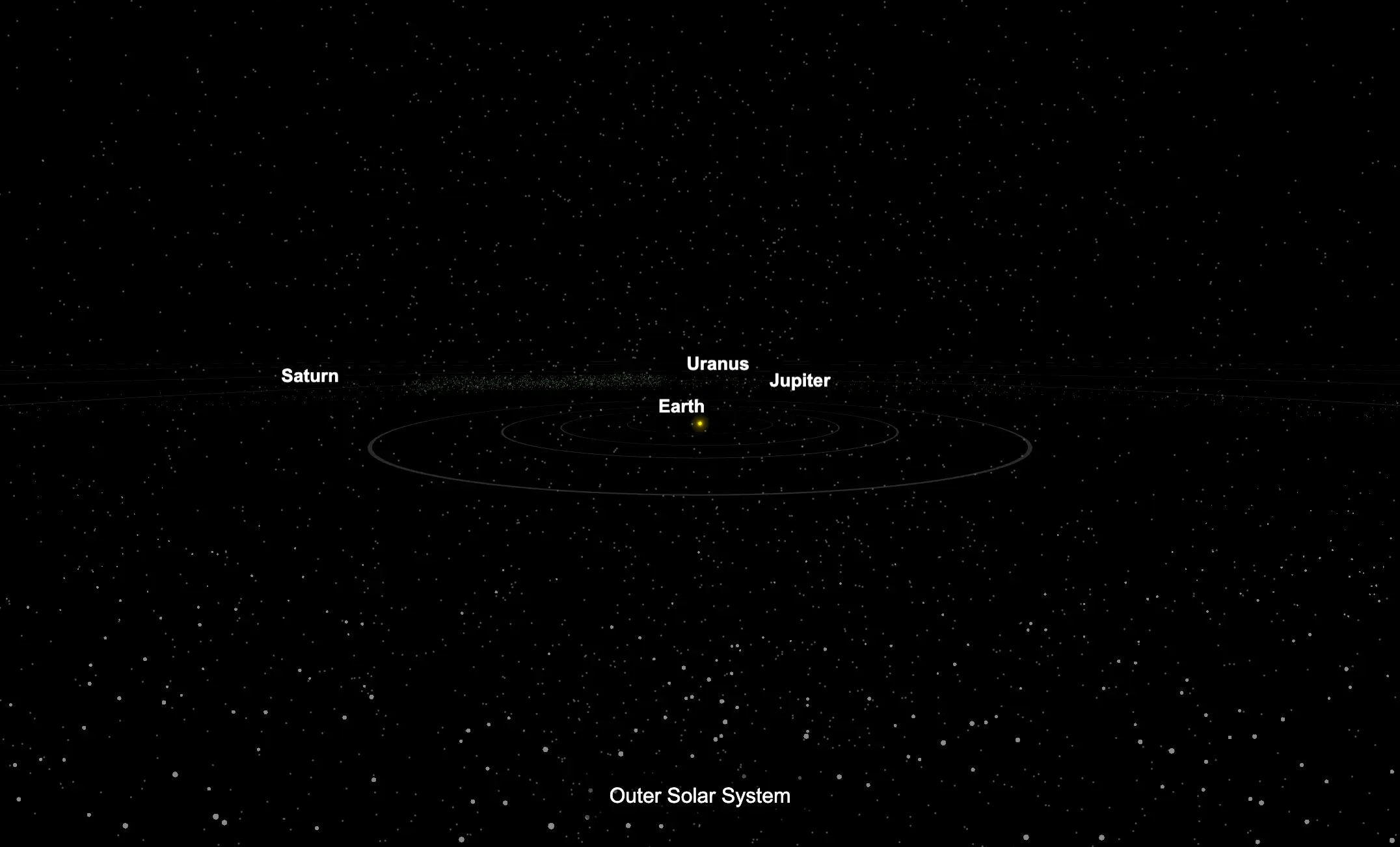
The asteroid belt is a torus-shaped region in the Solar System, located roughly between the orbits of the planets Jupiter and Mars. It contains a great many solid, irregularly shaped bodies, of many sizes but much smaller than planets, called asteroids or minor planets.
The Outer Solar System is the realm of the gas giants Jupiter and Saturn, and the ice giants Uranus and Neptune. These massive planets are accompanied by extensive systems of moons and rings.
Earth is the third planet from the Sun and the only astronomical object known to harbor life. With over 70%
of its surface covered by ocean, it supports a diverse biosphere and complex climate systems protected by a
magnetic field and atmosphere.
Diameter: 12,742 km
Day Length: 24 hours
Population: 8.2 billion
The Moon
Earth's Satellite
The Moon is Earth's only natural satellite. It is the fifth-largest satellite in the Solar System and the
largest among planetary satellites relative to the size of the planet that it orbits. Its gravitational
influence is the main driver of Earth's tides and very slowly lengthens Earth's day.
Diameter: 3,474 km
Distance: 384,400 km
Orbital Period: 27.3 days
Moon Surface
The Moon is a stark, airless world of ancient rock, its surface shaped by billions of years of
relentless impacts and volcanic activity. This natural satellite of Earth displays a dramatic
contrast between dark basaltic plains and bright, heavily cratered highlands, recording a visible
history of the early solar system. Locked in synchronous rotation, it exerts a profound
gravitational influence on Earth, governing ocean tides and subtly stabilizing the planet’s axial
tilt.
Lunar Rover
The lunar rover rests on a desolate expanse of gray regolith, its rugged metal frame and dust-coated
wheels standing as a testament to human engineering beyond Earth. In the pitch-black sky above, the
distant Earth glows in blue and white, a fragile oasis suspended in space, emphasizing the vast
scale of the cosmos and the quiet persistence of exploration on the Moon’s barren surface.
Earth
The Blue Marble
Earth is the third planet from the Sun and the only astronomical object known to harbor life. With over 70%
of its surface covered by ocean, it supports a diverse biosphere and complex climate systems protected by a
magnetic field and atmosphere.
Diameter: 12,742 km
Day Length: 24 hours
Population: 8.2 billion
The Moon
Earth's Satellite
The Moon is Earth's only natural satellite. It is the fifth-largest satellite in the Solar System and the
largest among planetary satellites relative to the size of the planet that it orbits. Its gravitational
influence is the main driver of Earth's tides and very slowly lengthens Earth's day.
Diameter: 3,474 km
Distance: 384,400 km
Orbital Period: 27.3 days
Moon Surface
The Moon is a stark, airless world of ancient rock, its surface shaped by billions of years of
relentless impacts and volcanic activity. This natural satellite of Earth displays a dramatic
contrast between dark basaltic plains and bright, heavily cratered highlands, recording a visible
history of the early solar system. Locked in synchronous rotation, it exerts a profound
gravitational influence on Earth, governing ocean tides and subtly stabilizing the planet’s axial
tilt.
Lunar Rover
The lunar rover rests on a desolate expanse of gray regolith, its rugged metal frame and dust-coated
wheels standing as a testament to human engineering beyond Earth. In the pitch-black sky above, the
distant Earth glows in blue and white, a fragile oasis suspended in space, emphasizing the vast
scale of the cosmos and the quiet persistence of exploration on the Moon’s barren surface.
Earth
The Blue Marble
Earth is the third planet from the Sun and the only astronomical object known to harbor life. With over 70%
of its surface covered by ocean, it supports a diverse biosphere and complex climate systems protected by a
magnetic field and atmosphere.
Diameter: 12,742 km
Day Length: 24 hours
Population: 8.2 billion
The Moon
Earth's Satellite
The Moon is Earth's only natural satellite. It is the fifth-largest satellite in the Solar System and the
largest among planetary satellites relative to the size of the planet that it orbits. Its gravitational
influence is the main driver of Earth's tides and very slowly lengthens Earth's day.
Diameter: 3,474 km
Distance: 384,400 km
Orbital Period: 27.3 days
Moon Surface
The Moon is a stark, airless world of ancient rock, its surface shaped by billions of years of
relentless impacts and volcanic activity. This natural satellite of Earth displays a dramatic
contrast between dark basaltic plains and bright, heavily cratered highlands, recording a visible
history of the early solar system. Locked in synchronous rotation, it exerts a profound
gravitational influence on Earth, governing ocean tides and subtly stabilizing the planet’s axial
tilt.
Lunar Rover
The lunar rover rests on a desolate expanse of gray regolith, its rugged metal frame and dust-coated
wheels standing as a testament to human engineering beyond Earth. In the pitch-black sky above, the
distant Earth glows in blue and white, a fragile oasis suspended in space, emphasizing the vast
scale of the cosmos and the quiet persistence of exploration on the Moon’s barren surface.
Earth
The Blue Marble
Earth is the third planet from the Sun and the only astronomical object known to harbor life. With over 70%
of its surface covered by ocean, it supports a diverse biosphere and complex climate systems protected by a
magnetic field and atmosphere.
Diameter: 12,742 km
Day Length: 24 hours
Population: 8.2 billion
The Moon
Earth's Satellite
The Moon is Earth's only natural satellite. It is the fifth-largest satellite in the Solar System and the
largest among planetary satellites relative to the size of the planet that it orbits. Its gravitational
influence is the main driver of Earth's tides and very slowly lengthens Earth's day.
Diameter: 3,474 km
Distance: 384,400 km
Orbital Period: 27.3 days
Moon Surface
The Moon is a stark, airless world of ancient rock, its surface shaped by billions of years of
relentless impacts and volcanic activity. This natural satellite of Earth displays a dramatic
contrast between dark basaltic plains and bright, heavily cratered highlands, recording a visible
history of the early solar system. Locked in synchronous rotation, it exerts a profound
gravitational influence on Earth, governing ocean tides and subtly stabilizing the planet’s axial
tilt.
Lunar Rover
The lunar rover rests on a desolate expanse of gray regolith, its rugged metal frame and dust-coated
wheels standing as a testament to human engineering beyond Earth. In the pitch-black sky above, the
distant Earth glows in blue and white, a fragile oasis suspended in space, emphasizing the vast
scale of the cosmos and the quiet persistence of exploration on the Moon’s barren surface.
Earth
The Blue Marble
Earth is the third planet from the Sun and the only astronomical object known to harbor life. With over 70%
of its surface covered by ocean, it supports a diverse biosphere and complex climate systems protected by a
magnetic field and atmosphere.
Diameter: 12,742 km
Day Length: 24 hours
Population: 8.2 billion
The Moon
Earth's Satellite
The Moon is Earth's only natural satellite. It is the fifth-largest satellite in the Solar System and the
largest among planetary satellites relative to the size of the planet that it orbits. Its gravitational
influence is the main driver of Earth's tides and very slowly lengthens Earth's day.
Diameter: 3,474 km
Distance: 384,400 km
Orbital Period: 27.3 days
Moon Surface
The Moon is a stark, airless world of ancient rock, its surface shaped by billions of years of
relentless impacts and volcanic activity. This natural satellite of Earth displays a dramatic
contrast between dark basaltic plains and bright, heavily cratered highlands, recording a visible
history of the early solar system. Locked in synchronous rotation, it exerts a profound
gravitational influence on Earth, governing ocean tides and subtly stabilizing the planet’s axial
tilt.
Lunar Rover
The lunar rover rests on a desolate expanse of gray regolith, its rugged metal frame and dust-coated
wheels standing as a testament to human engineering beyond Earth. In the pitch-black sky above, the
distant Earth glows in blue and white, a fragile oasis suspended in space, emphasizing the vast
scale of the cosmos and the quiet persistence of exploration on the Moon’s barren surface.
Scene: Asteroid Belt
The Outer Solar System is the realm of the gas giants Jupiter and Saturn, and the ice giants Uranus and Neptune. These massive planets are accompanied by extensive systems of moons and rings.
Asteroid Belt
Remnants of the Early Solar System
The asteroid belt is a torus-shaped region in the Solar System, located roughly between the orbits of the planets Jupiter and Mars. It contains a great many solid, irregularly shaped bodies, of many sizes but much smaller than planets, called asteroids or minor planets.
Objects: > 1M (est.)
Total Mass: 4% of Moon
Location: 2.2-3.2 AU
Circumstellar Disc
This circumstellar disc contains millions of diverse rocky and metallic bodies—ranging from the dwarf planet Ceres to microscopic dust.
Rocky Remnants
The asteroid belt is a vast, diffuse region of rocky remnants orbiting the Sun between Mars and Jupiter, composed of millions of bodies ranging from dust-sized fragments to dwarf planets like Ceres. Rather than a dense swarm, it is an immense and sparsely populated zone shaped by Jupiter’s powerful gravity, preserving primordial material from the early solar system and offering a window into the processes that governed planetary formation.
Jupiter
King of the Planets
Jupiter is the fifth planet from the Sun and the largest in the Solar System. It is a gas giant with a mass more than two and a half times that of all the other planets in the Solar System combined. It is known for its Great Red Spot and many moons, including the Galilean moons.
Diameter: 139,820 km
Day Length: 9.9 hours
Moons: 95 (known)
Jupiter
Jupiter is the largest planet in our solar system, a gas giant primarily composed of hydrogen and helium. Its iconic swirling cloud bands and the Great Red Spot, a massive storm that has raged for centuries, dominate its appearance.
Saturn
The Ringed Jewel
Saturn is the sixth planet from the Sun and the second-largest in the Solar System, after Jupiter. It is a gas giant with an average radius of about nine and a half times that of Earth. It is famous for its prominent ring system, which is composed mainly of ice particles.
Diameter: 116,460 km
Day Length: 10.7 hours
Rings: 7 groups
Uranus
The Ice Giant
Uranus is the seventh planet from the Sun. It has the third-largest planetary radius and fourth-largest planetary mass in the Solar System. It is an ice giant, and unlike the other planets, it rotates on its side, likely due to a massive collision in its early history.
Diameter: 50,724 km
Day Length: 17.2 hours
Orbital Period: 84 years
Neptune
The Windy Planet
Neptune is the eighth and farthest-known Solar planet from the Sun. It is the fourth-largest planet in the Solar System by diameter, the third-most-massive planet, and the densest giant planet. It is known for its strong supersonic winds and deep blue color.