Earth
The Blue Marble
Earth is the third planet from the Sun and the only astronomical object known to harbor life. With over 70%
of its surface covered by ocean, it supports a diverse biosphere and complex climate systems protected by a
magnetic field and atmosphere.
- Diameter: 12,742 km
- Day Length: 24 hours
- Population: 8.2 billion
Earth
The Blue Marble
Earth is the third planet from the Sun and the only astronomical object known to harbor life. With over 70%
of its surface covered by ocean, it supports a diverse biosphere and complex climate systems protected by a
magnetic field and atmosphere.
- Diameter: 12,742 km
- Day Length: 24 hours
- Population: 8.2 billion
Earth
The Blue Marble
Earth is the third planet from the Sun and the only astronomical object known to harbor life. With over 70%
of its surface covered by ocean, it supports a diverse biosphere and complex climate systems protected by a
magnetic field and atmosphere.
- Diameter: 12,742 km
- Day Length: 24 hours
- Population: 8.2 billion
Earth
The Blue Marble
Earth is the third planet from the Sun and the only astronomical object known to harbor life. With over 70%
of its surface covered by ocean, it supports a diverse biosphere and complex climate systems protected by a
magnetic field and atmosphere.
- Diameter: 12,742 km
- Day Length: 24 hours
- Population: 8.2 billion
Earth
The Blue Marble
Earth is the third planet from the Sun and the only astronomical object known to harbor life. With over 70%
of its surface covered by ocean, it supports a diverse biosphere and complex climate systems protected by a
magnetic field and atmosphere.
- Diameter: 12,742 km
- Day Length: 24 hours
- Population: 8.2 billion
Scene: Stellar Black Hole
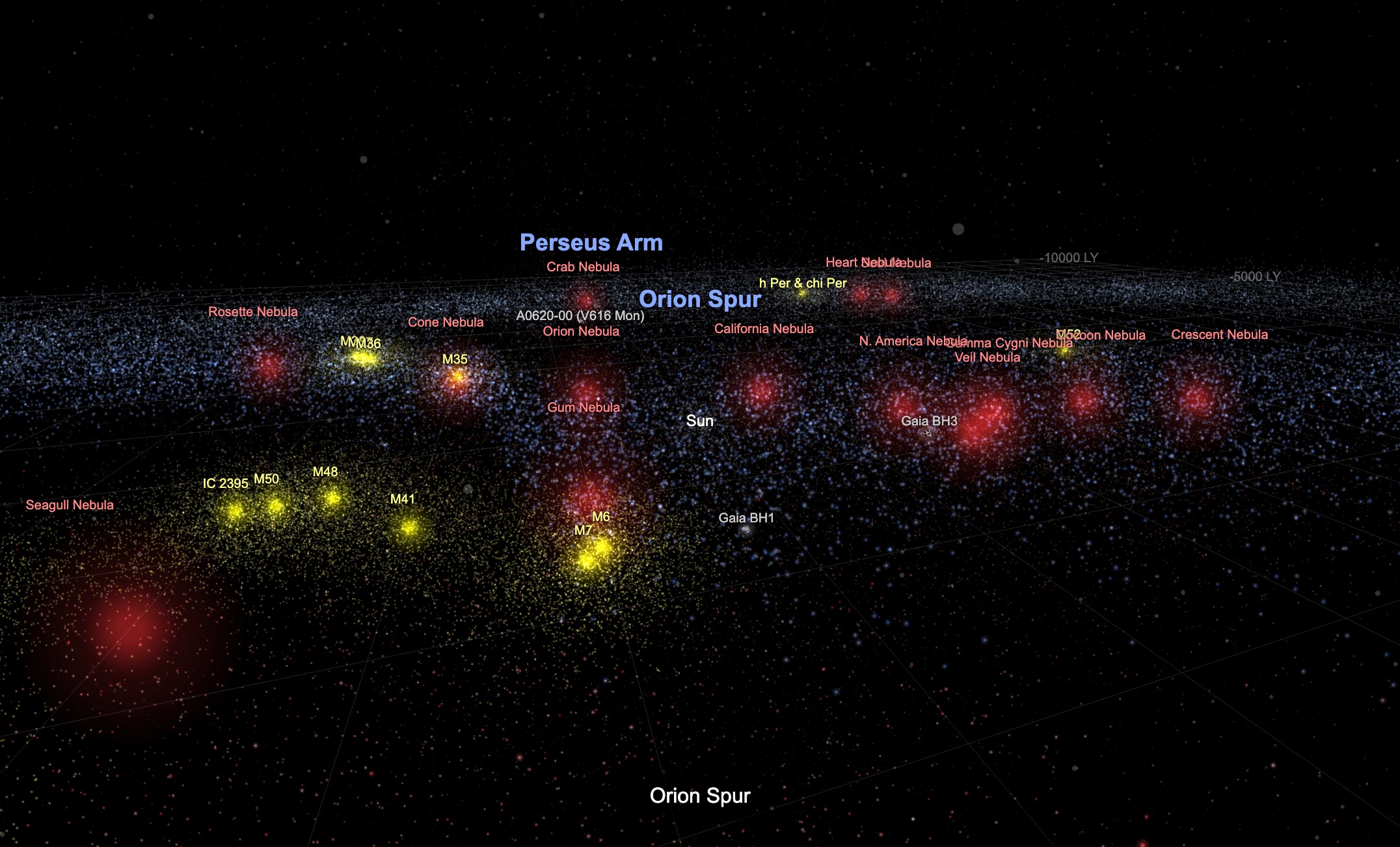
The Orion Spur is a minor spiral arm of the Milky Way between the Sagittarius and Perseus arms. Our Solar System is located within this spur, also known as the Local Arm.
Stellar Black Hole
Gravity's Ultimate Trap
A stellar black hole is a black hole formed by the gravitational collapse of a massive star. They have masses ranging from about 5 to several tens of times the mass of the Sun. They are invisible directly but can be detected by their interaction with nearby matter.
- Mass: 10-100 Suns
- Radius: 30-300 km
- Origin: Supernova Collapse
Spiral Arm
Regions of Star Formation
Spiral arms are regions of stars that extend from the center of spiral and barred spiral galaxies. These long, thin regions resemble a spiral and are sites of active star formation, containing young, hot, blue stars and large clouds of gas and dust.
- Type: Density Wave
- Contents: Stars, Gas & Dust
- Activity: Star Formation