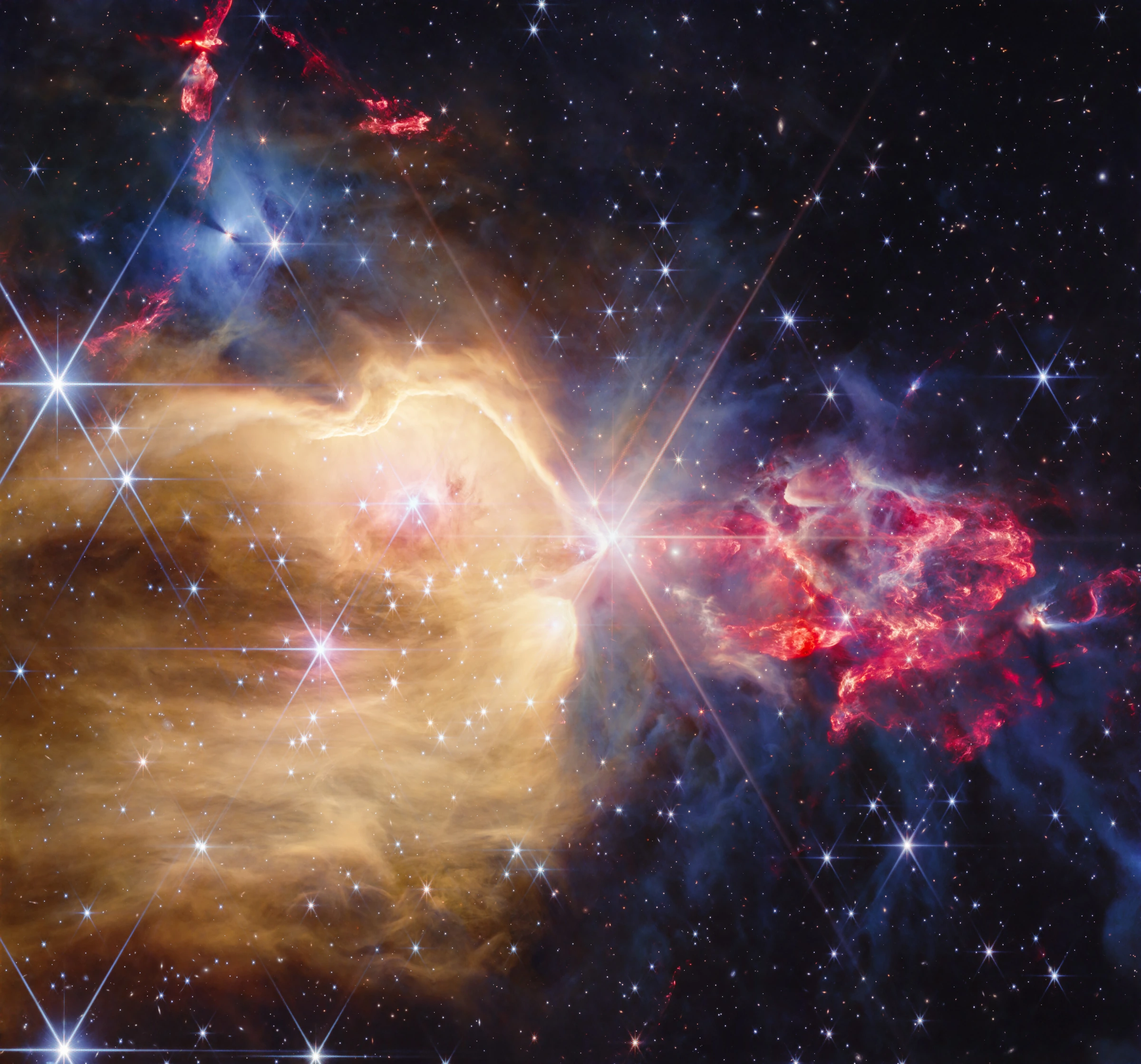
Webb has captured young stars reshaping NGC 7129. Beside the bright central star lies a cavity about 3.5 light-years across, while younger protostars drive outflows that leave red shock structures in dense gas.
Key points
- NGC 7129 lies about 3,300 light-years from Earth. Webb’s near-infrared image reveals several stages of stellar growth.
- The central star, LkHα 234, has an estimated mass of 5–8 Suns. The cavity to its left spans about 3.5 light-years.
- Outflows from younger protostars produce shocks in surrounding gas. Gold and red highlight different states of hydrogen.
Newborn stars in NGC 7129 are stirring up their birthplace. On 6 October, NASA released a new James Webb Space Telescope image of this stellar nursery, about 3,300 light-years away. Beside the bright central star, a broad golden cavity opens on one side while red streams thread through dense dust on the other.
Webb’s Near-Infrared Camera, NIRCam, sees through some of the obscuring material, revealing stars at different stages of growth alongside their surrounding gas. Visible colours represent different infrared wavelengths: gold, red and blue-grey help distinguish gas conditions and structures rather than showing what human eyes would see in space.
A bright star carves a 3.5-light-year cavity
The most prominent star near the centre is LkHα 234. The official release estimates its mass at 5–8 times that of the Sun. It is a pre-main-sequence star: it has largely finished gathering matter but is still contracting and heating up as it approaches the main-sequence stage, when sustained hydrogen fusion in its core supports stable shining.
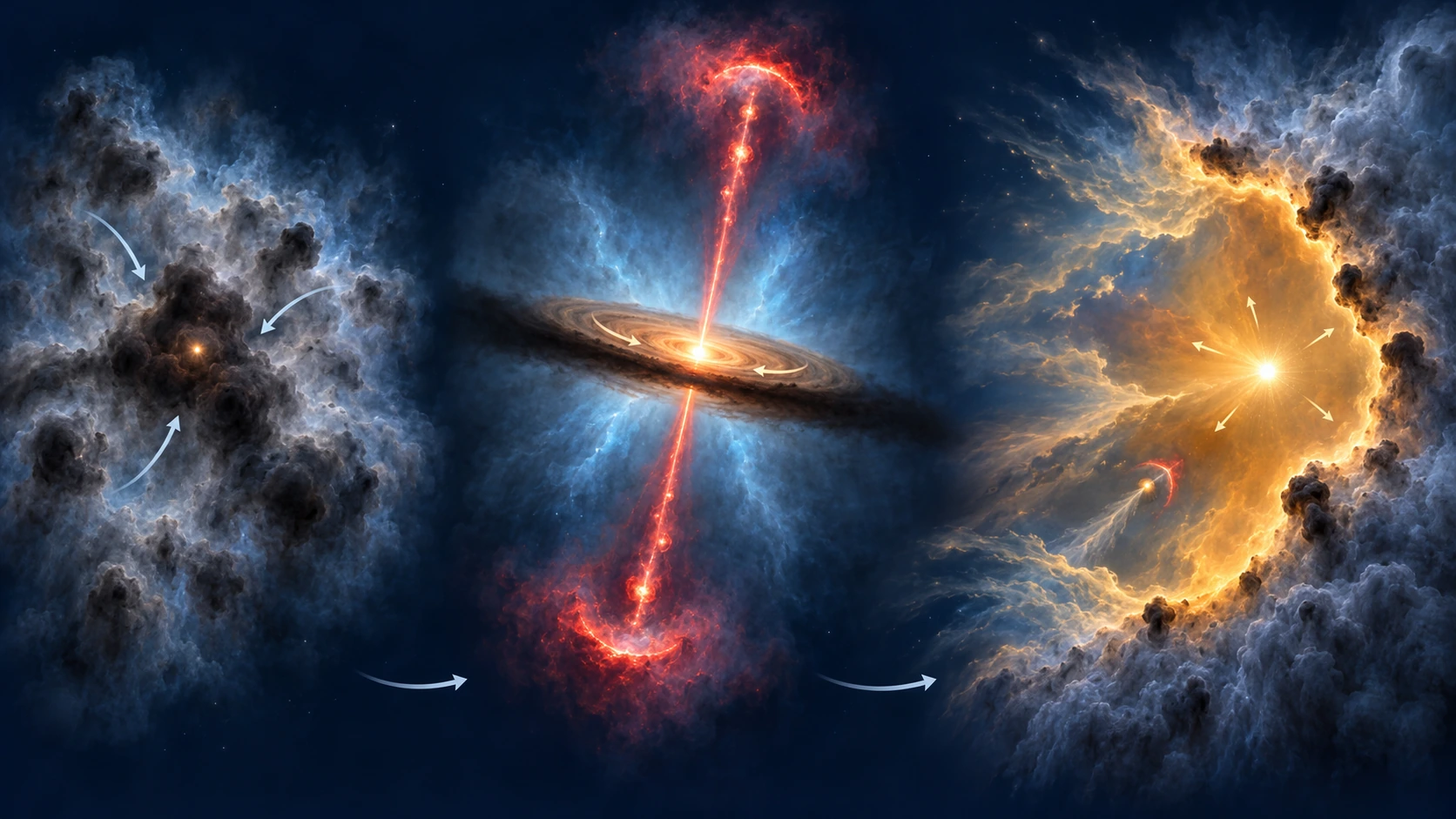
The golden cavity to its left spans about 3.5 light-years. The release attributes this structure to earlier outflows eroding the dense molecular cloud. Both the outflows and starlight energise the gas and make it glow. Some gas is dispersed and some compressed; the latter can create conditions favourable for other stars to form.
Other young stars occupy the cavity. Their stellar winds push into nearby gas, producing curved bow shocks and smaller cavities. The sharp ridge along the top of the golden region marks the boundary between warm gas and colder, denser material outside. In this photodissociation region, stellar radiation breaks hydrogen molecules into atoms.
Red jets leave shock structures
The red clumps to the right of the central star conceal younger protostars. They are still accreting gas and dust and gaining mass while ejecting hot outflows. As these flows strike the dense material around the protostars, shocks heat the gas and make it glow, producing intricate, overlapping structures.
The official image description associates the red region with shock-affected molecular hydrogen and the golden region mainly with hotter atomic hydrogen. Outflows from several protostars overlap along our line of sight. Tracing each flow back to its source will require further analysis.
A dusty disc casts a vast shadow
More red outflows appear near the blue nebula at the upper left. A protostar at the centre of this blue region is surrounded by a disc with a ring-like appearance. The disc blocks some starlight and casts a shadow onto the surrounding nebula. The release compares it with the ‘Bat Shadow’ previously imaged by the Hubble Space Telescope.
Following the influence of young stars
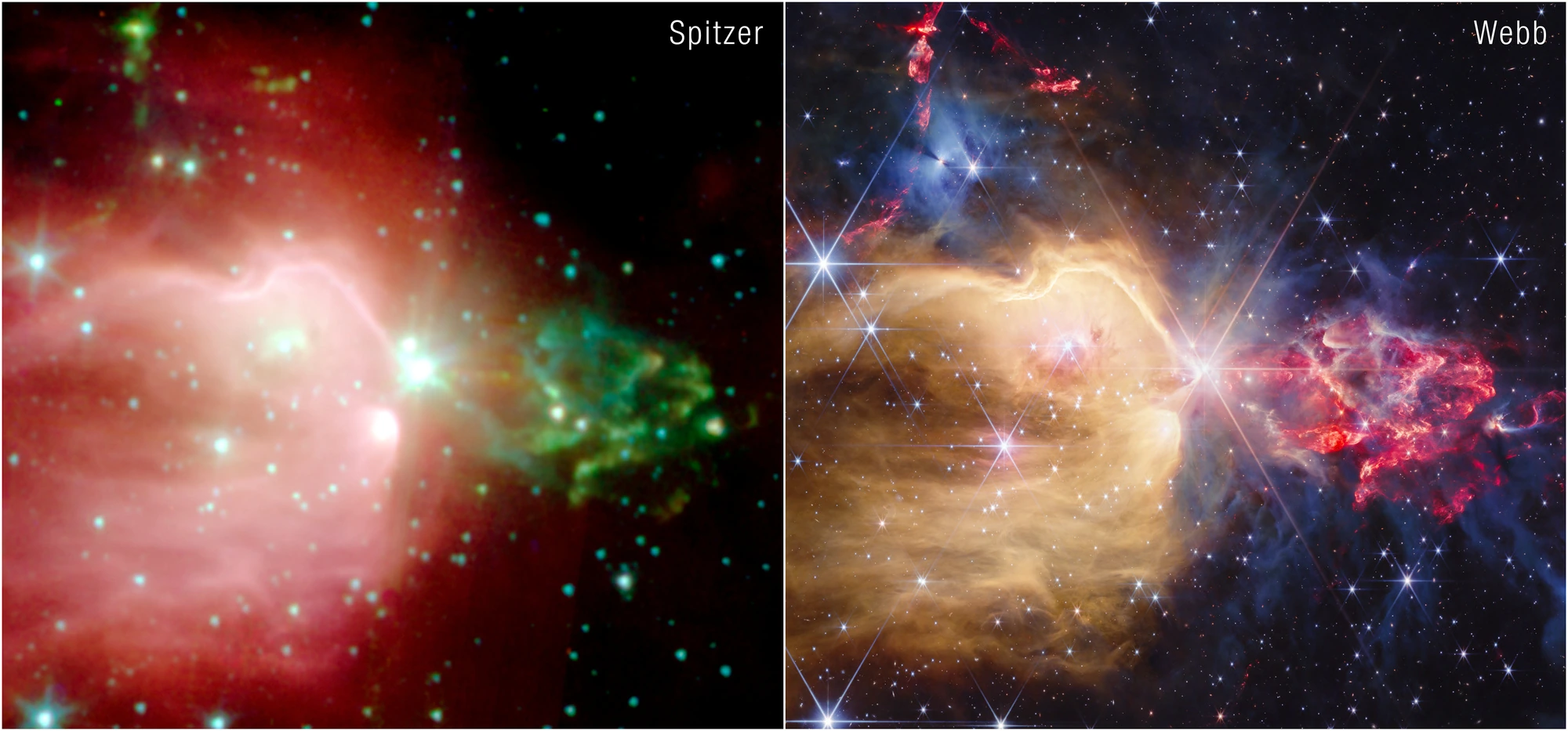
The Spitzer Space Telescope previously observed the gas and dust of NGC 7129. Webb’s higher spatial resolution now separates finer gas filaments and makes background galaxies easier to see. The two telescopes’ composite images use different wavelengths and colour mappings, so structural detail is the most useful basis for comparison.
This nebula brings stellar growth and environmental change into one view. More mature young stars illuminate and erode their surroundings, while younger protostars mark the gas with outflow shocks. Researchers will continue analysing Webb’s data to investigate changes in temperature, chemistry and gas distribution, and how molecular clouds gradually erode over millions of years.