Cosmological simulations turn billions of years of galaxy growth into a process we can watch. Starting from the distribution of matter in the early universe, IllustrisTNG calculates the joint evolution of dark matter, gas, stars, black holes and magnetic fields. TNG50 research and official visualizations show how gas gathers, forms stars and builds galactic disks through the interplay of inflows and feedback.
Key points
- IllustrisTNG uses the AREPO code to calculate galaxy evolution in a virtual universe, following dark matter, gas, stars, supermassive black holes and magnetic fields together.
- An official TNG50 movie follows a galaxy as it develops an ordered disk from turbulent gas. By the present day, its mass is similar to that of Andromeda.
- Feedback from stars and black holes returns energy to the surrounding gas. Together with continuing inflows, it regulates galaxy growth.
- The model is calibrated and tested against observational statistics. It explains patterns across galaxy populations, while physics on smaller scales still requires approximations.
Gas streams in from the surroundings. Smaller structures approach one another and merge, and a rotating disk gradually takes shape at the center. Supercomputers turn billions of years of galaxy growth into a continuous sequence, revealing how a galaxy emerges from its cosmic environment. IllustrisTNG research and public visualizations make this long history a physical process that can be followed, analyzed and compared with observations.
Matter evolves, and galaxies emerge
IllustrisTNG creates a large volume of virtual space and evolves it from the early universe at redshift z = 127 to the present day at z = 0. It follows the gravity of dark matter alongside gas flows, cooling and magnetic fields, then includes star formation, the production of chemical elements, black hole growth and energy feedback. Galactic shapes gradually emerge from the interaction of these processes.
Dark matter structures provide a gravitational framework, while gas gathers in denser regions along the cosmic web. As gas cools, it can fuel star formation. Rotation, accretion and mergers continually reshape galaxies and change their sizes. Researchers can then ask which growth histories tend to preserve a disk, and which interactions transform a galaxy.
An ordered disk grows out of turbulent gas
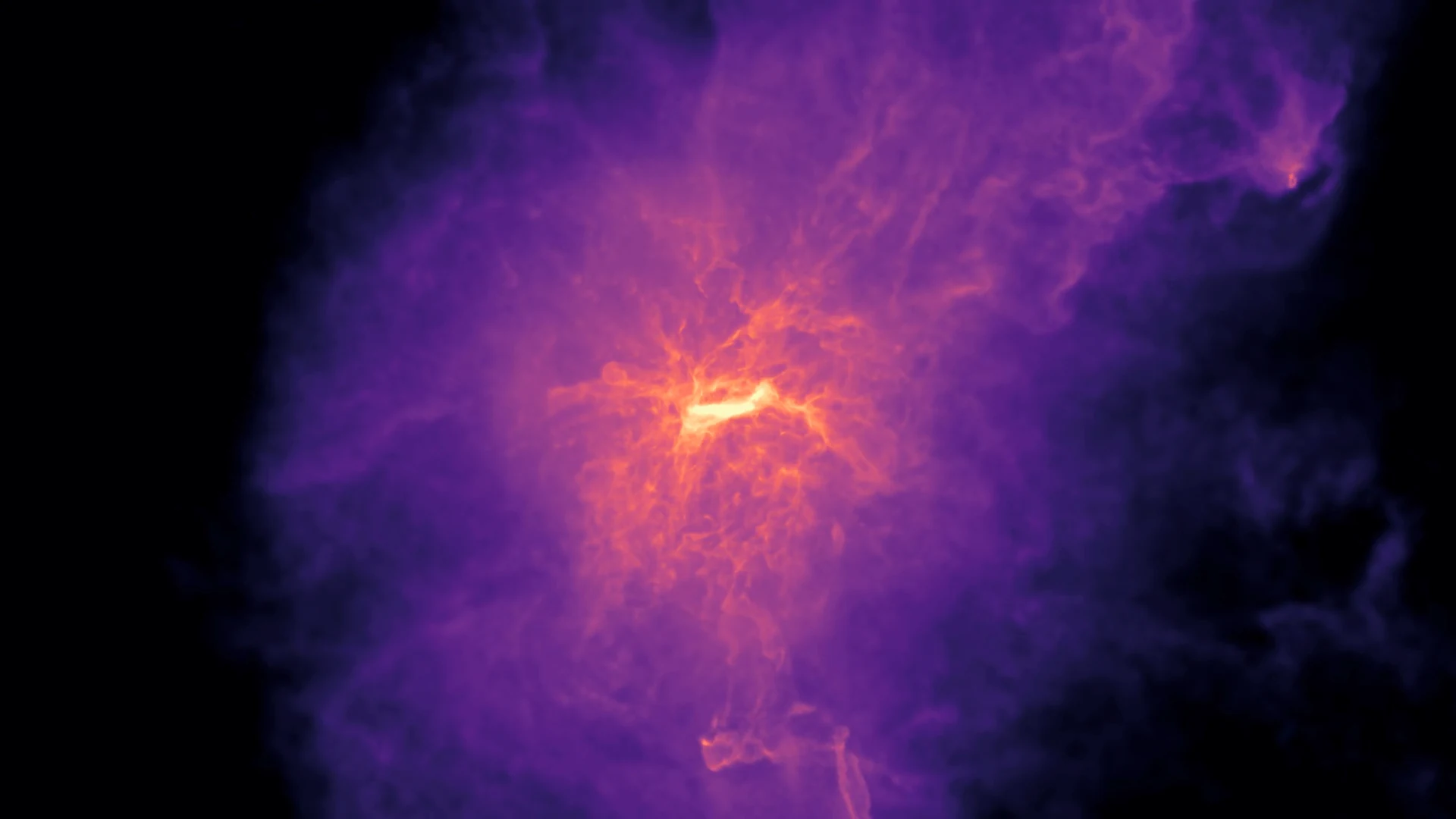
One official TNG50 movie follows a galaxy labeled g1. Early on, it forms stars rapidly within a turbulent gas reservoir. After redshift falls below about 2, the gas gradually settles into a more ordered disk. A relatively quiet later history, without major mergers, allows stellar feedback and inflowing gas to approach a balance. By the present day, the simulated galaxy has a mass similar to that of Andromeda. Explore the Local Group scene to see Andromeda and neighboring galaxies in their spatial context; g1 is a simulated example.
This example also reflects TNG50 studies of galaxy populations. The model predicts that, as cosmic time passes, disk shapes become more common among star-forming galaxies. TNG50's high resolution lets researchers study the thickness, shape and rotation of many galaxies together, moving beyond a single visually striking growth history.
Galaxies take gas in and push it out
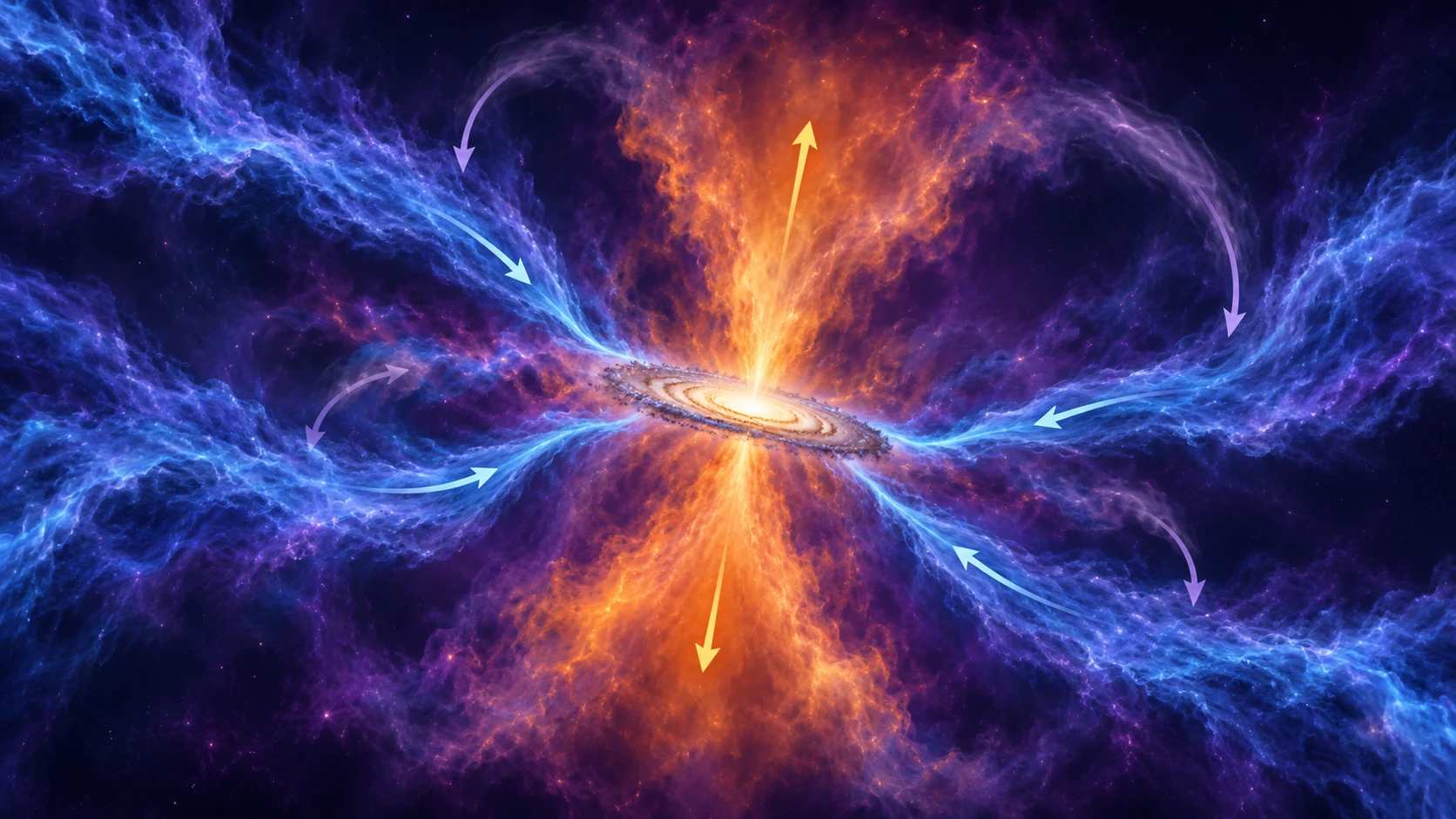
During growth, matter keeps flowing inward while energy is transferred outward. Supernovae and accreting supermassive black holes inject energy into the surrounding gas, driving outflows on galactic scales. This feedback can heat gas, push some material away from the galaxy and change the supply of fuel available for later star formation.
A companion TNG50 study examines these outflows and how stellar and black hole feedback jointly shape the gas around galaxies. Viewed through both inflows and outflows, a galaxy is a system that continually exchanges matter with its environment. The formation of its disk and the pace of star formation are both connected to that exchange.
Testing virtual galaxies against the real sky
IllustrisTNG is calibrated using statistics such as observed galaxy mass distributions and sizes, relationships between black holes and their host galaxies, and the history of cosmic star formation. Other observations then test its predictions. The calculations reproduce many features of galaxy populations and help researchers identify where the model still differs from the real universe.
The simulations have finite spatial and mass resolution. Some details of star formation and the immediate surroundings of black holes must therefore be represented by approximate models informed by observations and smaller-scale studies. Beyond watching spiral arms appear, the key question is whether the same physics can explain many different galaxies at once. As the virtual universe develops structures resembling those in the sky, it offers a concrete way to test why galaxies look the way they do today.
The matter cycle behind galaxy growth
The image below brings this exchange into one cycle. Blue gas flows toward the galaxy from its surroundings, replenishing the fuel for star formation. Gold gas is driven outward by stellar and black hole feedback, expanding above and below the disk along paths of lower resistance. Some of that outflow slows down and returns to the galaxy's outskirts along the pale violet arcs, forming a galactic fountain. These flows redistribute gas and interact with the growth of the disk. Colors, arrows and proportions distinguish the processes rather than encode precise values at a particular moment.