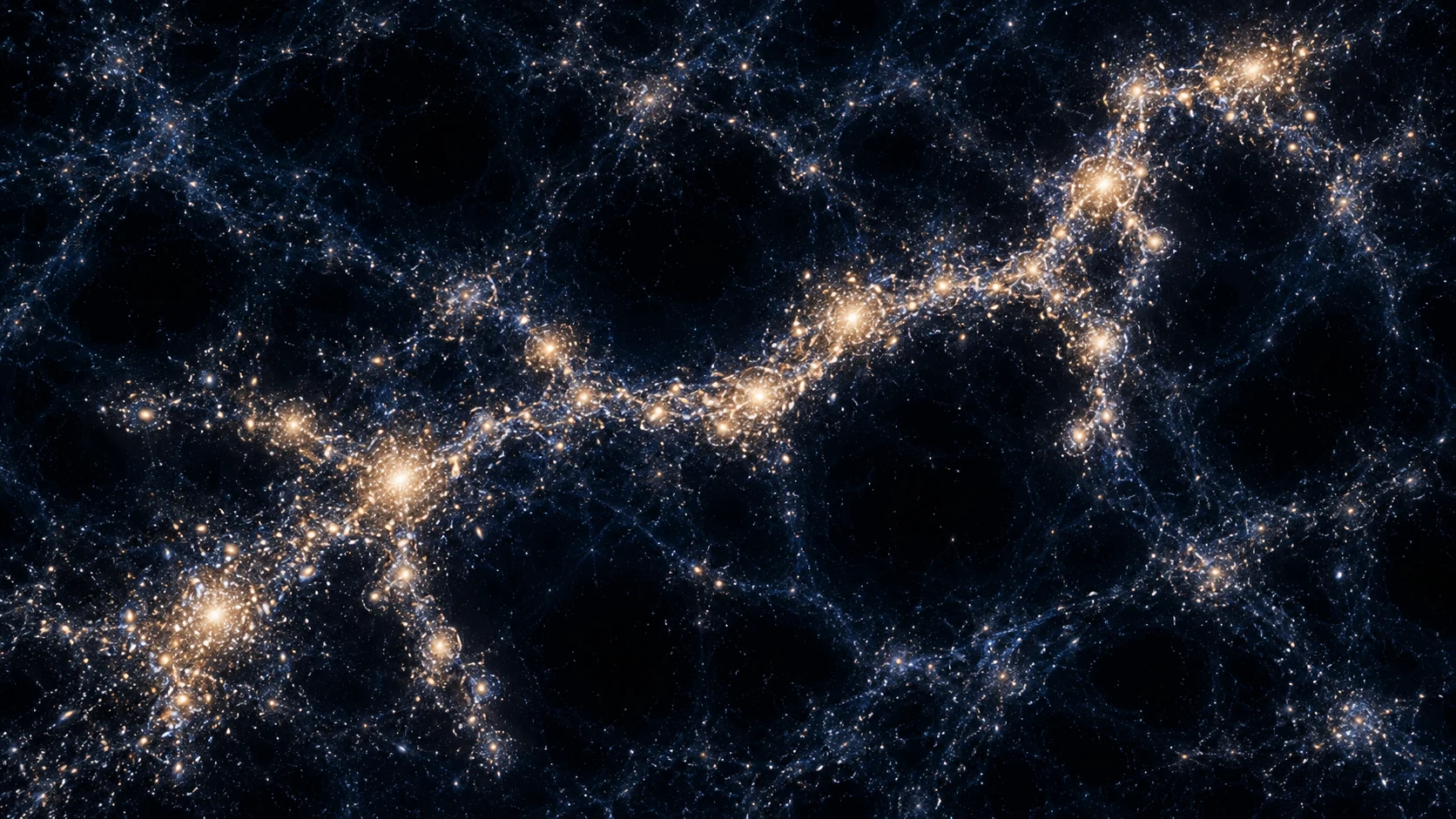
Astronomers have identified the Quipu superstructure using an X-ray survey of galaxy clusters in the nearby Universe. Shaped like a long knotted cord, its most widely separated members lie about 1.4 billion light-years apart. Such immense concentrations of matter also affect precision measurements of cosmic expansion and the microwave background.
Key points
- Quipu contains 68 galaxy clusters, with a maximum member separation of 428 Mpc, or about 1.4 billion light-years. Its estimated total mass is about 2.4 × 10¹⁷ solar masses.
- The study maps galaxy clusters using ROSAT X-ray data, then compares the structure with galaxy distributions and cosmological simulations.
- Superstructures may affect precise measurements of expansion and the microwave background; the microwave signal sought in this study has low statistical significance.
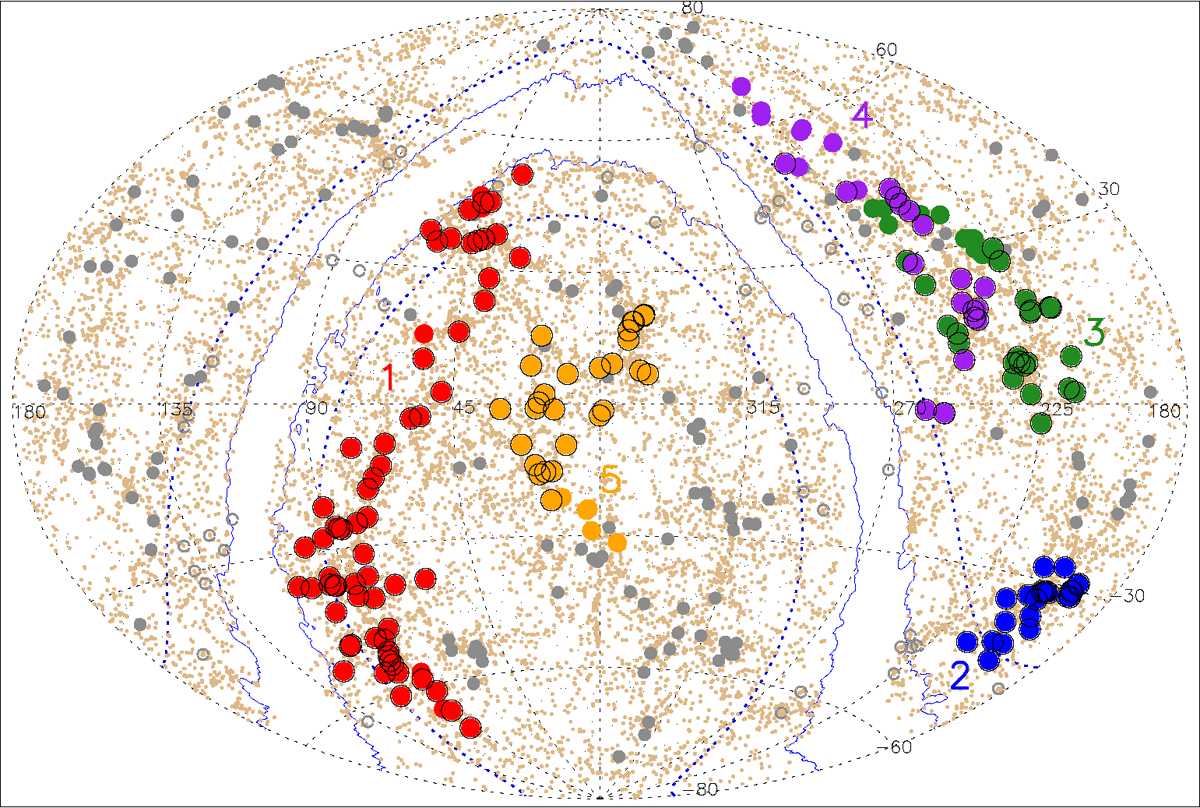
On a map of galaxy clusters in the nearby Universe, a vast branching network stretches from the northern to the southern sky. In a study published in 2025, Hans Böhringer and colleagues named this superstructure Quipu. It contains 68 galaxy clusters, and its two most widely separated members are 428 megaparsecs (Mpc), about 1.4 billion light-years, apart: the largest structure found in this survey.
A cosmic cord with side branches
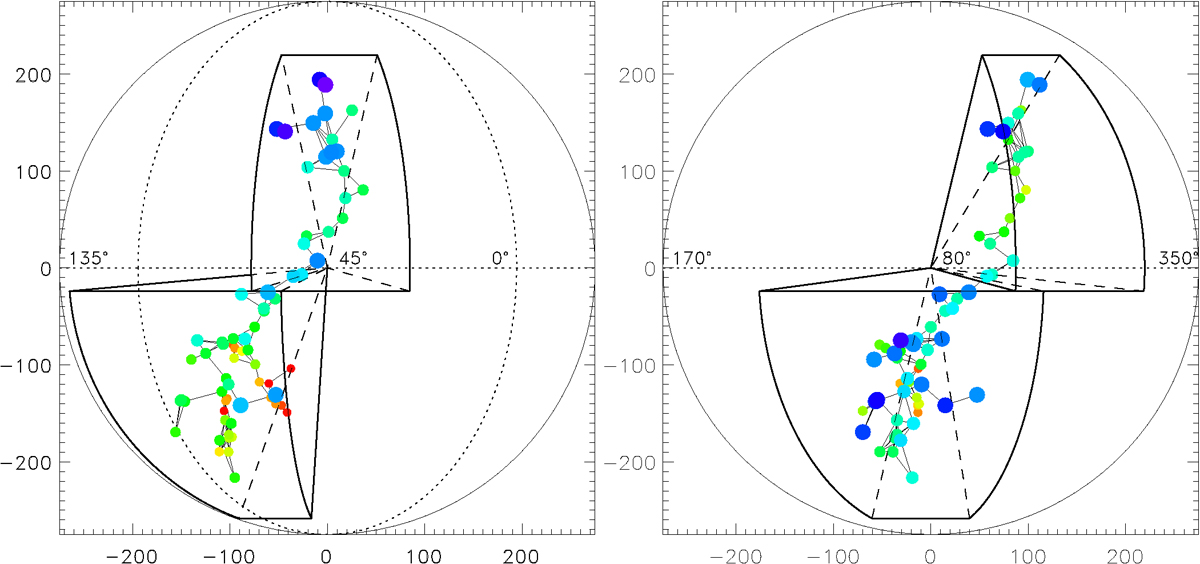
Plotted in three dimensions, Quipu forms a long, curved spine with shorter branches extending from it. Quipu refers to the knotted cords used by the Inca to record information. The name reflects the network's shape and the observing work in Chile that supplied many of the cluster redshifts.
Each 'knot' here is a galaxy cluster containing many galaxies. The paper's 428 Mpc measures the greatest straight-line separation between members, exceeding the 328 Mpc length cited for the Sloan Great Wall. The research institute therefore described Quipu as the largest reliably measured cosmic superstructure known at the time. That comparison depends on how each study identifies structures and defines its measurement range.
Tracing matter with X-ray galaxy clusters
The team used the CLASSIX cluster survey, identifying clusters in the ROSAT satellite's all-sky X-ray data and confirming their identities and redshifts with optical spectroscopy. The catalogue covers about 86% of the sky. This study focuses on redshifts from 0.03 to 0.06, at distances of roughly 130–250 Mpc, while also following linked members beyond those boundaries.
Galaxy clusters serve as signposts for dense regions of the cosmic web. A friends-of-friends algorithm progressively links clusters that are close enough, adjusting the linking threshold for the survey's changing sampling density with distance. The 2MASS galaxy redshift data show corresponding dense regions, providing independent observational support for the outlines traced by clusters.
Quipu's estimated total mass is about 2.4 × 10¹⁷ solar masses, including the large-scale matter distribution around its clusters. The estimate converts cluster density into matter density and combines it with an assigned structural volume, so it depends on the model and chosen boundaries. Observable signposts thus help infer the distribution of dark matter.
How much do five superstructures contain?
Alongside Quipu, the team identified four other large superstructures: Shapley, Serpens–Corona Borealis, Hercules and Sculptor–Pegasus. Combining survey and simulation analyses, the authors estimate that these superstructures contain about 45% of the clusters, 30% of the galaxies and 25% of the matter in the study region, while occupying about 13% of its volume. These fractions describe the superstructures collectively within that region, rather than Quipu alone.
The Millennium cosmological simulation also produces superstructures with similar numbers and member distributions. This comparison shows that the observed giant networks can arise in the ΛCDM model, which includes cold dark matter and a cosmological constant. Their distinctive environments offer opportunities to study how surrounding matter influences galaxies.
How the cord affects cosmic measurements
The gravity of these matter concentrations gives galaxies additional motion beyond the overall cosmic expansion. Using flows around Shapley as an example, the paper estimates that local measurements of the Hubble constant in some directions could shift by one to a few percent. This estimate illustrates the effect of the large-scale environment; precise corrections require more complete matter and velocity maps.
Light from the cosmic microwave background can acquire small temperature shifts while crossing a gravitational potential that changes with time: the integrated Sachs–Wolfe effect, or ISW. Simple models in the study predict signals of about 3–5 microkelvin from such superstructures. The search in Planck data finds a similar amplitude, but with statistical significance below 1σ, leaving confirmation to stronger observations.
The ends of the cord remain to be traced
Parts of Quipu's edges approach regions where the Milky Way obscures background objects, and its southern end lies near the Vela supercluster. Under the linking threshold used in this study, the two remain separate. Future surveys must establish whether additional members lie behind the Galactic disc; new data could extend the cord's mapped outline.
Superstructures also evolve with time. The authors expect them eventually to separate into several individually collapsing units. The long-cord shape seen today is a stage in the evolution of the cosmic web. Mapping it helps astronomers understand how nearby matter shapes galaxies and affects measurements of the more distant Universe.