
The Large Hadron Collider has long recorded brief beam losses caused by micrometre-scale dust entering the proton beams. Two physicists propose that a small fraction might be triggered by axion quark nuggets passing through nearby rock. No such dark matter has been detected, but timing correlations around the ring offer a direct test of the model.
Key points
- At the LHC, a UFO is a sudden beam-loss event usually attributed to micrometre-scale dust entering a proton beam; it is not an observation of an alien craft.
- A two-author Physical Review D paper proposes that antimatter axion quark nuggets weighing roughly 5 to 1,000 grams could generate acoustic shock waves while passing through rock within about 100 kilometres of the LHC.
- The model estimates that roughly 1% to 10% of UFO events might arise through this mechanism; that fraction comes from assumptions, and the study does not identify an axion quark nugget in LHC data.
- Its clearest signature would be several correlated UFO events at widely separated points around the ring within roughly 6 milliseconds to 2 seconds, a pattern that ordinary local dust events are less likely to produce.
- The calculation indicates that three correlated events within two seconds could produce a signal-to-noise ratio above 5 across the assumed mass range in about 360 hours of measurement; rock attenuation, dust distribution and correlated backgrounds still require tests with real data.
The Large Hadron Collider may be able to do more than collide protons in searches for new particles. It could also act like a giant underground stethoscope, listening for vibrations left as a macroscopic dark-matter candidate passes through rock. University of British Columbia physicists Xunyu Liang and Ariel Zhitnitsky propose in Physical Review D that the LHC's existing beam-loss monitoring system could search for multipoint events produced by axion quark nuggets, or AQNs.
This is a model awaiting a data test, not a discovery of dark matter. Under the paper's AQN assumptions, roughly 1% to 10% of the LHC's unidentified falling object, or UFO, events might be related to the mechanism. The authors have not selected a single event as a confirmed AQN signal. The proposal matters because it defines a timing and location pattern that can be sought, constrained or ruled out.
At a collider, a UFO is a dust alarm
Since 2010, the LHC has recorded a class of brief beam losses in which micrometre-scale dust detaches from the beam-screen surface, becomes charged, is pulled toward a proton beam and undergoes inelastic collisions with high-energy protons. A typical event lasts only about 0.1 milliseconds to several milliseconds, yet it can trigger a beam dump and may even quench a superconducting magnet. CERN operations and experimental studies have accumulated substantial evidence for the dust explanation. What remains less clear is how most grains attached to the bottom of the beam screen are initially released.
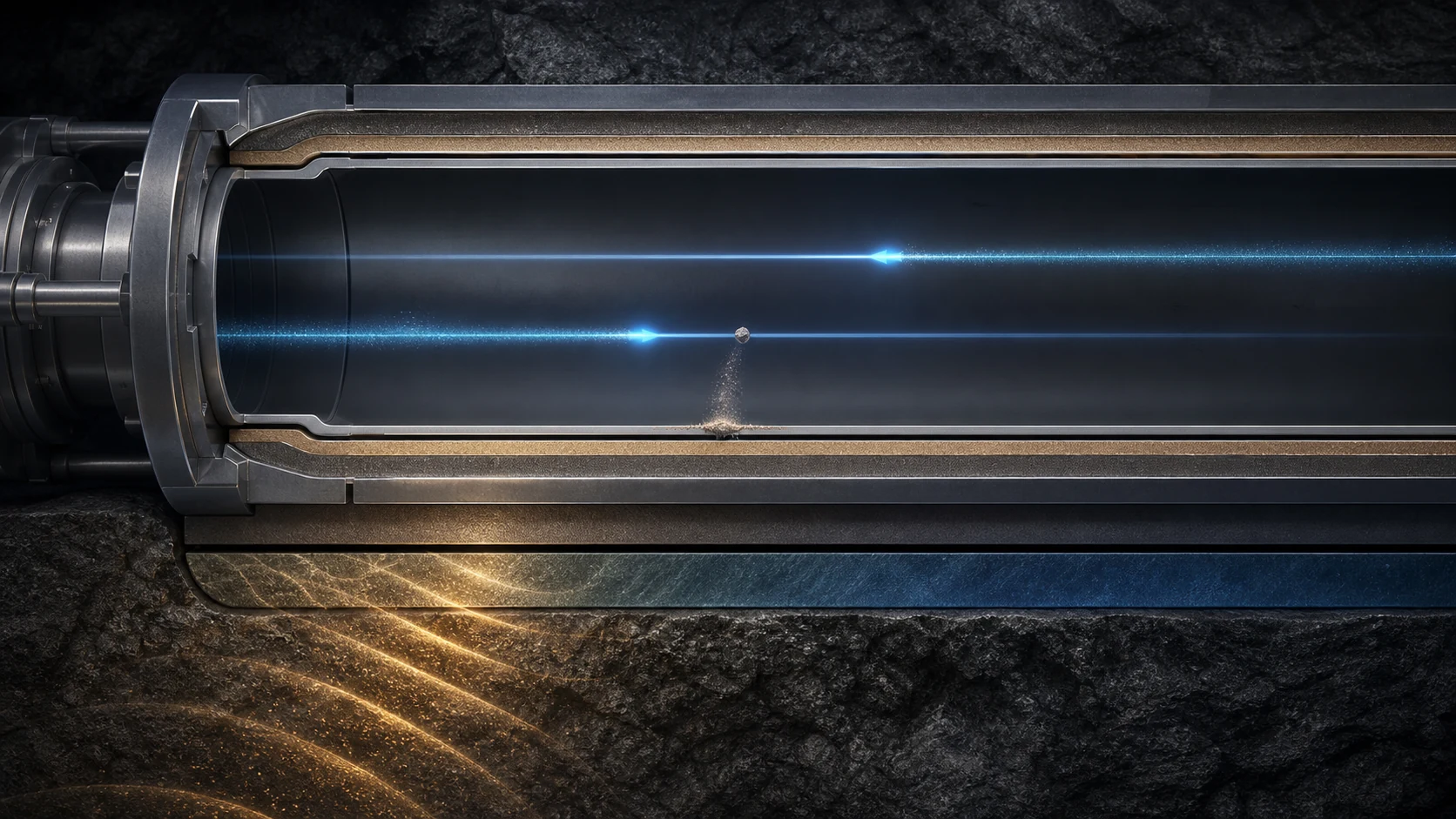
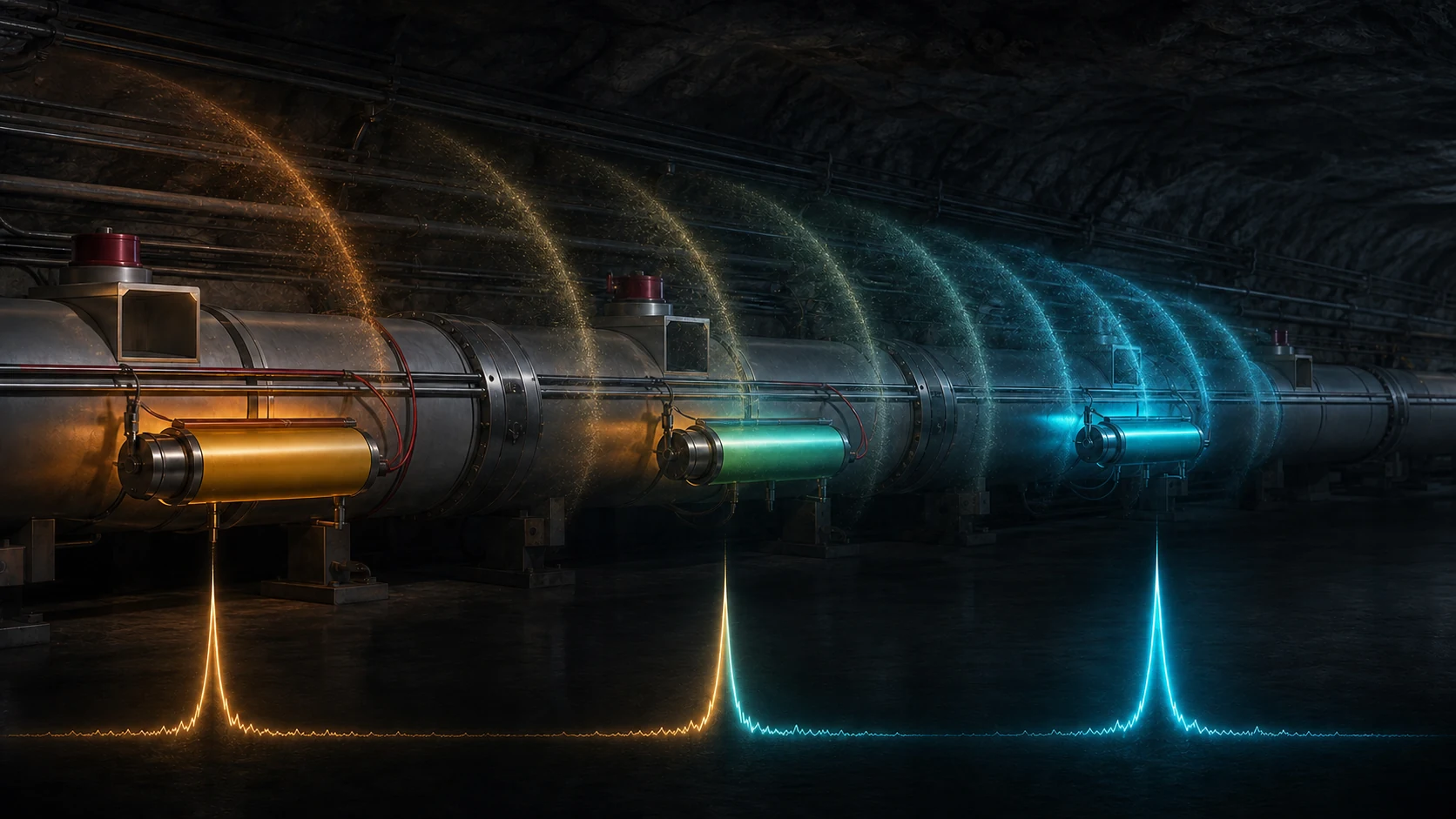
Roughly 4,000 beam-loss monitors are distributed around the LHC's 27-kilometre ring to protect the machine when a particle beam strays. A single grain entering a beam usually leaves a local millisecond-scale spike. If one external mechanical disturbance sweeps through the whole facility, however, monitors at widely separated positions could record events in sequence. The new proposal focuses on that combination of spatial and temporal correlation.
How a macroscopic candidate could shake dust loose through rock
An AQN is a hypothetical lump of nuclear-density quark matter stabilised by an axion field, with the model allowing matter and antimatter versions to coexist. It differs from searches for conventional weakly interacting massive particles or individual axions. The paper considers nuggets with masses of roughly 5 to 1,000 grams. Their volumes would remain tiny, while their numbers and rates of passage through Earth would be relatively low. This mechanism concentrates on antimatter AQNs because they could annihilate with ordinary matter after entering Earth and release energy.
In the paper's acoustic model, an antimatter AQN travelling rapidly underground generates a shock wave along its path. If the trajectory passes within about 100 kilometres of the LHC, the pressure disturbance reaching the tunnel might overcome adhesion between some dust grains and the beam screen, shaking them into the vacuum pipe. Only then would the dust interact with a proton beam and cause a familiar UFO beam loss. In other words, the model does not have dark matter striking the proton beam directly.
That causal chain contains several estimates: AQN mass and flux, annihilation energy in rock, acoustic pressure and frequency, attenuation during propagation through rock, and the size, location and adhesion of dust on the beam screen. The paper acknowledges that sound absorption in solids is complex and that its weak-attenuation assumption needs experimental calibration. A calculation showing that dust could be dislodged is therefore not evidence that the machine has already measured this mechanism.
A fingerprint stretching around the ring within two seconds
Local dust sources normally affect only nearby sections. An AQN-generated acoustic wave in the model could instead cross the LHC ring, which is about 8.5 kilometres in diameter. The authors therefore recommend searching for a UFO burst: multiple events occurring at separated positions around the ring within roughly 6 milliseconds to 2 seconds, with arrival-time differences consistent with the wave direction and distances between monitors. This long-range, short-time correlation is better able to reject chance background than a single beam loss.
The study adopts a conservative background of no more than 10 ordinary UFO events per hour and assumes about 12 hours of LHC operation per day. Its calculation indicates that after about 360 hours of data, two correlated events would be strongly distinctive only for heavier AQNs. Three correlated events in the same two-second window could yield a signal-to-noise ratio above 5 across the full mass range used in the paper. These values are predictions of model sensitivity, not an experimental significance already achieved.
The LHC's existing monitors make this test possible without building a new large dark-matter detector, but a reliable analysis would still have to account for machine status, dust activity and other vibration backgrounds. The authors also propose cross-checking beam losses against the CERN seismic network, distributed acoustic sensing and infrasound data. Compatible arrival times across different systems could help distinguish a common wavefront from local mechanical noise.
Let old monitors answer a new question
The most direct next step is not to announce a discovery but to reanalyse beam-loss records with explicit selection criteria: find cross-region UFOs within two seconds, test whether their locations fit one propagating wavefront, and check seismic and acoustic backgrounds. If the expected proportion of candidates is absent, the data could instead constrain the AQN mass distribution, flux or acoustic coupling.
The proposal is attractive because it repurposes a sensor network built for machine safety to test a macroscopic dark-matter model at the boundary of particle physics and cosmology. AQNs remain hypothetical, however, and acoustic propagation and dust release carry substantial uncertainties. Only a transparent analysis that removes known operating backgrounds and finds a consistent signal in independent detection systems could begin to turn an anomaly heard by this underground stethoscope into evidence for dark matter.