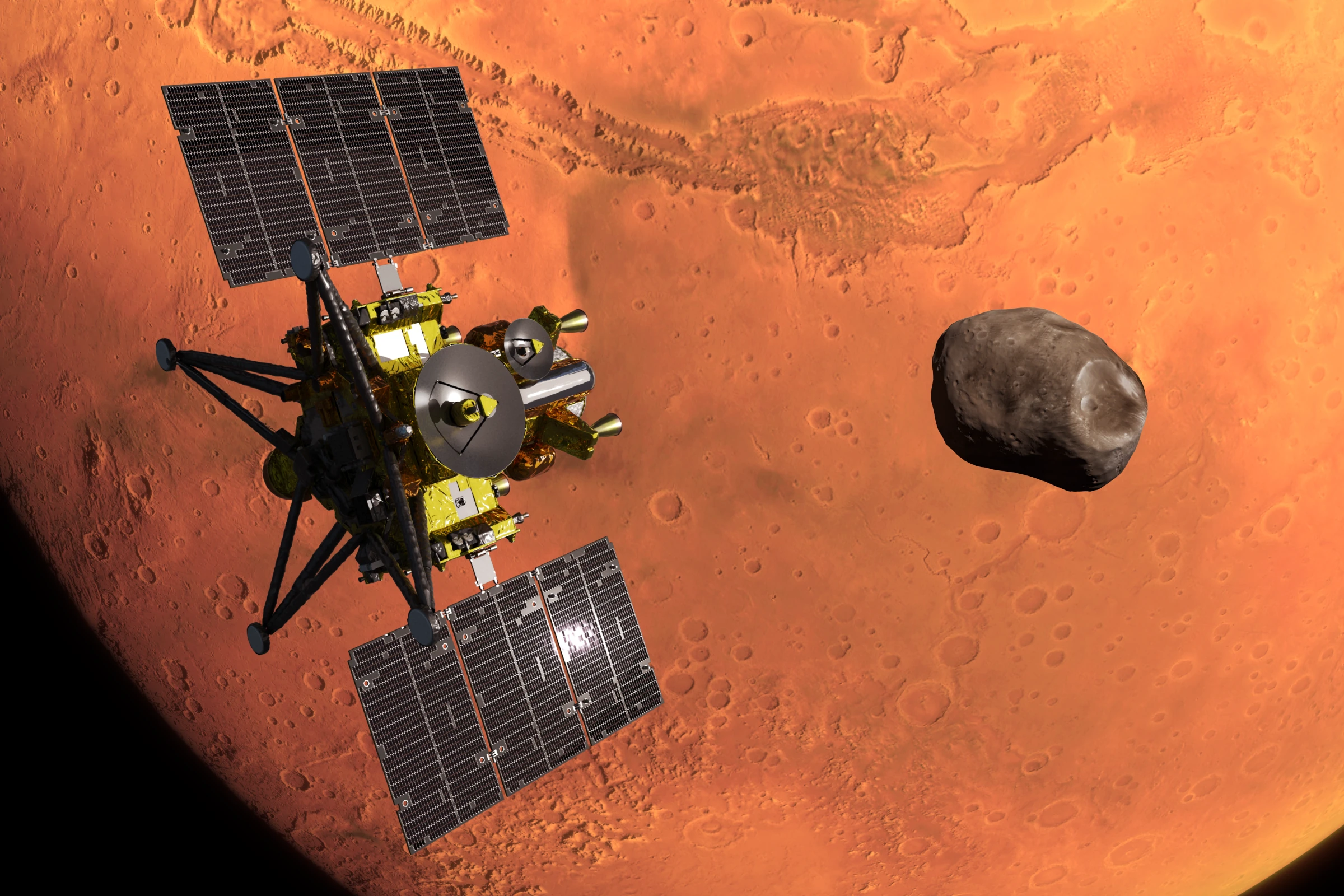
Japan’s MMX spacecraft has launched aboard an H3 rocket, aiming to collect at least 10 grams of material from Phobos and deliver it to Earth in 2031. The grains could reveal how Mars’s moons formed and may include material blasted off Mars by impacts, opening another route to studying the planet’s history.
Key points
- MMX lifted off from Tanegashima aboard H3 Flight No. 10 at 04:41:03 Japan Standard Time on 20 October, separating normally about 1 hour 11 minutes later.
- The mission plans to reach the Mars system in 2027, collect at least 10 grams of material from Phobos and deliver the samples to Earth in 2031.
- Phobos may have accumulated debris ejected from Mars by impacts. Identifying any such grains in the returned samples will be an important scientific question.
This journey to Mars aims to bring home a handful of material from one of its moons. The Japan Aerospace Exploration Agency’s (JAXA) Martian Moons eXploration spacecraft, MMX, launched successfully on 20 October 2026, beginning a five-year round trip to Phobos. Its goal is to make the first return to Earth of samples collected within the Mars system.
H3 Flight No. 10 lifted off with MMX from Tanegashima Space Center at 04:41:03 Japan Standard Time, or 03:41:03 in Hong Kong. JAXA confirmed that the rocket flew as planned and released the spacecraft normally about 1 hour 11 minutes 13 seconds after launch, placing it in its intended orbit.
On 21 October, JAXA announced that MMX had completed its initial critical operations and was in good health. These operations included deploying its solar arrays, establishing three-axis attitude control and releasing the medium-gain antenna’s restraint. The team will next check the initial functions of onboard equipment and prepare for the cruise to Mars.
Five years to bring home at least 10 grams
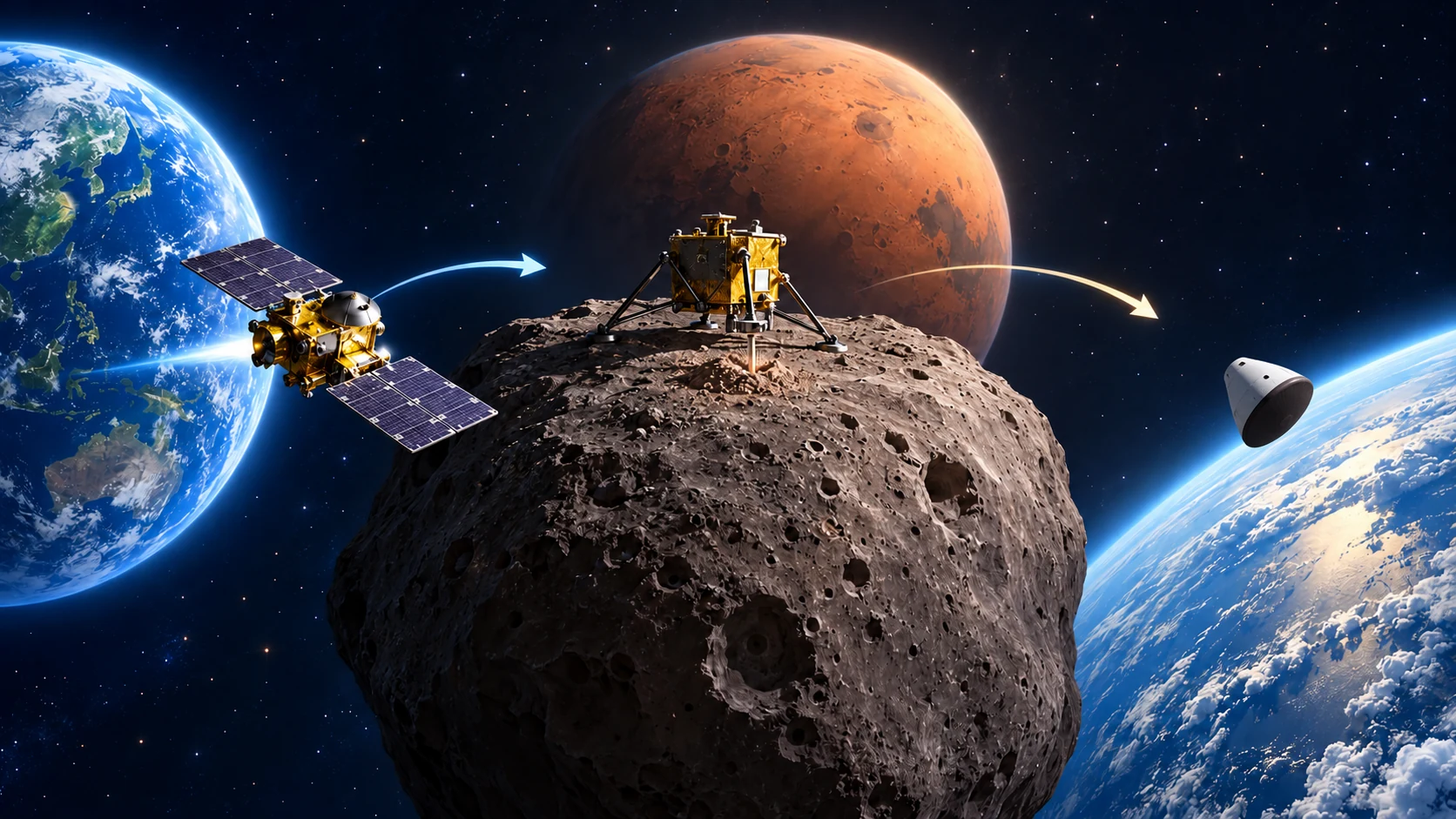
The mission plan calls for roughly a year of travel to Mars, arrival in 2027 and about three years of observation and sampling. MMX would leave the Mars system in 2030 and deliver its samples to Earth in 2031. While orbiting Mars, it will fly near Phobos on a quasi-satellite orbit (QSO), mapping terrain and material distribution to select suitable landing sites.
IDEFIX, a small rover jointly developed by the French space agency CNES and the German Aerospace Center DLR, is planned to reach the surface before the main spacecraft. It will examine the physical properties of the regolith to help reduce landing and sampling risks. MMX itself plans to attempt two landings and collect at least 10 grams of samples. The mission will also observe Deimos and attempt a close flyby. These remain future mission objectives.
Why visit Phobos first?
Phobos is irregularly shaped, reaches about 27 kilometres along its longest dimension and has surface gravity roughly 1/1,700 of Earth’s. Compared with returning from the surface of Mars, this small body lets the mission build on Japan’s small-body exploration and sampling experience from Hayabusa and Hayabusa2. Its very weak gravity still demands precise control during landing, surface contact and grain collection.
Returning material to Earth also lets researchers analyse individual grains directly and compare laboratory results with the terrain and mineral distributions recorded by the spacecraft. MMX aims to extend sample-return exploration, already achieved at the Moon and asteroids, to the region containing Mars and its moons.
Moon grains may contain fragments of Mars
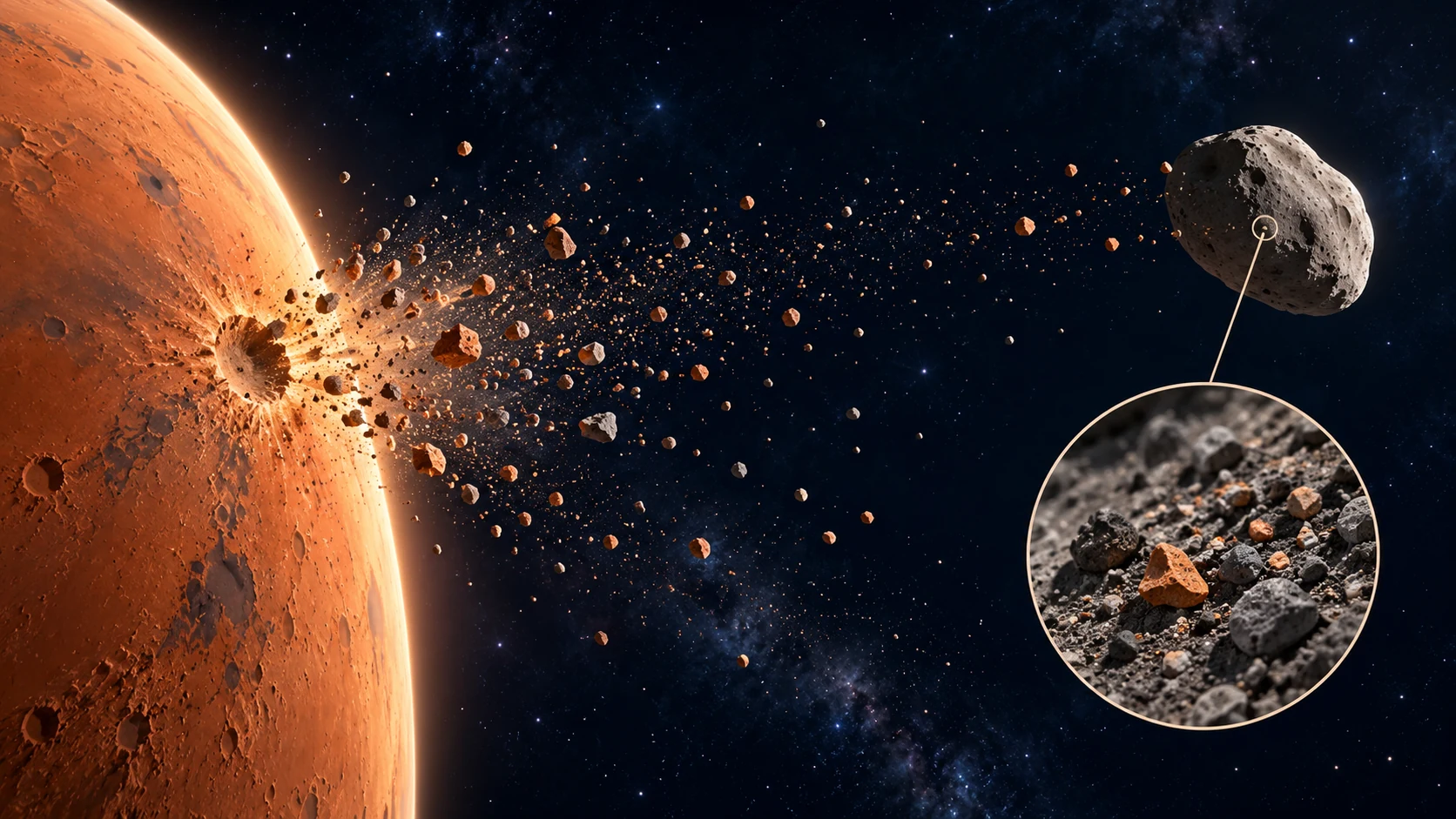
Another attraction of Phobos is the exchange of material between the moon and Mars. When meteorites strike Mars, some rocky debris can be ejected from the surface. Models predict that a fraction may reach Phobos and mix into its loose surface regolith. Sampling Phobos therefore offers a chance to obtain grains originating from Mars.
This could make Phobos another window onto Mars’s changing environment. Whether the samples contain identifiable Martian material, the periods those grains represent and the records they preserve must await analysis after their return. The actual sampling site is the surface of Phobos; searching the samples for Martian components is a scientific objective based on models of material transfer.
Where did the two small moons come from?
Two main explanations remain for the origins of Phobos and Deimos. They may have been asteroids captured by Mars’s gravity, or they may have formed from debris produced by an ancient giant impact on Mars. MMX will combine observations of the moons with returned samples to seek material evidence that can distinguish these hypotheses.
JAXA leads the mission with partners including NASA, CNES, DLR and the European Space Agency (ESA). Alongside its science goals, the journey will test travel to and from the Mars system, surface operations, sampling and deep-space communications. The successful launch has opened the route to Phobos; the next challenge is to bring its distant grains safely into the laboratory.