
Astronomers detected escaping helium in transit spectra of the habitable-zone rocky exoplanet LHS 1140 b, providing the first clear evidence that this super-Earth about 48 light-years away retains an atmosphere. The signal appeared only in the 2024 observation, and the study constrains only the upper atmosphere; the composition of the lower atmosphere remains unknown.
Key points
- In 2024 near-infrared transit spectra of LHS 1140 b, the team detected the metastable-helium triplet near 10,833 angstroms; the main blended lines produced an extra absorption depth of 1.24% (+0.22/−0.23 percentage points).
- The helium signal began before the optical transit, consistent with gas extending along the orbit ahead of the planet; evidence for a trailing tail after transit was weaker.
- The same method did not detect helium in 2025. That observation was insensitive to absorption shallower than about 0.6%, so the result supports variable escape rather than showing that the atmosphere disappeared.
- Models interpret the signal as an outflow heated by stellar X-rays and extreme ultraviolet radiation. The upper atmosphere may be helium-rich and hydrogen-poor, while heavier carbon-, nitrogen- and oxygen-bearing species could remain lower down.
- The finding does not detect a biosignature or confirm liquid water. A habitable zone describes the range of received energy; the surface environment still depends on the unknown atmospheric composition and climate.
At 14.96 parsecs, or about 48.8 light-years from the Sun, LHS 1140 b has finally revealed evidence of an atmosphere flowing away into space. A team led by Collin Cherubim reports in Science that it detected metastable helium in the transit spectrum of this habitable-zone rocky exoplanet. This is the first clear demonstration of an atmosphere on a rocky planet in another star’s habitable zone. The signal comes from the rarefied upper atmosphere, not from a direct image of the planet’s surface.
How did the 2024 helium absorption emerge from the starlight?
LHS 1140 b has 5.60 ± 0.19 times Earth’s mass and 1.730 ± 0.025 times its radius, and orbits a low-mass red dwarf every 24.7 days. It receives about 42% of Earth’s stellar irradiation and has an equilibrium temperature of 226 ± 4 K if zero reflectivity is assumed. On 23 September 2024, the team used the high-resolution near-infrared WINERED spectrograph on the 6.5-metre Magellan Clay Telescope at Las Campanas Observatory in Chile. During 6.5 hours it obtained 70 spectra covering transits of LHS 1140 c and b separated by 39 minutes.
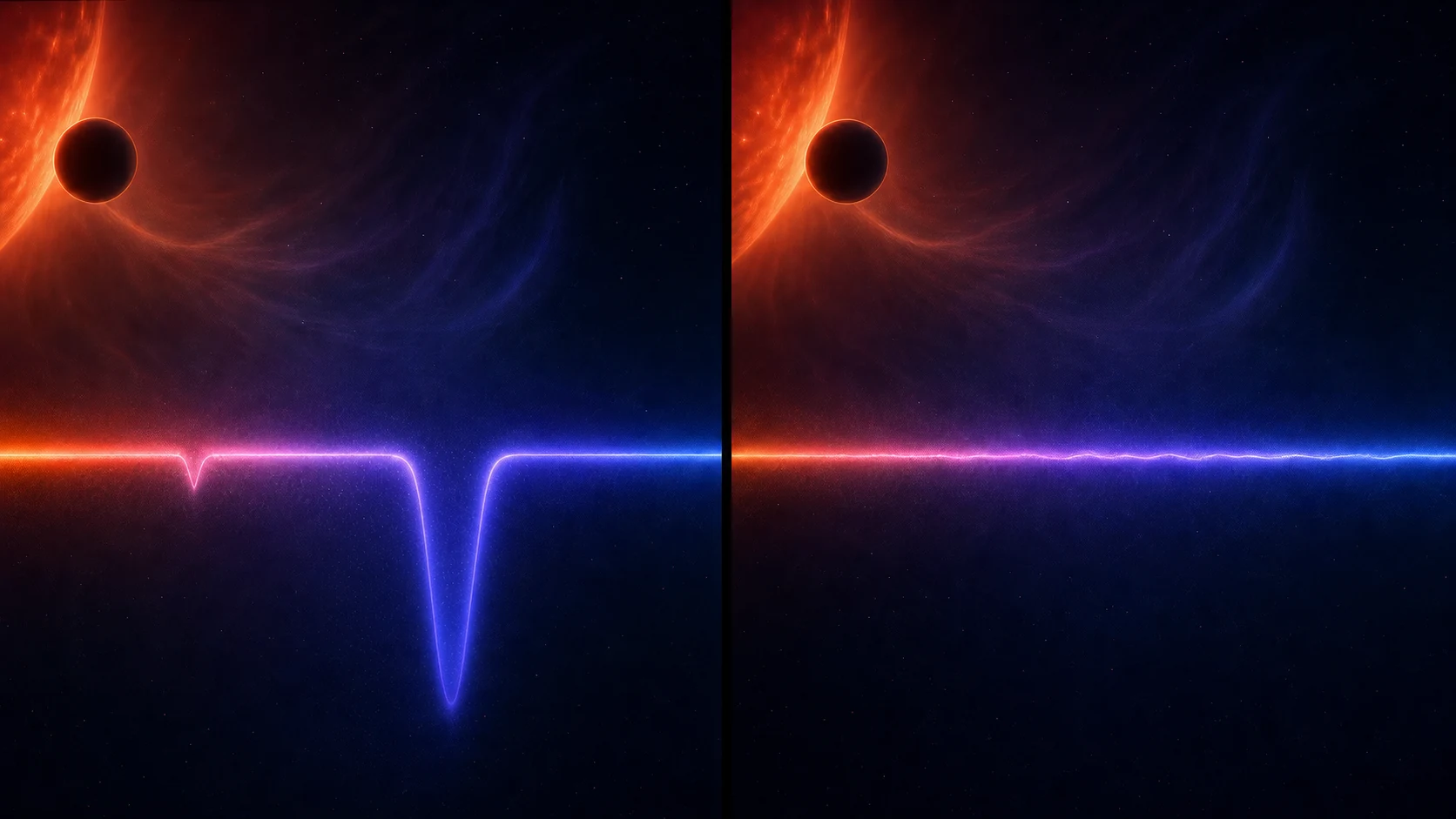
As LHS 1140 b passed in front of its star, some starlight filtered through the upper atmosphere. The study found extra absorption at the vacuum wavelengths 10,832.057, 10,833.217 and 10,833.306 angstroms of the metastable-helium triplet. The latter two blended lines reached 1.24% absorption (+0.22/−0.23 percentage points), equivalent to an opaque atmospheric layer extending to 1.52 planetary radii. The signal rose before the formal transit, consistent with helium extending ahead of the planet along its orbit; a trailing tail after transit has only tentative support.
The team checked alternatives including changes in the star’s own helium line, absorption in Earth’s atmosphere and night-sky OH emission. An independent analysis pipeline reprocessed both the 2024 and 2025 data and recovered the signal only in 2024. The transit observed on 29 September 2025 did not yield another helium detection, but injection-and-recovery tests showed that absorption no deeper than about 0.6% would be difficult to distinguish. The non-detection can therefore reflect changes in stellar XUV radiation, outflow temperature or stellar wind, and cannot establish that the atmosphere vanished within a year.
Escaping helium does not measure the entire atmosphere
The study interprets the 2024 signal as a hydrodynamic outflow heated by the host star’s X-rays and extreme ultraviolet radiation. The p-winds model indicates that the hydrogen-to-helium number ratio in the upper outflow may be only about 10⁻³. If much more hydrogen were present, it would absorb the high-energy radiation needed to produce metastable helium and make the observed signal harder to form. The data therefore support a helium-rich, hydrogen-poor upper atmosphere, but this is a model inference about a rarefied high-altitude region rather than a complete assay of air near the surface.

The modelled helium escape rate is too low to drag species with atomic masses of 9 or more into space, allowing heavier carbon, nitrogen and oxygen species to accumulate at lower altitudes. The planet’s low temperature may also trap water below the top of the convective atmosphere, preventing much water vapour from reaching the upper layers. These results permit a heavier lower atmosphere or a large water inventory, but nitrogen, water vapour, carbon dioxide and oxygen have not yet been detected directly.
Habitability needs further observations
LHS 1140 b lies in the habitable zone, has a rocky bulk composition and retains an atmosphere, making it an important target for studying temperate exoplanets. Assessing its habitability still requires evidence about surface liquid water and life-related signals. An equilibrium temperature accounts only for absorbed and emitted energy; the actual surface temperature, day–night pattern and ability of water to remain liquid also depend on atmospheric thickness, greenhouse gases, clouds and heat transport.
The next step is to track the helium signal across more transits to see how it responds to stellar activity, while facilities such as the James Webb Space Telescope search the lower atmosphere for water, carbon dioxide and other molecules. This discovery advances the question from whether the planet has an atmosphere to how upper-atmosphere escape connects with the climate below. Only when the latter is better constrained can scientists assess the habitability of this world 48 light-years away more reliably.