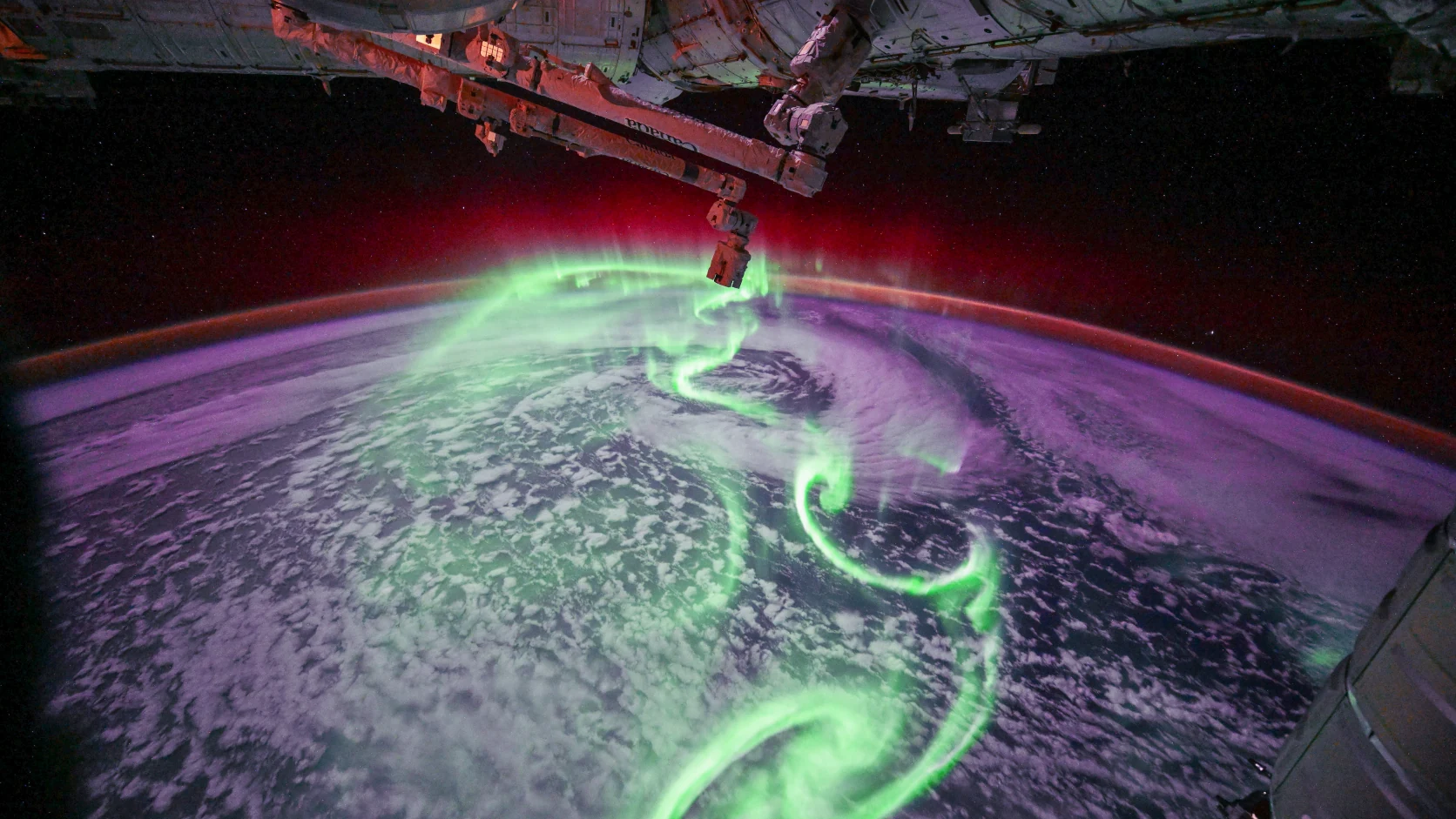
ESA astronaut Sophie Adenot filmed an aurora australis from the International Space Station. Bright green light ripples along the edge of Earth’s nightside atmosphere, framed by city lights and parts of the station.
Key points
- ESA released the official 77-second timelapse on 3 July 2026. It was filmed by French astronaut Sophie Adenot during her εpsilon mission.
- The view brings together city lights on Earth’s nightside, the exterior of the International Space Station and an aurora australis extending along the atmospheric limb.
- The familiar green auroral light is produced mainly by excited oxygen atoms emitting at a wavelength of 557.7 nanometres, typically about 120 to 400 kilometres above the ground.
- Looking obliquely towards Earth’s edge from the ISS at an altitude of about 400 kilometres makes the glowing atmosphere appear as a green ribbon following the planet’s curve.
- Adenot called it the most spectacular aurora of the εpsilon mission so far; the timelapse compresses the changing light and the station’s orbital perspective into a short film.
A bright green band stretches along Earth’s curve, with city lights in the distance and the structure of the International Space Station in the foreground. The European Space Agency (ESA) released the 77-second timelapse on 3 July 2026 and confirmed that it was filmed by French astronaut Sophie Adenot during her εpsilon mission. ESA’s catalogue identifies the display as an aurora australis.
Aurora australis outside the space station window
In the film, green light winds between black space and Earth’s nightside. City lights sweep past below, while parts of the ISS remain close to the camera. The band is smooth at times and rises like a curtain at others, revealing the scale and layers of an aurora as seen from orbit.
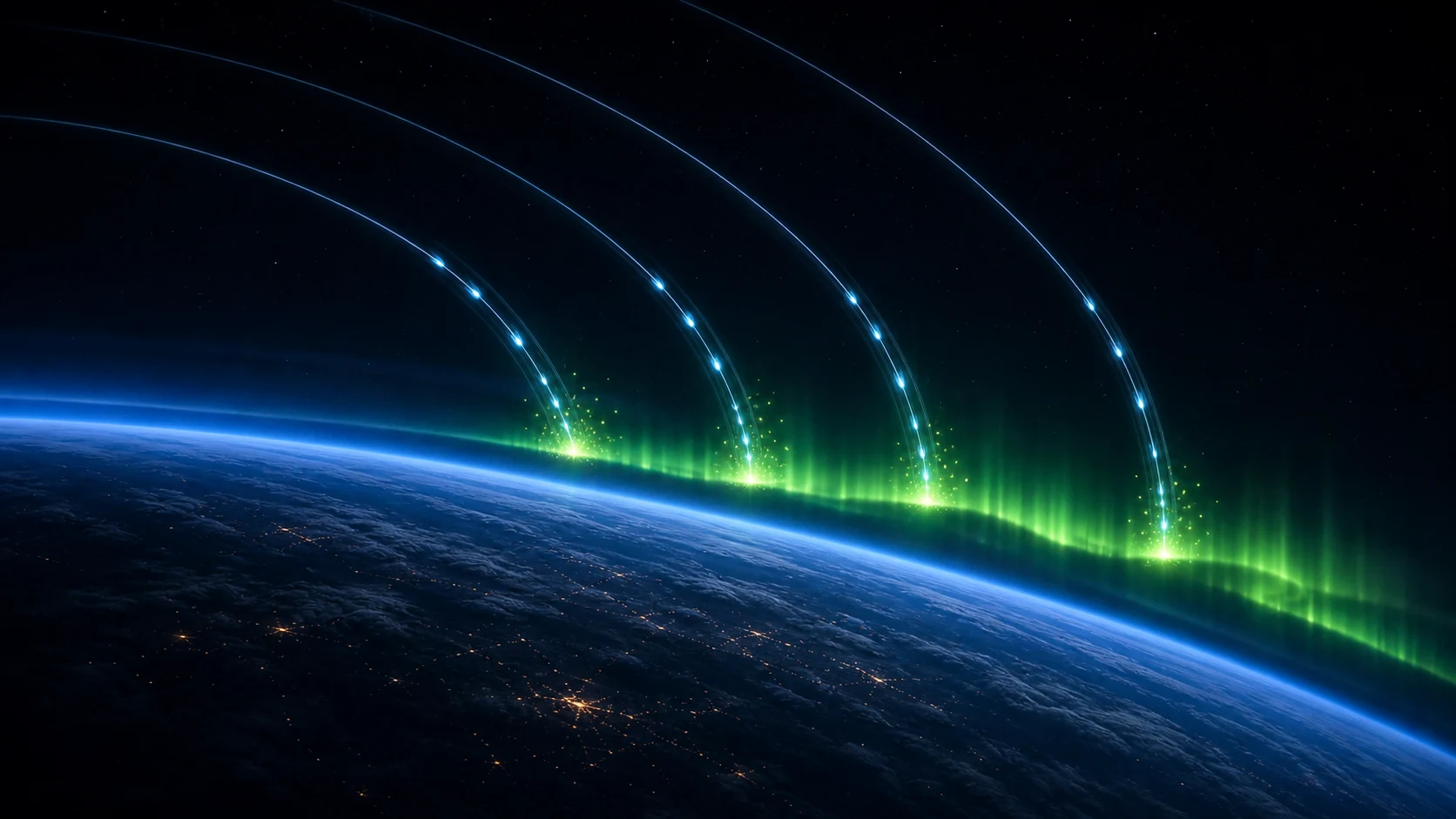
Adenot described it as the most spectacular aurora of the εpsilon mission so far. ESA’s 77-second version preserves the curved Earth, glowing atmosphere and space-station viewpoint she saw in orbit, allowing viewers on the ground to follow this flight across the nightside.
The green ribbon seen from the space station
An aurora is not a solid band of light wrapped around Earth. High-energy electrons from the magnetosphere travel along Earth’s magnetic field into the upper atmosphere, colliding with atoms and molecules and transferring energy to them. When the excited particles return to lower-energy states, they release photons. The US National Oceanic and Atmospheric Administration says the most common pale-green aurora comes from oxygen atoms emitting at 557.7 nanometres, typically at altitudes of about 120 to 400 kilometres.
The ISS itself orbits in low Earth orbit at roughly 400 kilometres. When an observer looks obliquely towards Earth’s edge, the line of sight passes through a long section of the glowing atmosphere. Aurora spread across a broad region can therefore appear as a narrow band hugging the planet’s curve. Overlapping altitudes, brightness levels and viewing angles make it look thick and wavelike. This perspective clearly places the aurora in the atmosphere rather than deep space, but the images alone cannot measure its actual altitude.
ESA labels the video Aurora Australis—the aurora around the southern magnetic polar region. Aurora australis and aurora borealis share the same basic light-producing mechanism, and both form auroral ovals around the magnetic poles. The “green ribbon” is the appearance of one curved section seen from a particular direction; it does not mean that an equally bright band completely encircles Earth.
What the 77-second timelapse reveals
Time-lapse photography plays frames captured at intervals in quick succession, accelerating slow changes into a short film. In this 77-second edit, viewers can watch the aurora’s brightness and shape change repeatedly while sensing how Earth’s surface and atmospheric edge move through the view as the ISS travels along its orbit.
The apparent flow combines changes in the auroral structure driven by the magnetosphere and upper atmosphere, the ISS travelling along its orbit at about 8 kilometres per second, and the compression of time in the edit. ESA has not published the frame interval or total recording time, so the film is best understood as a visual record that brings several kinds of motion together.
Looking back at Earth from orbit
The official footage preserves an unusual view of the aurora australis from orbit: Earth’s curvature, a thin glowing atmosphere, nightside lights and space-station structures all appear in the same frame. Adenot’s timelapse records a memorable observation and makes it easy to see how the aurora belongs to the edge of Earth’s atmosphere, drawing a fluid green outline across the dark nightside.