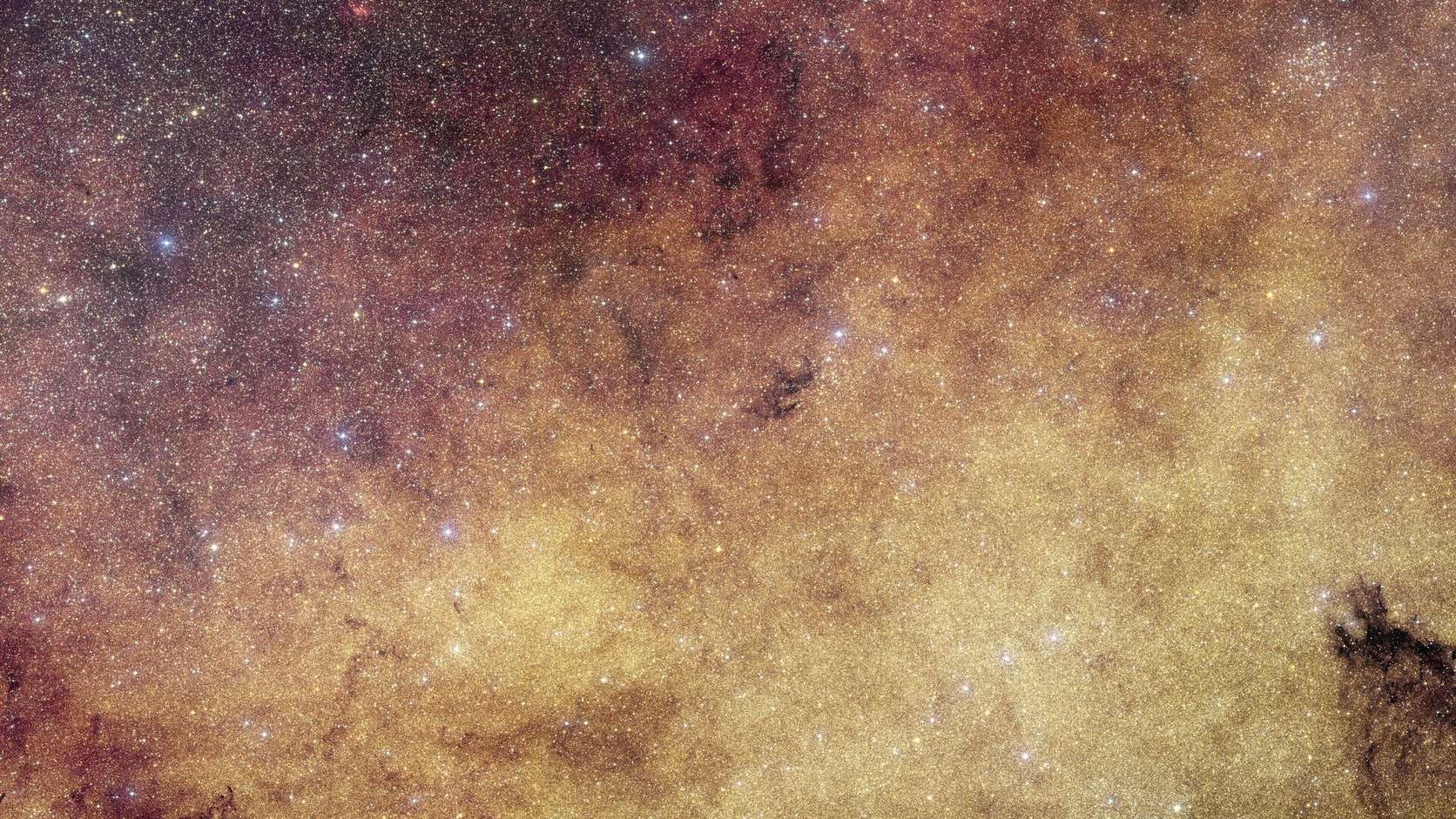
ESA and the Euclid team have released the Q2 quick data set: in March 2025, Euclid used its visible-light instrument to scan nine adjoining fields near the Milky Way’s centre, producing a high-resolution 4.8-square-degree image containing more than 60 million stars. The picture reveals the crowded bulge and gives known and future microlensing planet events an early optical reference point.
Key points
- Euclid Q2 is a dedicated quick release for the Galactic bulge, observed on 23-24 March 2025.
- The public image covers 4.8 square degrees, about 22 full Moons on the sky, and contains more than 60 million stars.
- The observations used Euclid’s VIS visible-light instrument; the science data are monochrome, while the public colour image adds CFHT MegaCam colour observations.
- Euclid’s high-resolution image can serve as an early optical reference for known and future gravitational microlensing events.
- As of 3 September 2026, NASA’s Roman Space Telescope had launched on 30 August, and its later bulge survey will complement Euclid’s data.
The centre of the Milky Way is not just a bright haze. In the Q2 quick data release announced on 24 June 2026, ESA and the Euclid team resolved this direction into stars that can be measured. On 23-24 March 2025, the Euclid space telescope used its VIS visible-light instrument to observe nine adjoining fields near the Galactic bulge, producing a roughly six-billion-pixel image over 4.8 square degrees.
ESA describes it as the largest and most detailed high-resolution visible-light image yet made of the Milky Way’s centre. The view contains more than 60 million stars and spans an area about the size of 22 full Moons. The bulge is dominated by older, cooler stars, giving the public image its gold-to-ochre colours; the dark patches are not empty space but foreground molecular clouds whose dust absorbs and scatters the starlight behind them.
One Day, Nine Star Fields
The Q2 paper notes that this Galactic bulge survey used a strategy outside Euclid’s usual cosmology survey. Each of the nine main fields was observed with 16 exposures of 400 seconds, with extra calibration fields used to build point-spread-function models. The team used VIS only, not the near-infrared NISP instrument, to preserve the highest spatial resolution for future measurements of stellar positions and relative proper motion.
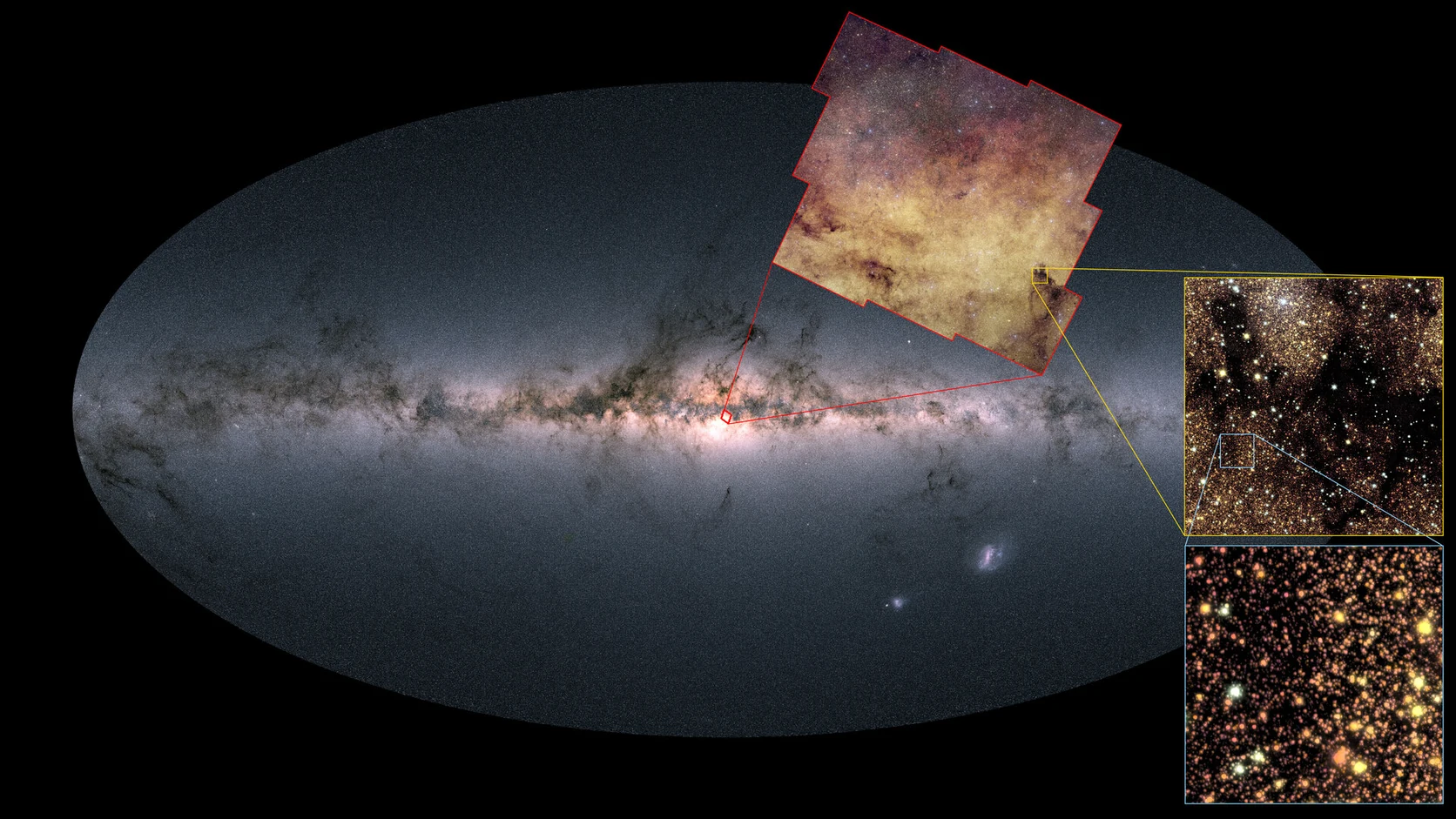
Because VIS is a monochrome instrument, the science data themselves are primarily black and white. The colours in the public image come from supplementary u-, g- and r-band observations made in summer 2025 with MegaCam on the Canada-France-Hawaii Telescope. Those colours help readers separate old bulge stars, blue young stars, red ionised hydrogen gas and dark molecular clouds, but they are a visual layer added to Euclid’s high-resolution visible-light image.
Waiting for Starlight to Brighten
The scientific focus of this star map is gravitational microlensing. When a nearer star passes in front of a background star, the foreground object’s gravity acts like a small cosmic magnifier, bending the background starlight and briefly making it brighter. If the foreground star has a planet, the planet’s gravity can add a smaller irregular feature to the light curve, allowing astronomers to infer the planet’s presence and mass ratio.
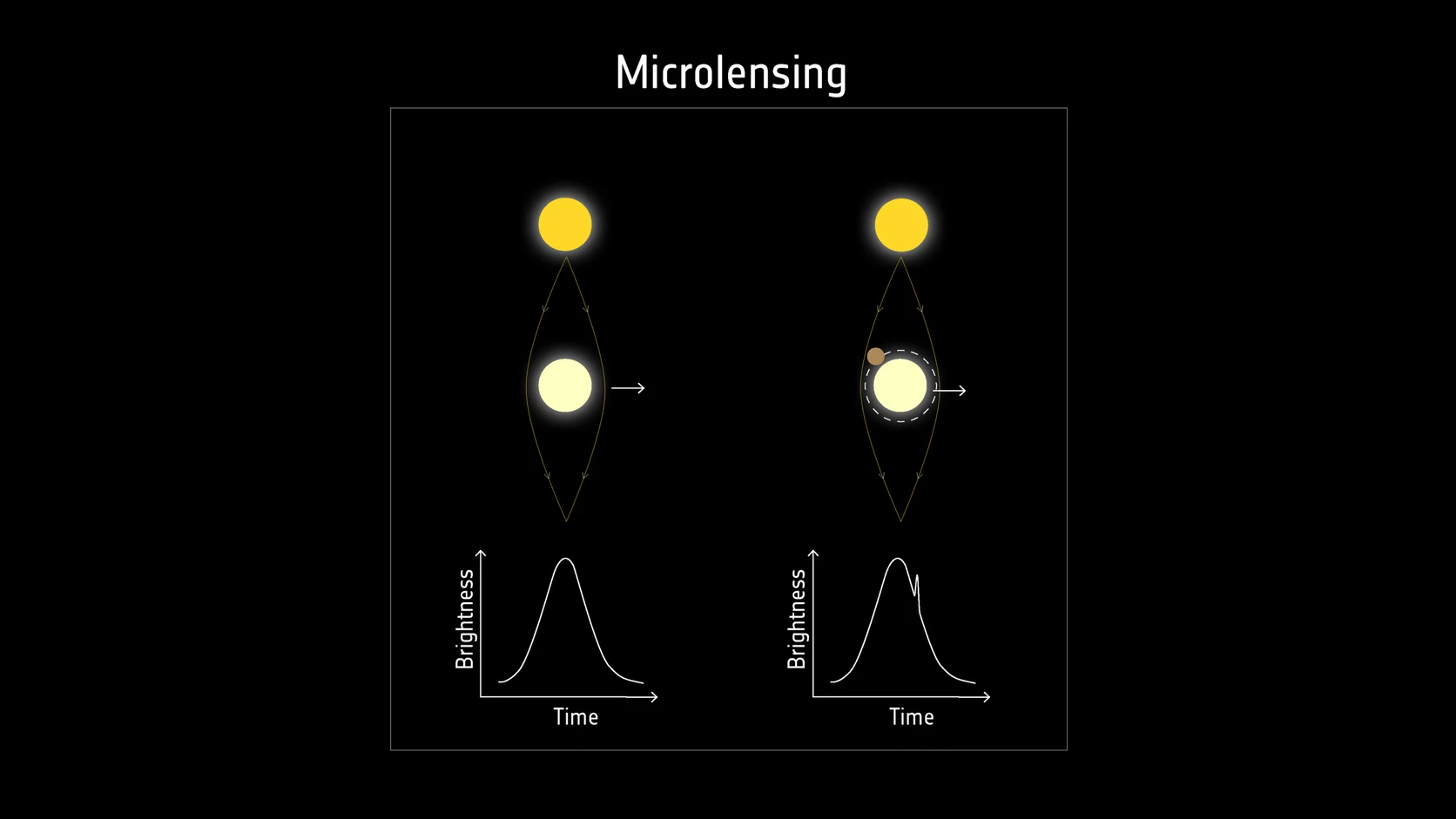
The direction of the Milky Way’s centre is packed with stars, so these chance alignments are more common than in sparse regions of the sky. The Q2 paper lists 7,801 microlensing events within the Euclid bulge survey footprint up to 2023, including 51 published planetary systems. The roughly one-day Euclid image is therefore like a sharp, time-stamped earlier view: if starlight brightens in the same region later, researchers can compare back to the pre-event field, separate the source star from the lens star after they drift apart, and use relative motion plus lens brightness to infer physical mass. The paper identifies this as a route to lens-mass measurements with roughly 10% precision or better in some cases.
That early reference is especially important for the Roman Space Telescope. When Q2 was released, the paper still described Roman as an upcoming mission; as of 3 September 2026, NASA had successfully launched the Nancy Grace Roman Space Telescope on 30 August 2026, and the spacecraft was beginning its roughly three-month journey and commissioning phase toward the L2 region. Roman will later monitor the Galactic bulge for long periods in near-infrared light, while Euclid supplies a high-resolution visible-light reference from before many events occur.
A Dark-Universe Mission Looks Homeward
Euclid’s main mission is to measure the shapes and distances of faraway galaxies and the large-scale structure of the Universe, tracing how dark matter and dark energy affect cosmic evolution. Q2 turns the same wide-field, high-resolution capability inward: instead of looking only at galaxies billions of light-years away, Euclid peers through dust and spiral arms toward the Milky Way’s bulge, about 26,000 light-years from Earth.
The Q2 products include calibrated single-dither images, dedicated point-spread-function models, and photometric and astrometric catalogues with about 45 million detected sources per dither. The paper also warns that the bulge is extremely crowded and that the catalogues remain incomplete in the densest regions. Any rigorous statistical use must handle blending, extinction and calibration limits. In other words, this is a powerful foundation data set, not a final star catalogue that solves every problem at once.
The beautiful “gold dust” view is only the entry point. The deeper value is that it fixes the crowded heart of the Milky Way at a revisitable, comparable high-resolution moment. If Roman or ground-based surveys later find more cold planets, free-floating planets or microlensing signals from known planets in the same region, this Euclid image will help researchers tell which star was in front, which was behind, and how massive the planet really is.