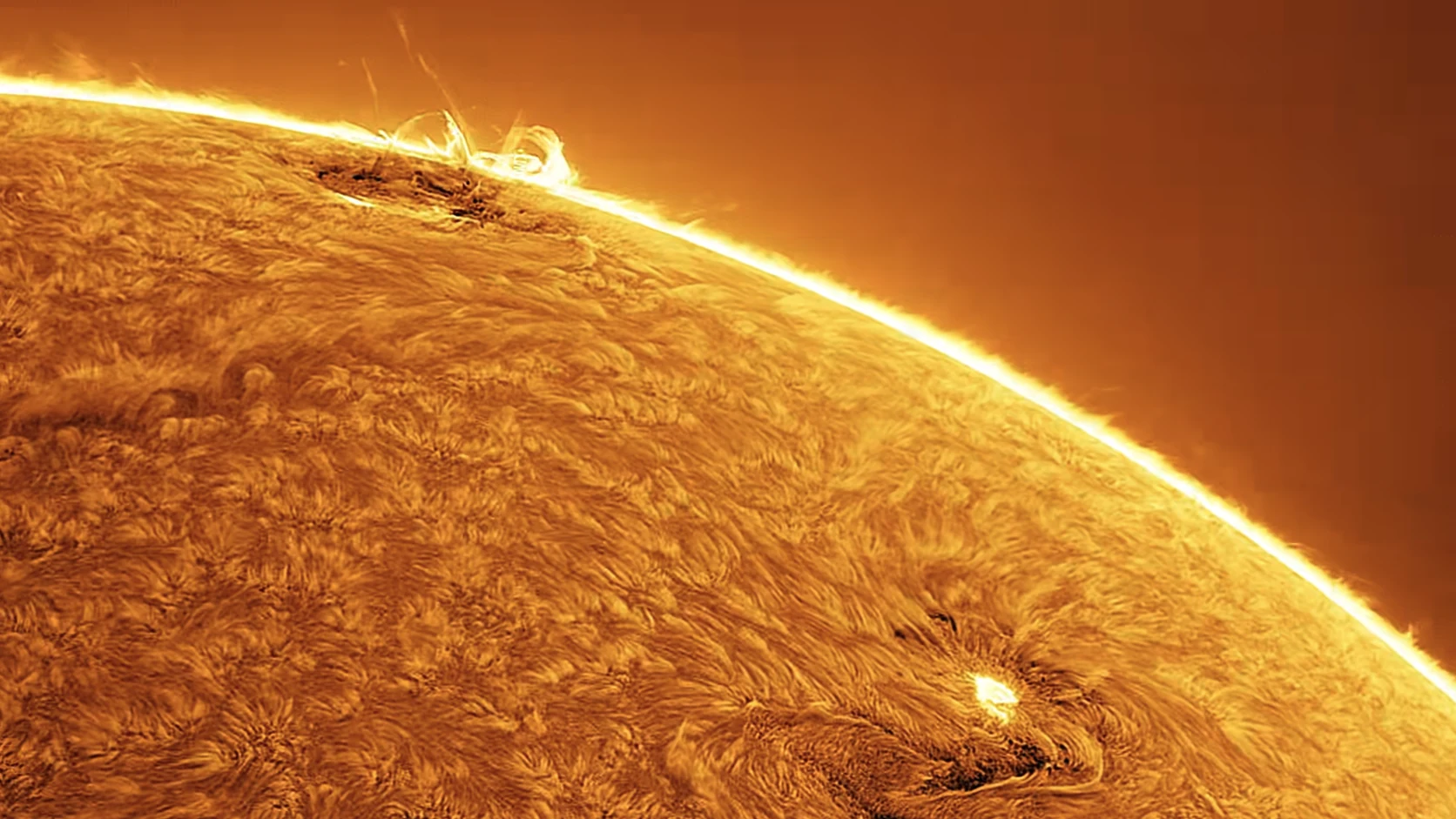
Astronomy channel DudeLovesSpace filmed the same active region with two H-alpha solar setups, then combined the close-up and full-disc views into an 18-second timelapse. The finished video runs at about 280 times real time and was colourised in post-production; the uploader also notes that the Earth graphic should be half its displayed size.
Key points
- DudeLovesSpace published the 18-second Short on 21 October 2025, moving from a close-up of the solar limb to the complete disc.
- The “extreme zoom” was assembled from two telescopes recording the same active region, not from one lens changing focal length continuously.
- Both the close-up and full-disc setups used a DayStar Quark Chromosphere H-alpha filter; the finished video was colourised and plays at about 280 times real time.
- Narrowband H-alpha observation highlights the chromosphere, prominences and filaments; this video alone is not enough to confirm a specific flare event.
- The uploader says the Earth shown at 0:14 is too large and should be half the diameter; NASA data put the Sun at about 109 Earth diameters.
- The soundtrack uses sonified Parker Solar Probe data, not ambient sound recorded by an ordinary microphone in space.
The camera begins tight on the solar limb: bright prominences arch against black space while the chromosphere resembles a field of constantly shifting fibres. The view then pulls back until the full disc hangs in the centre. Astronomy channel DudeLovesSpace edited the observation into an 18-second Short, taking the same active region from an extreme close-up to a full-disc view.
The “extreme zoom” is a relay between two telescopes
According to the video description, the close-up was captured with a 120 mm f/8 Sky-Watcher EvoStar refractor, a DayStar Quark Chromosphere solar filter and a ZWO ASI432MM camera. The full-disc view used a 60/240 mm f/4 finder scope with the same filter and camera. Both setups targeted the same active region, and their different fields of view were joined in post-production. The apparent pullback is therefore an edit, not a continuous optical zoom during recording.
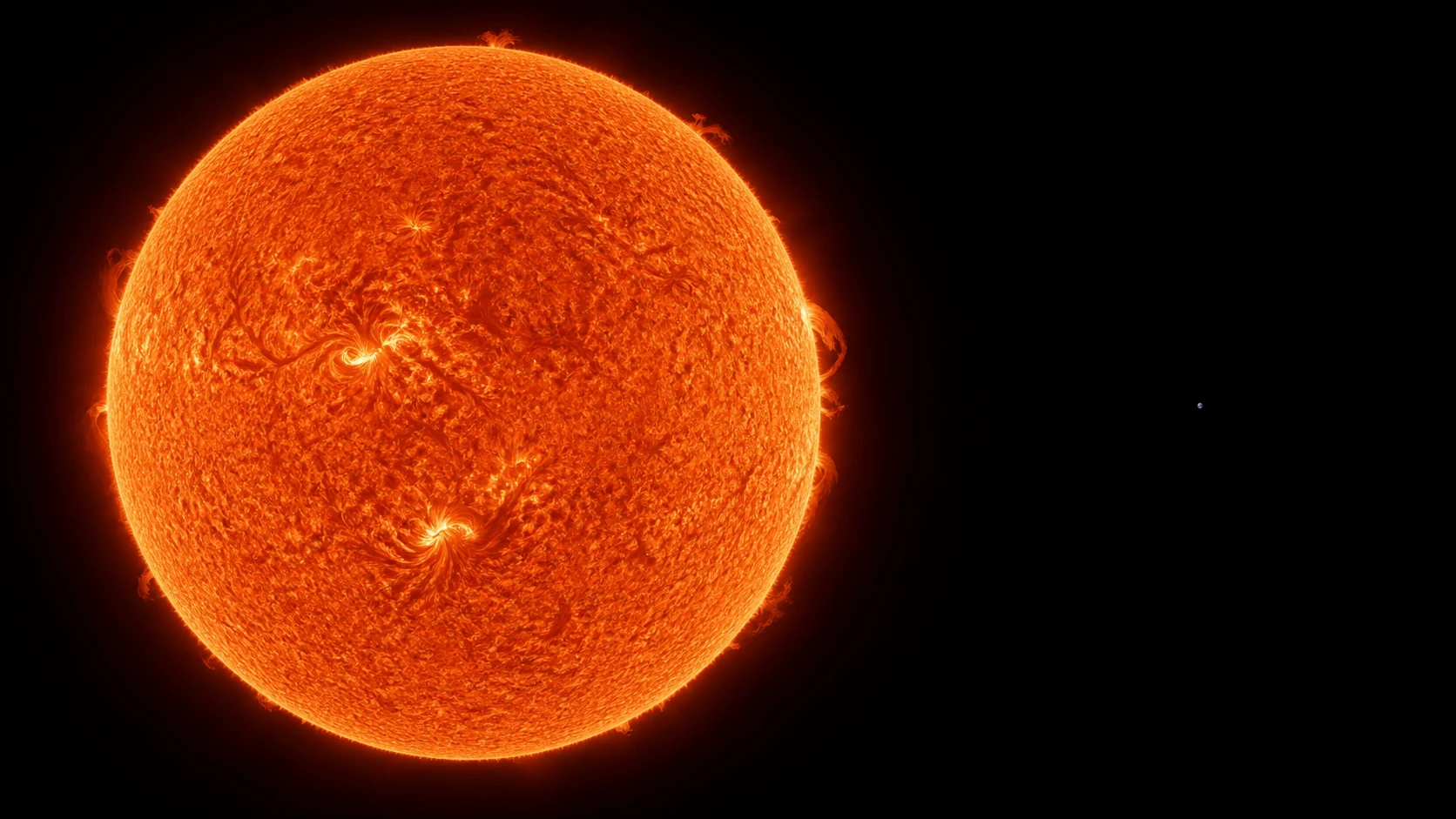
The creator captured the footage with FireCapture, stacked frames in AutoStakkert 4, enhanced detail in ImPPG, stabilised and edited the sequence in After Effects, and added colour with PixInsight’s SolarToolBox. The final cut plays at roughly 280 times real time. The prominences and chromospheric structure come from observational data, but their apparent speed and orange-gold appearance reflect time compression and visual processing.
H-alpha brings out the chromosphere and prominences
DayStar’s product information says the Quark Chromosphere is designed for solar H-alpha observing, with optical coatings centred near the 656-nanometre hydrogen line. The Chromosphere version aims for higher surface contrast while retaining prominences. This narrowband view suppresses much of the other visible light, making the Sun’s thin chromosphere, dark filaments across the disc and prominences extending beyond the limb easier to distinguish.
NASA describes a prominence as relatively cool, dense solar material suspended by strong local magnetic fields; when the same structure is projected against the bright disc, it is usually called a filament. The video shows arcing material above the limb and narrow dark features across the disc. Its description also uses the phrase “solar flares”, but identifying a particular flare requires brightness, wavelength and timing measurements. This article therefore limits itself to the chromosphere, prominences and filaments directly supported by the images.
The Earth at 0:14 should be half the size
Near 0:14, the video adds an Earth graphic for scale. The uploader explicitly notes that it is too large and should be half the diameter. NASA lists the Sun’s diameter at about 1.4 million kilometres and Earth’s equatorial diameter at 12,756 kilometres, a ratio of about 109.7. In other words, roughly 109 Earths would fit across the Sun’s diameter.
That ratio also explains why a prominence covering only a short arc of the solar limb can still span several Earth diameters. The Short’s strength is not a single dramatic number, but the way it places close-up detail and a full-disc view on one visual path. Once the Earth graphic is corrected, the sense of scale becomes even clearer.
The sound is data sonification, not an ambient recording in space
The creator says the soundtrack was made from NASA Parker Solar Probe audio. NASA explains that the spacecraft’s instruments record particles in the solar wind and changes in electric and magnetic fields over time; scientists can map those plasma-wave measurements into frequencies audible to human ears. The sound in the video is therefore a sonification of data, not “the sound of the Sun” captured by an ordinary microphone in a vacuum.
Solar observing requires a dedicated filter
This footage relies on an H-alpha system designed specifically for the Sun; it was not made by pointing an ordinary telescope directly at it. Without a compliant, undamaged and correctly installed solar filter, eyes, cameras and telescopes can suffer permanent damage in a very short time. Sky-Watcher’s safety guidance likewise warns that improper solar observing can cause severe and permanent eye injury. Any real observation should use a complete purpose-built system and follow every manufacturer instruction.
After narrowband filtering, stacking, stabilisation, time compression and colourisation, this 18-second video brings together two kinds of information that are difficult to show at once in amateur solar imaging: the fine structure of an active region and its size relative to the whole Sun. It is not a new scientific discovery, but it is a direct observational record with a traceable equipment and processing workflow—and a compact visual journey through the dynamics and scale of our star.