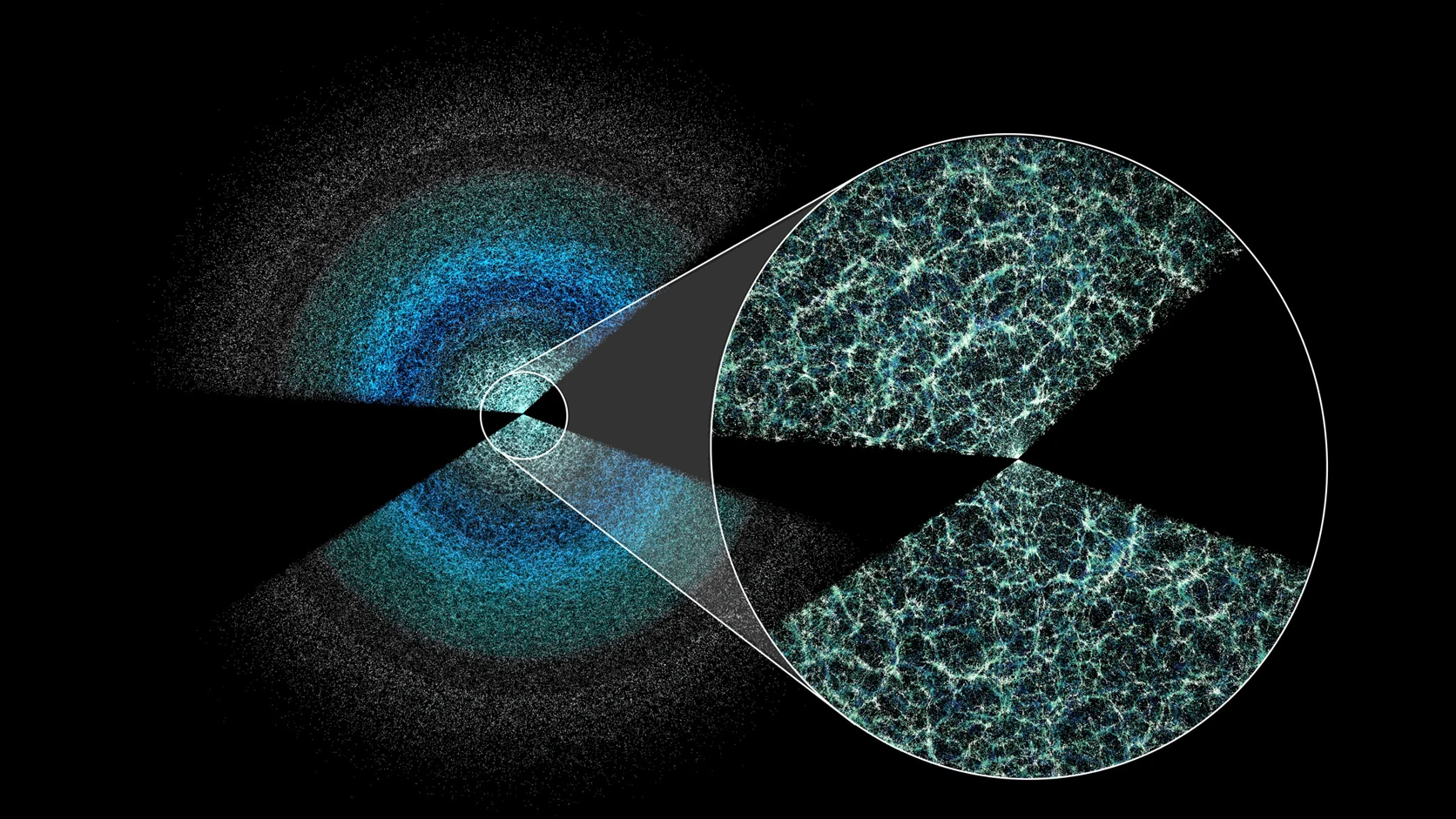
DESI has completed its originally planned five-year 3D map of the universe. The data set is large enough to test hints that dark energy may evolve, but it is not yet a discovery that dark energy changes.
Key points
- DESI announced on 15 April 2026 that it had completed the planned sky area for its original five-year 3D map.
- The survey has measured spectra for more than 47 million galaxies and quasars, above the original 34 million target.
- The map traces large-scale structure through about 11 billion years of cosmic history.
- Hints that dark energy may evolve remain provisional and depend on combined data sets, not DESI alone.
- DESI will keep observing until 2028, extending the survey from about 14,000 to 17,000 square degrees.
The newest three-dimensional base map of the universe is now large enough to press one of cosmology’s biggest questions again: what is dark energy doing over time? In April 2026, the Dark Energy Spectroscopic Instrument, or DESI, announced that it had completed the sky area planned for its original five-year survey. The result is one of the largest and highest-resolution 3D cosmic maps yet made.
A five-year survey beyond its target
DESI was designed to measure 34 million galaxies and quasars across about two-thirds of the northern sky. It finished the planned observing footprint early and has already collected spectra for more than 47 million galaxies and quasars, along with more than 20 million Milky Way stars. Berkeley Lab says the survey now contains many times more cosmological measurements than all previous similar surveys combined.
The important product is not a single pretty picture. Each spectrum turns a flat sky position into a redshift distance, so galaxies and quasars become three-dimensional tracers of the universe’s expansion history. In the official thin-slice view, Earth sits at the centre of the fan; the farthest points show light that has travelled about 11 billion years.
Spectra pull the sky into depth
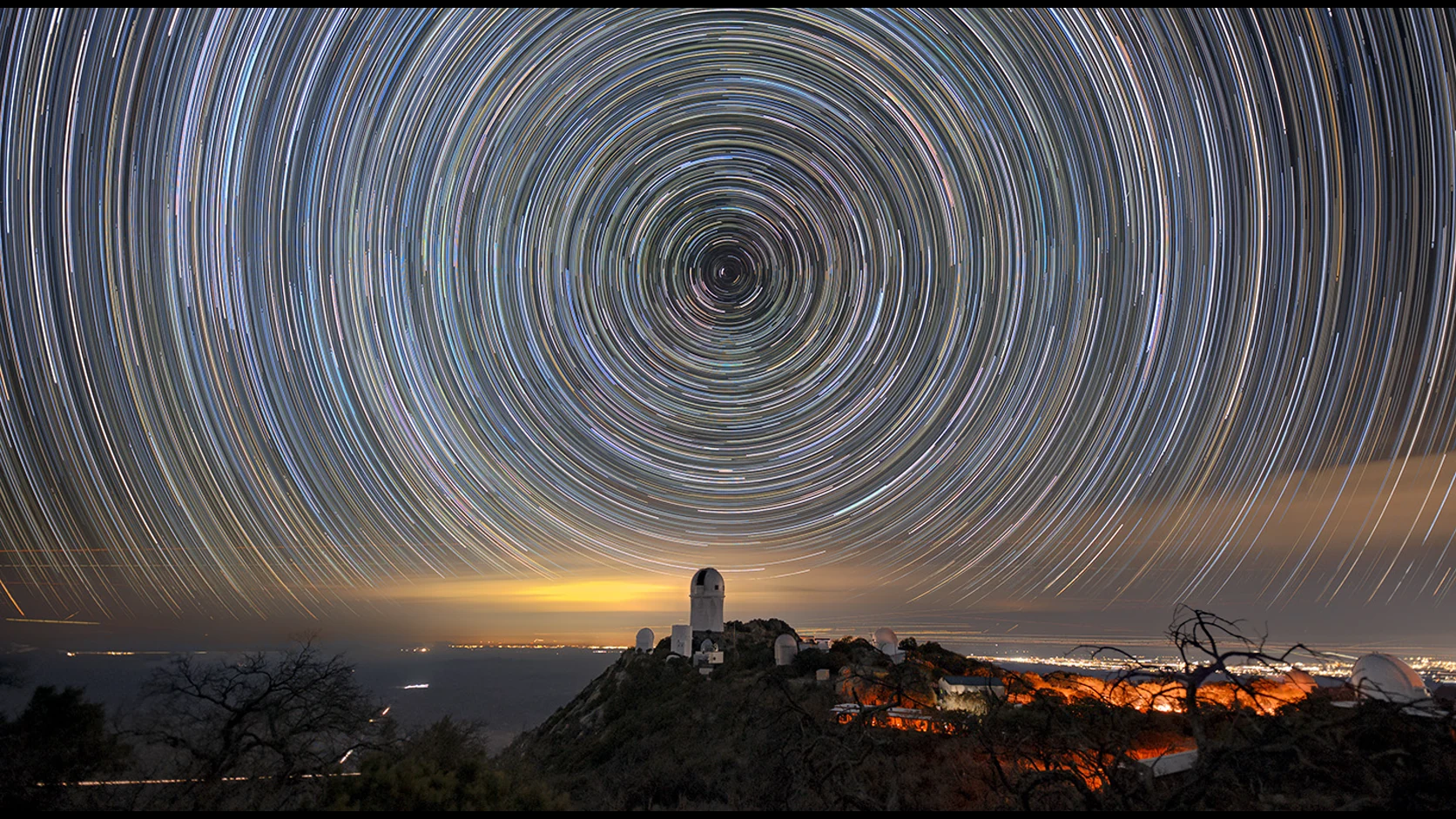
DESI sits on the Nicholas U. Mayall 4-meter Telescope at Kitt Peak in Arizona. Five thousand robotic positioners place optical fibres onto selected targets, and ten spectrographs split the collected light into wavelengths. Those spectra reveal redshift and other physical information, while nightly data are transferred to Berkeley Lab’s NERSC supercomputing centre for processing.
Cosmologists use the pattern of galaxy clustering as a standard ruler. Baryon acoustic oscillations left a preferred statistical scale in the distribution of matter. Measuring that scale at different distances, and therefore different cosmic ages, helps reconstruct expansion history and constrain dark energy.
The dark-energy clue is not a verdict yet
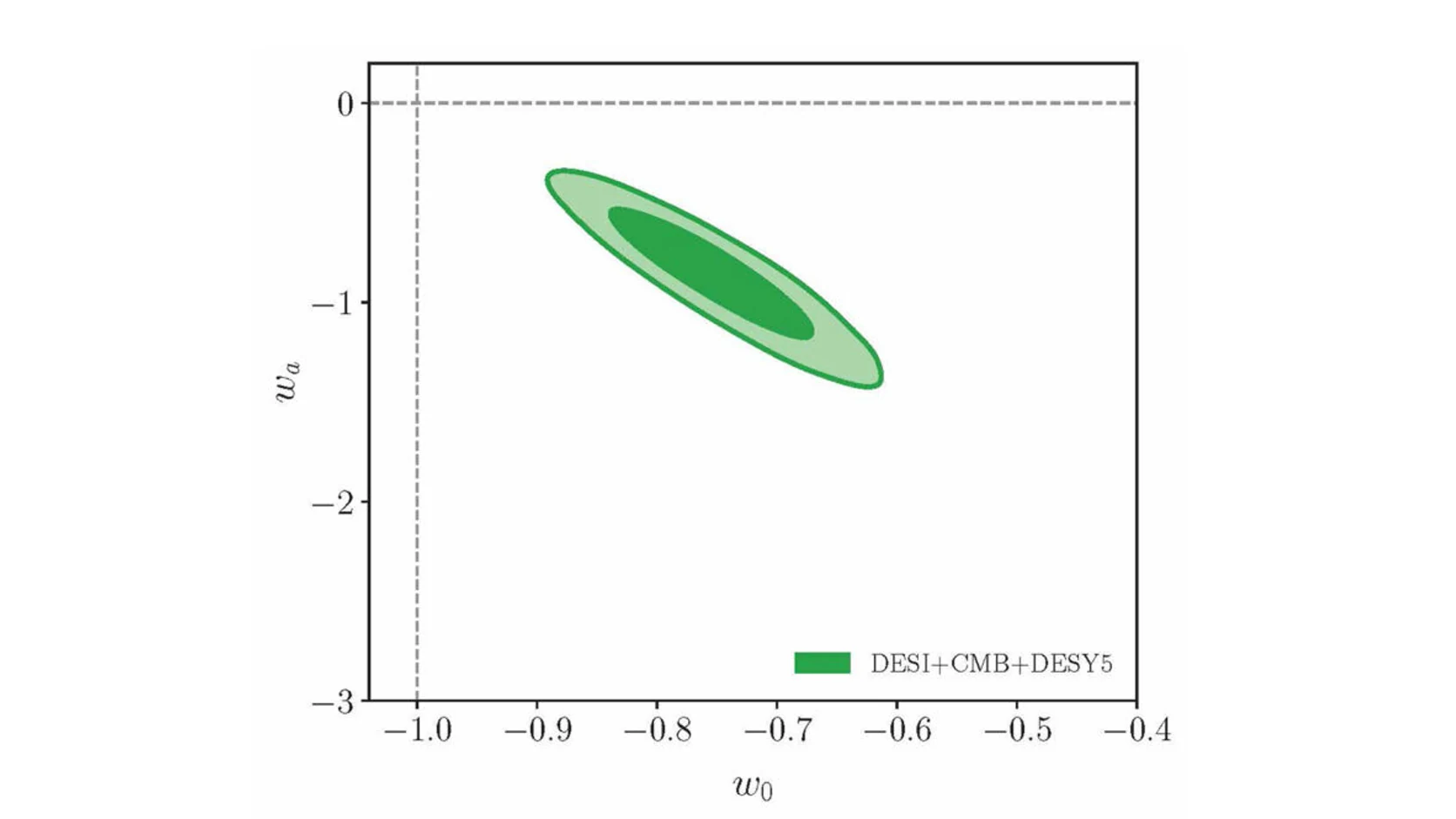
DESI’s first three years of data have made the debate livelier. When combined with cosmic microwave background, supernova and weak-lensing measurements, some data combinations prefer models in which dark energy evolves with time. But DESI data on their own still remain compatible with the standard Lambda CDM model, and the combined evidence is not a five-sigma discovery.
The map is finished; the survey is not
The team will now process the complete five-year data set, with the first full five-year dark-energy results expected from 2027. DESI will also keep observing until 2028, extending its area from about 14,000 to 17,000 square degrees and aiming for roughly 63 million extragalactic redshifts.
That extended work will reach closer to the Milky Way plane and farther south, revisit existing fields, and study dwarf galaxies and stellar streams around the Milky Way. The completed map therefore sharpens the next questions rather than closing them: does accelerated expansion require evolving dark energy, and how does dark matter shape small-scale cosmic structure?