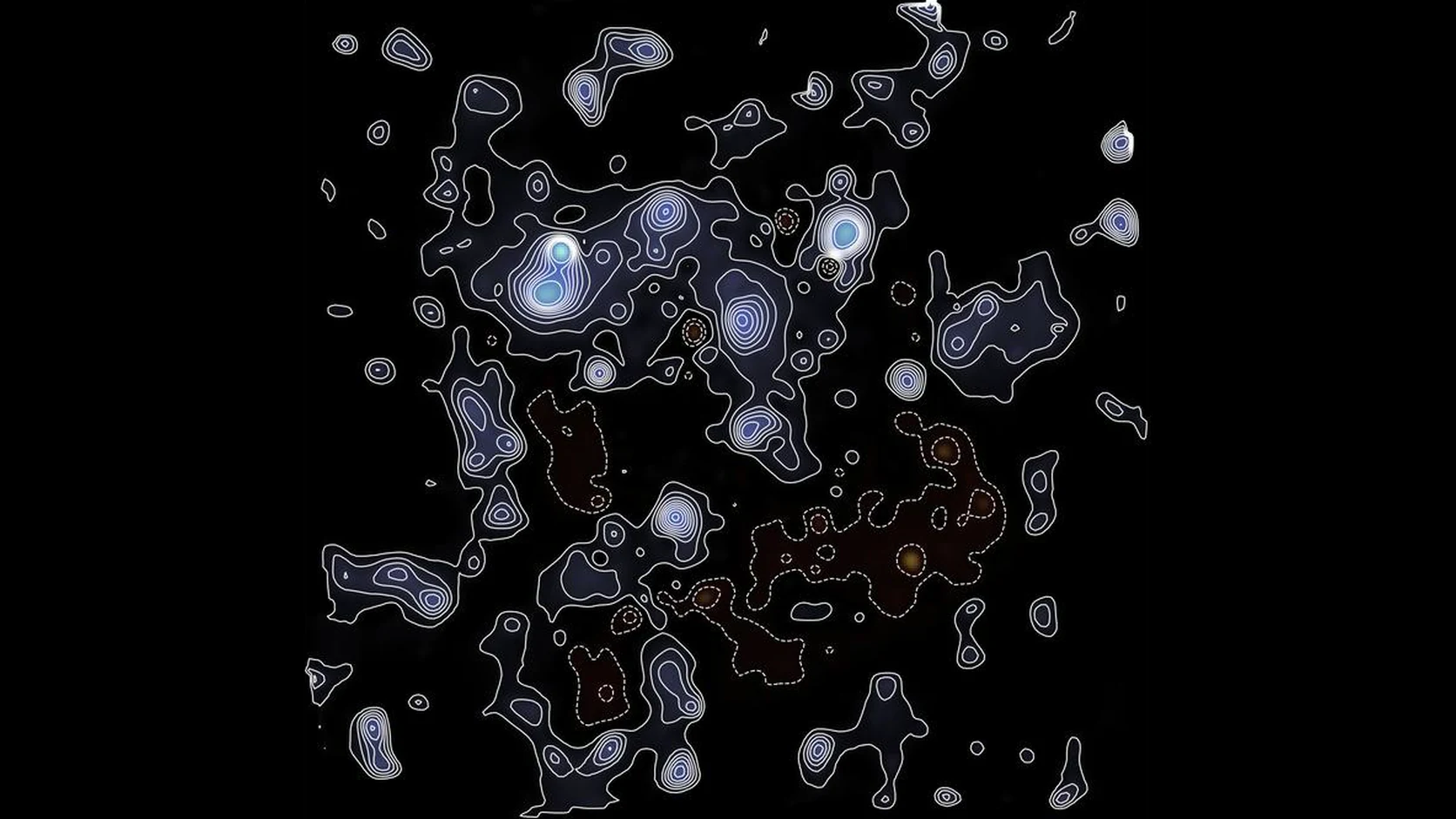
Researchers used the shapes of nearly 800,000 galaxies in Webb COSMOS-Web images to reconstruct a dark-matter mass map sharper than earlier Hubble maps. The map clarifies how galaxies trace an unseen cosmic scaffold, while the dark-matter particle itself remains unidentified.
Key points
- Nature Astronomy published the 41-author study “An ultra-high-resolution map of (dark) matter” on 26 January 2026.
- The team used JWST COSMOS-Web imaging to measure about 129 usable galaxy shapes per square arcminute and reconstruct a 0.77-by-0.70-degree weak-lensing mass map.
- NASA/JPL describes the field as nearly 800,000 galaxies across about 2.5 full Moons, built from roughly 255 hours of Webb observing time.
- The paper reports an angular resolution of 1.00 ± 0.01 arcminutes, more than twice the resolution of earlier Hubble mass maps, and traces mass features to about redshift z = 2.
- The map supports the view that dark matter and ordinary matter co-evolve along clusters, filaments and lower-density regions, but it does not reveal the particle nature of dark matter.
Dark matter is still invisible, but the scaffold it pulls through the universe has become a little sharper. Diana Scognamiglio, Gavin Leroy, David Harvey and 38 other researchers report in Nature Astronomy that they used James Webb Space Telescope COSMOS-Web survey images to reconstruct a high-resolution weak-lensing mass map. The map does not photograph dark matter directly; it infers where mass lies from the tiny distortions imposed on background galaxy images as light travels toward us.
The field lies in the COSMOS region toward Sextans and covers 0.77 by 0.70 degrees, about 0.54 square degrees. NASA/JPL describes it as roughly 2.5 full Moons on the sky and says the image set includes nearly 800,000 galaxies. Webb’s NIRCam observed this region for about 255 hours, bringing some galaxies into this kind of mass map for the first time.
Webb makes the COSMOS field denser
Weak gravitational lensing depends on statistics across many galaxies. A single galaxy can be elliptical, twisted or irregular for its own reasons, so it cannot by itself reveal the foreground mass. But when thousands of background galaxies show a minute, coherent shear pattern in the same direction, researchers can infer the total mass that bent their light. That mass includes stars and gas, but also dark matter: material that does not emit, absorb or reflect ordinary light and is mainly known through gravity.
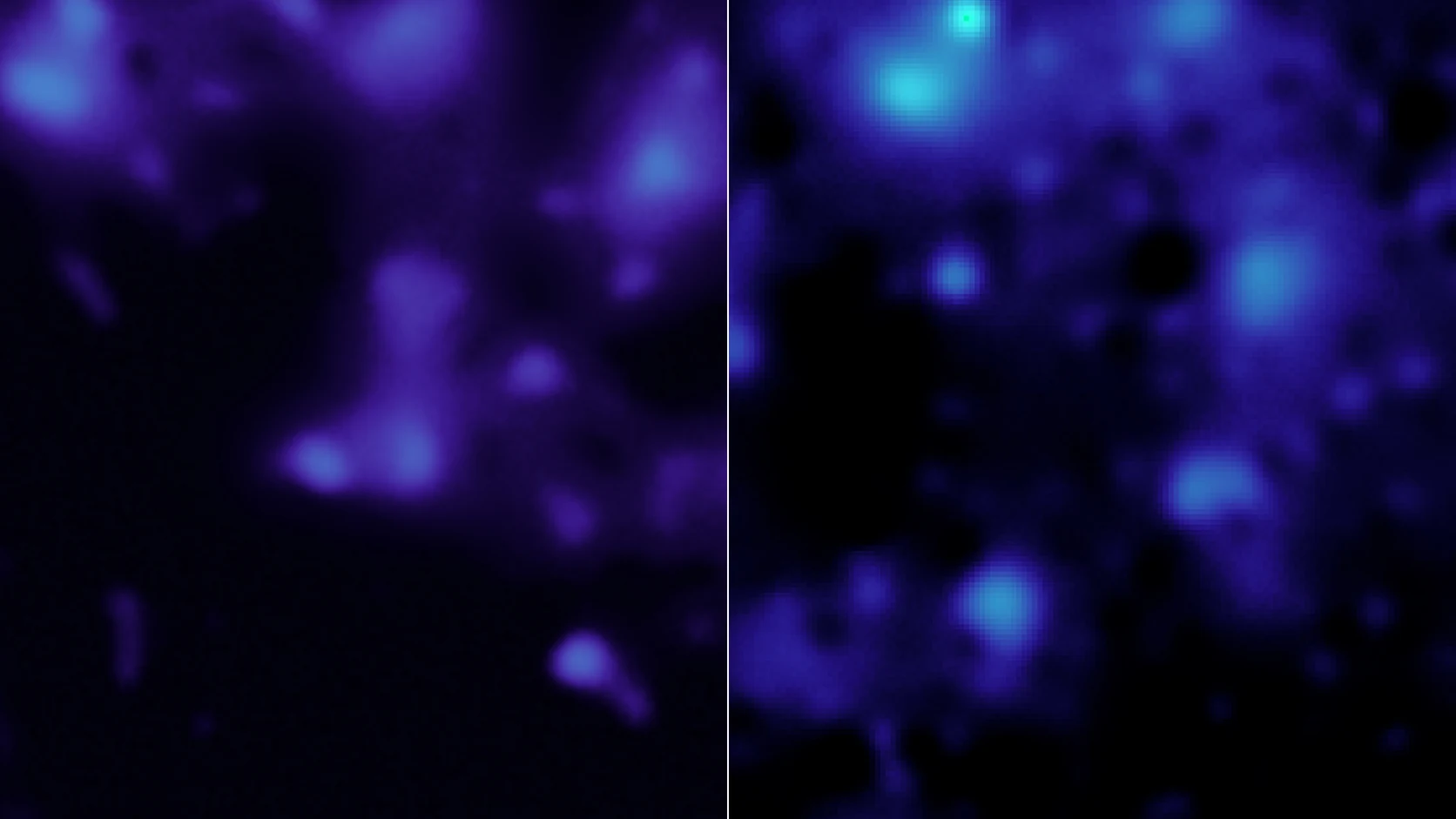
The paper reports about 129 usable galaxy-shape measurements per square arcminute in this field, with many targets measured independently in the F115W and F150W near-infrared bands. The resulting mass reconstruction reaches an angular resolution of 1.00 ± 0.01 arcminutes, more than twice that of earlier Hubble Space Telescope mass maps of the same region. NASA/JPL also notes that the Webb map includes about 10 times as many galaxies as ground-based maps and about twice as many as the Hubble map.
Blue is not the colour of dark matter
Public images often show high-density dark-matter regions in blue. That colour is a visualization choice, not a sign that dark matter glows blue. The core measurement is the weak-lensing shear in galaxy shapes, which is then converted into a mass map by reconstruction methods. In other words, the galaxy images provide gravitational clues; the map shows the inferred surface density of mass.
This indirect approach is central to dark-matter science. Ordinary matter accounts for only about one sixth of all matter in the universe; the rest is dark matter, which ordinary telescopes cannot see the way they see stars, dust or gas. Webb helps by combining infrared sensitivity with sharp imaging, allowing fainter, more distant and dust-obscured galaxies to enter the shape catalogue and making the background-galaxy grid denser.
The cosmic web lines up more clearly
The new map shows high-density dark-matter regions, galaxy clusters and lower-density filamentary structures linking together into the cosmic web. The paper says the map can trace mass features out to about redshift z = 2, with the clearest far structures near z = 1.1. That reaches galaxy environments around the era when cosmic star formation was near its peak, letting the team compare how dark matter and luminous matter evolve together in clusters, filaments and low-density regions.
NASA/JPL describes this picture as dark matter providing a large-scale scaffold for ordinary matter. The claim rests on gravitational-evolution models and on the alignment between the mass map and the galaxy distribution: where massive galaxy clusters appear, substantial dark matter is usually present too; where ordinary matter stretches along narrow links between clusters, the dark-matter map shows corresponding filaments. The result supports the standard view that dark matter gathers first and then helps pull ordinary matter into galaxies and stars.
It still cannot say what dark matter is
The importance of this map is not that it finally identifies the dark-matter particle. It fixes the locations and details of the dark-matter distribution more precisely. Those structures become benchmarks for testing cold dark matter, warm dark matter and other models. If competing theories predict subtly different filaments, cluster edges or low-density voids, higher-resolution mass maps have more power to distinguish them.
Future work will need to combine Webb’s small-area, high-detail maps with much wider surveys. NASA/JPL notes that the Nancy Grace Roman Space Telescope should map dark matter over a sky area 4,400 times larger than COSMOS, though not at Webb’s spatial resolution. Webb supplies a finely detailed sample; broader surveys will test how representative that sample is across the universe.
The paper also states that JWST, HST, XMM-Newton, Chandra and weak-lensing mass-map products are released as public data or supplementary material. That allows other teams to repeat the analysis, compare galaxy types with dark-matter environments, or connect the map to new cosmological models. Dark matter itself remains mysterious, but Webb has drawn its place in the cosmic web more sharply than before.