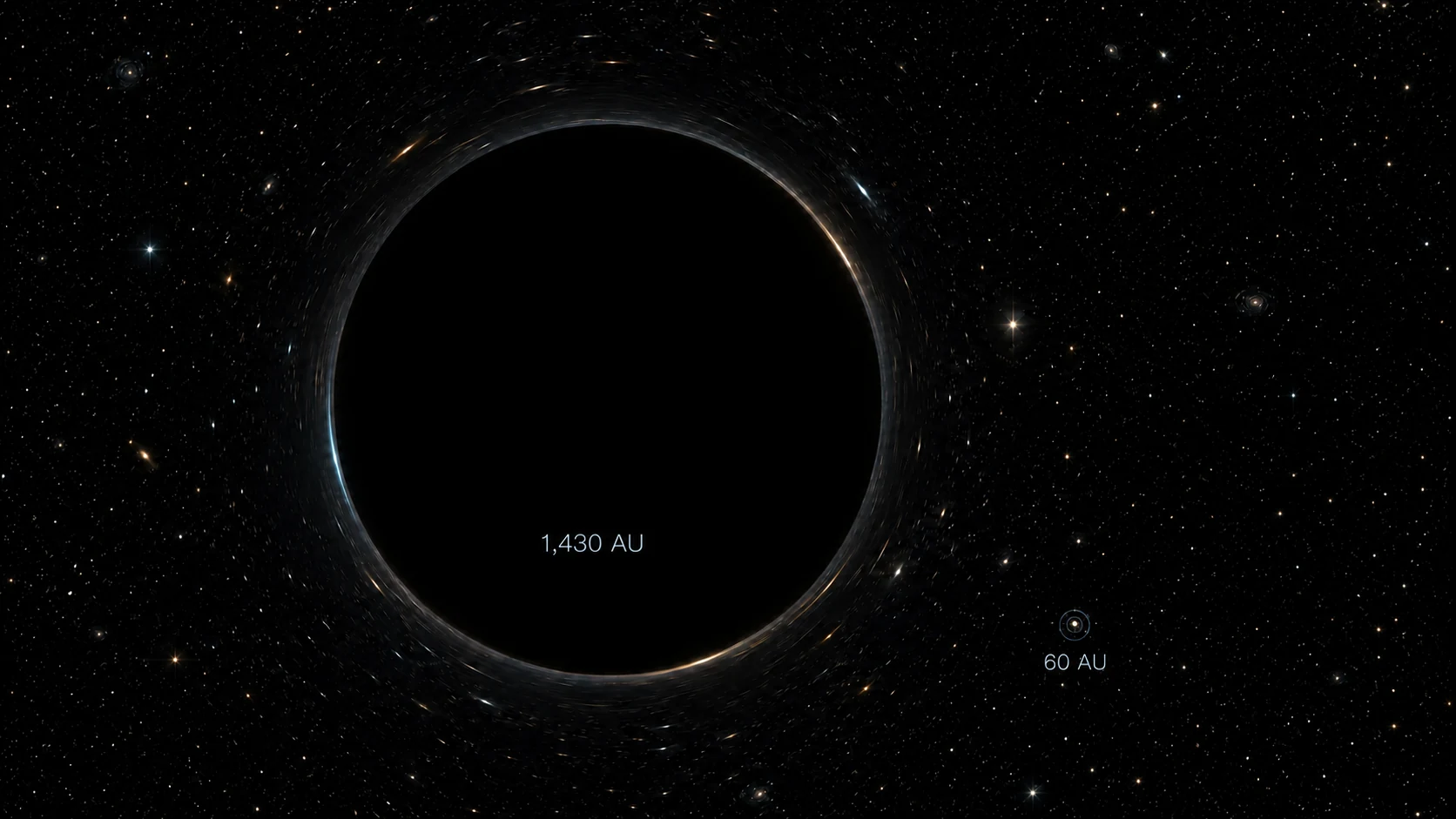
Astronomers used strong gravitational lensing and two-dimensional stellar dynamics to constrain the central mass of the Cosmic Horseshoe lens galaxy, about five billion light-years away. They infer a black hole of roughly 36 billion solar masses. Models with a central black hole are favoured at more than 5σ, demonstrating a way to weigh distant, weakly accreting black holes.
Key points
- The study jointly fits Hubble Space Telescope images and VLT/MUSE integral-field spectroscopy, combining strong gravitational lensing with two-dimensional stellar dynamics.
- The fiducial model gives log10(MBH/M☉)=10.56, or about 36 billion solar masses, with statistical uncertainties of +0.07/−0.08 dex and an additional ±0.12 dex systematic uncertainty.
- Bayesian evidence favours a model with a central black hole over one without it at more than 5σ; alternative mass-distribution assumptions broadly converge on compatible results.
- The mass is inferred from the black hole’s gravitational effects on light paths and stellar velocities, not from a directly resolved image of the event horizon.
- It is among the heaviest black holes measured. Comparing methods and their uncertainties together is essential when mapping the extreme high-mass end of the black-hole population.
A massive foreground galaxy at redshift z=0.44, about five billion light-years from Earth, bends light from a more distant galaxy into an almost complete horseshoe-shaped Einstein ring—hence the name Cosmic Horseshoe. Carlos R. Melo-Carneiro, Thomas E. Collett and colleagues report that the foreground galaxy needs a central black hole of roughly 36 billion solar masses to explain both the lensing images and the stellar-motion data.
How two gravitational signals weigh the black hole together
The team used high-resolution Hubble Space Telescope images and integral-field spectroscopy from the MUSE instrument on ESO’s Very Large Telescope. Hubble records the positions and shapes of two background sources after the foreground galaxy bends their light; MUSE separates the host galaxy’s spectrum across the sky to build a two-dimensional stellar-kinematics map. The paper measures an effective stellar velocity dispersion of 366 ± 6 km/s.
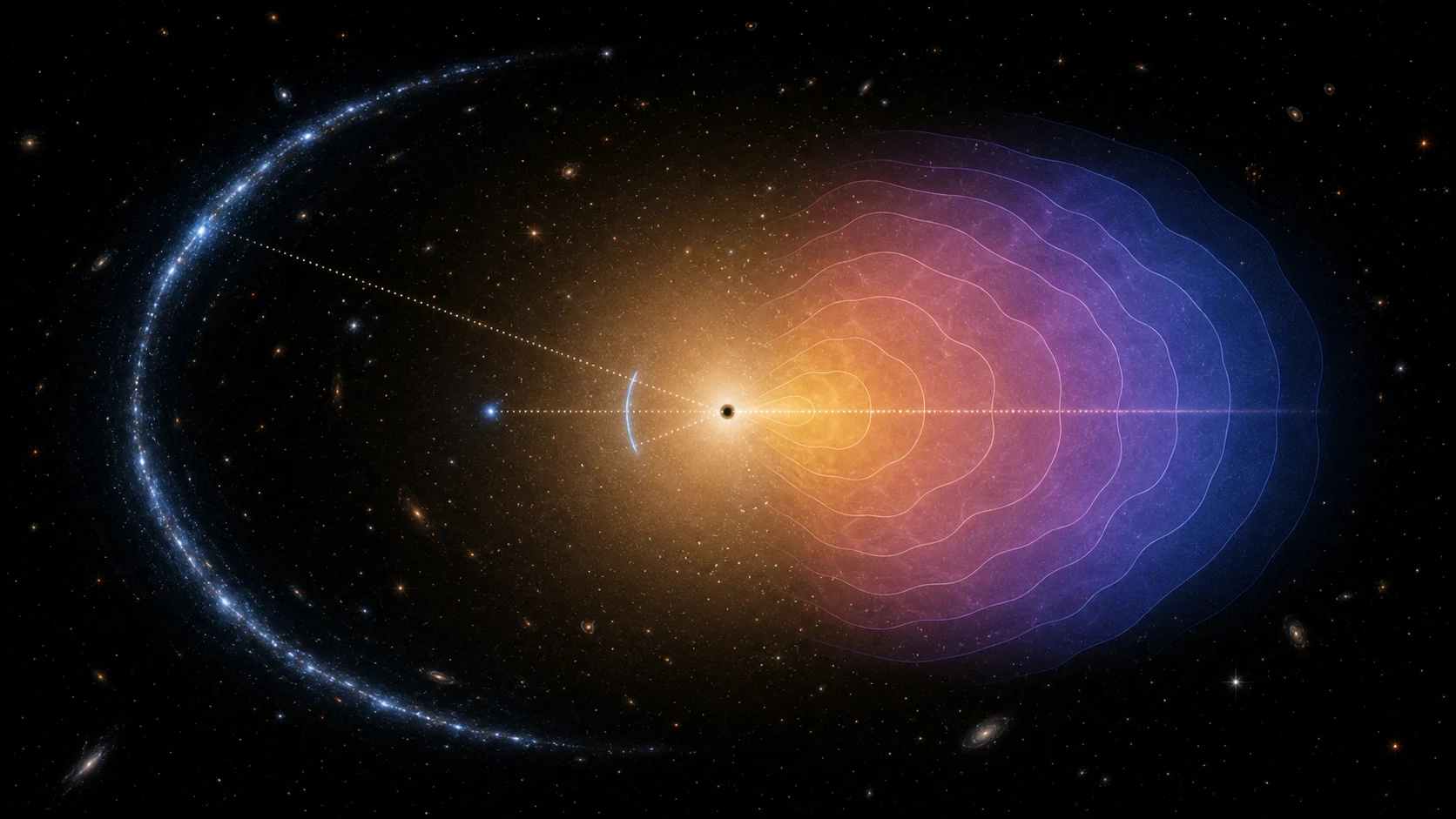
The most important lensing feature is not the prominent outer Horseshoe but a faint radial arc and its counter-image close to the galaxy centre. These features are especially sensitive to the central mass distribution. Stellar dynamics alone allows larger model-to-model differences and uncertainties in the black-hole mass; adding the radial arc limits how massive the black hole can become, so the two data sets narrow the allowed range together.
The fiducial model gives log10(MBH/M☉)=10.56, with statistical uncertainties of +0.07 and −0.08 dex and a further ±0.12 dex systematic uncertainty. In more familiar terms, the central value is about 3.6×10¹⁰ solar masses. The researchers also tested different dark-matter haloes, stellar mass-to-light ratios and orbital-anisotropy assumptions. Individual central values change, but the overall results remain compatible with the fiducial model.
Why model comparison supports a central black hole
When the team removes the central black-hole component, the model struggles in particular to reproduce the galaxy core’s stellar motions. Bayesian model comparison favours the black-hole model at more than 5σ, supporting a highly concentrated central mass. Here, 5σ describes the statistical support for a central black-hole component within the tested family of models; the measurement comes from its gravitational influence on light and stars.
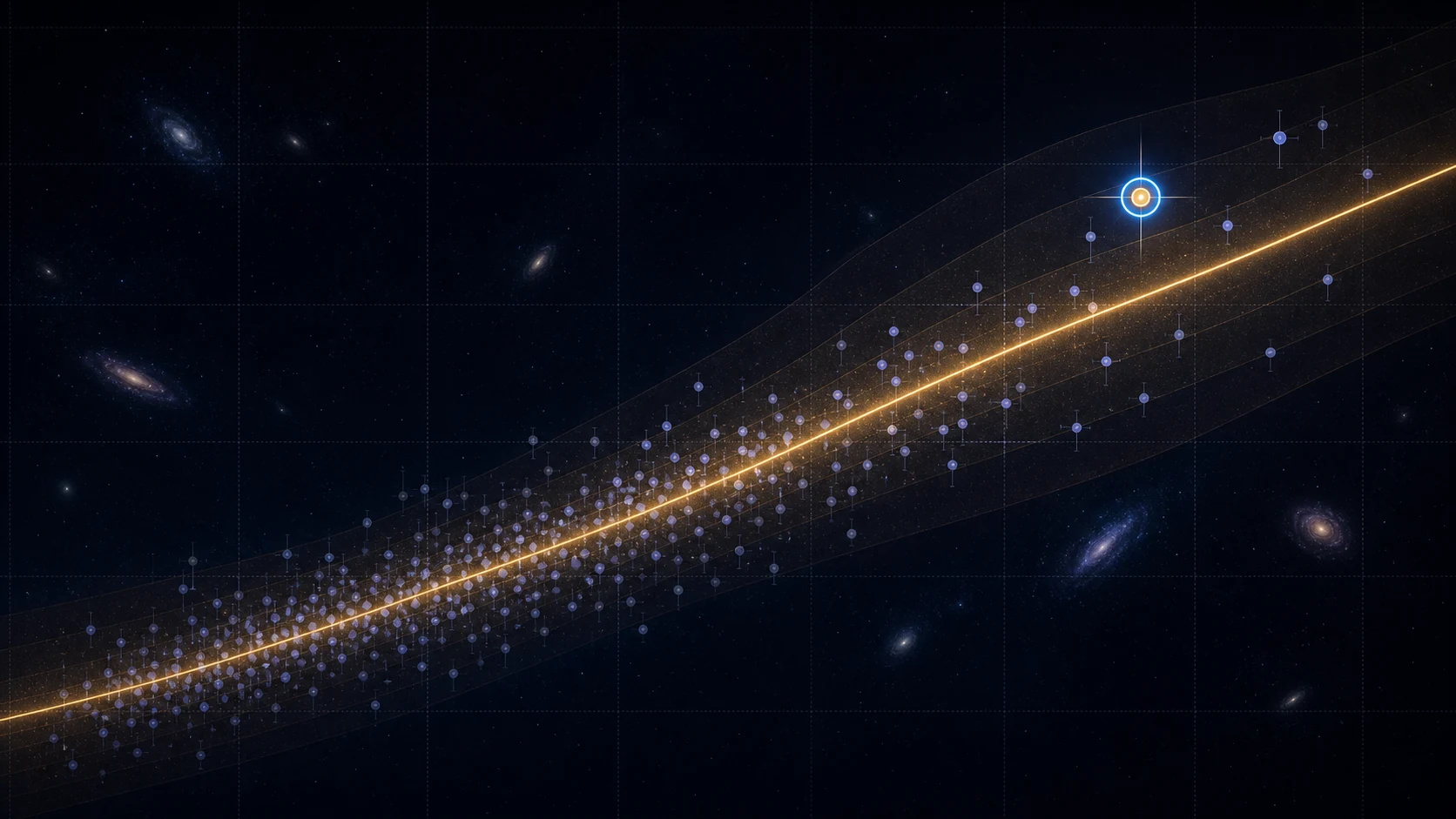
The Cosmic Horseshoe black hole lies at the highest-mass end of the measured population. Comparisons at this extreme include stellar dynamics, gas dynamics, strong lensing and active-galactic-nucleus spectroscopy, each with different observing requirements and systematic uncertainties. This study is valuable because two independent signals—lensing and stellar motions—provide a comparatively robust constraint on one of the heaviest known black holes.
Why is it heavier than the host-galaxy relation predicts?
Black-hole mass normally correlates with the host galaxy’s effective stellar velocity dispersion. The Cosmic Horseshoe black hole lies about 1.5σ above the mean relation. That offset does not by itself overturn the relation, but it resembles a trend seen in some brightest cluster galaxies: at the highest masses, black holes and their hosts may no longer grow along the same slope. This is a statistical and evolutionary interpretation, not a direct observation of the system’s formation history.
The paper suggests that the foreground galaxy may be the central member of a fossil group—a giant galaxy left after repeated early mergers, with no comparably bright companion nearby. Scouring of central stars by a black-hole binary, active-galactic-nucleus feedback and rapid accretion during an early quasar phase could all help produce a departure at the highest masses. Current data do not uniquely select among these scenarios.
The real breakthrough: weighing dormant black holes farther away
The black hole showed no strong accretion signature at the time of observation, so its mass cannot be estimated from bright quasar emission. The importance of the work therefore lies not only in how heavy the object is, but in demonstrating that radial arcs and stellar motions can jointly weigh distant, weakly accreting black holes. The Euclid space telescope is expected to discover many new gravitational lenses; systems with clear radial arcs could extend this method across a wider range of redshifts and masses.
The most secure conclusion is that the lensing and stellar-motion data for the Cosmic Horseshoe foreground galaxy both require an ultramassive black hole of roughly 36 billion solar masses, and that this inference remains robust under many model tests. How it grew so large, how black holes are distributed at the highest masses and how they co-evolve with their host galaxies will require a larger sample of similar systems.