Astronomical spectroscopy is the study of astronomy using the techniques of spectroscopy to measure the spectrum of electromagnetic radiation, including visible light and radio, which radiates from stars and other celestial objects. It reveals information about composition, temperature, and motion.
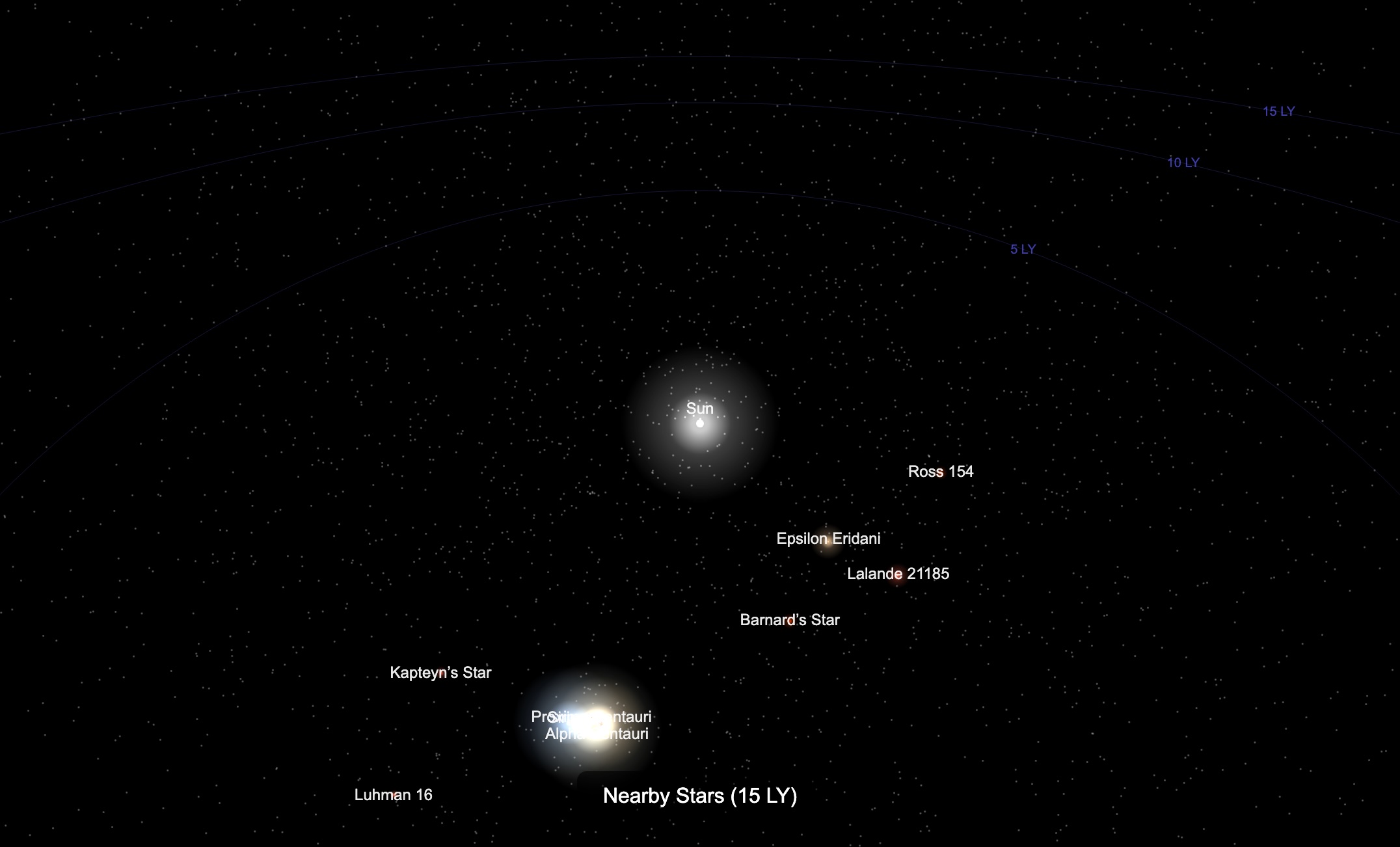
The Solar Neighborhood contains stars within a few light-years of the Sun. These include Proxima Centauri, our closest stellar neighbor, and other systems that help us understand stellar evolution.
Earth is the third planet from the Sun and the only astronomical object known to harbor life. With over 70%
of its surface covered by ocean, it supports a diverse biosphere and complex climate systems protected by a
magnetic field and atmosphere.
Diameter: 12,742 km
Day Length: 24 hours
Population: 8.2 billion
The Moon
Earth's Satellite
The Moon is Earth's only natural satellite. It is the fifth-largest satellite in the Solar System and the
largest among planetary satellites relative to the size of the planet that it orbits. Its gravitational
influence is the main driver of Earth's tides and very slowly lengthens Earth's day.
Diameter: 3,474 km
Distance: 384,400 km
Orbital Period: 27.3 days
Moon Surface
The Moon is a stark, airless world of ancient rock, its surface shaped by billions of years of
relentless impacts and volcanic activity. This natural satellite of Earth displays a dramatic
contrast between dark basaltic plains and bright, heavily cratered highlands, recording a visible
history of the early solar system. Locked in synchronous rotation, it exerts a profound
gravitational influence on Earth, governing ocean tides and subtly stabilizing the planet’s axial
tilt.
Lunar Rover
The lunar rover rests on a desolate expanse of gray regolith, its rugged metal frame and dust-coated
wheels standing as a testament to human engineering beyond Earth. In the pitch-black sky above, the
distant Earth glows in blue and white, a fragile oasis suspended in space, emphasizing the vast
scale of the cosmos and the quiet persistence of exploration on the Moon’s barren surface.
Earth
The Blue Marble
Earth is the third planet from the Sun and the only astronomical object known to harbor life. With over 70%
of its surface covered by ocean, it supports a diverse biosphere and complex climate systems protected by a
magnetic field and atmosphere.
Diameter: 12,742 km
Day Length: 24 hours
Population: 8.2 billion
The Moon
Earth's Satellite
The Moon is Earth's only natural satellite. It is the fifth-largest satellite in the Solar System and the
largest among planetary satellites relative to the size of the planet that it orbits. Its gravitational
influence is the main driver of Earth's tides and very slowly lengthens Earth's day.
Diameter: 3,474 km
Distance: 384,400 km
Orbital Period: 27.3 days
Moon Surface
The Moon is a stark, airless world of ancient rock, its surface shaped by billions of years of
relentless impacts and volcanic activity. This natural satellite of Earth displays a dramatic
contrast between dark basaltic plains and bright, heavily cratered highlands, recording a visible
history of the early solar system. Locked in synchronous rotation, it exerts a profound
gravitational influence on Earth, governing ocean tides and subtly stabilizing the planet’s axial
tilt.
Lunar Rover
The lunar rover rests on a desolate expanse of gray regolith, its rugged metal frame and dust-coated
wheels standing as a testament to human engineering beyond Earth. In the pitch-black sky above, the
distant Earth glows in blue and white, a fragile oasis suspended in space, emphasizing the vast
scale of the cosmos and the quiet persistence of exploration on the Moon’s barren surface.
Earth
The Blue Marble
Earth is the third planet from the Sun and the only astronomical object known to harbor life. With over 70%
of its surface covered by ocean, it supports a diverse biosphere and complex climate systems protected by a
magnetic field and atmosphere.
Diameter: 12,742 km
Day Length: 24 hours
Population: 8.2 billion
The Moon
Earth's Satellite
The Moon is Earth's only natural satellite. It is the fifth-largest satellite in the Solar System and the
largest among planetary satellites relative to the size of the planet that it orbits. Its gravitational
influence is the main driver of Earth's tides and very slowly lengthens Earth's day.
Diameter: 3,474 km
Distance: 384,400 km
Orbital Period: 27.3 days
Moon Surface
The Moon is a stark, airless world of ancient rock, its surface shaped by billions of years of
relentless impacts and volcanic activity. This natural satellite of Earth displays a dramatic
contrast between dark basaltic plains and bright, heavily cratered highlands, recording a visible
history of the early solar system. Locked in synchronous rotation, it exerts a profound
gravitational influence on Earth, governing ocean tides and subtly stabilizing the planet’s axial
tilt.
Lunar Rover
The lunar rover rests on a desolate expanse of gray regolith, its rugged metal frame and dust-coated
wheels standing as a testament to human engineering beyond Earth. In the pitch-black sky above, the
distant Earth glows in blue and white, a fragile oasis suspended in space, emphasizing the vast
scale of the cosmos and the quiet persistence of exploration on the Moon’s barren surface.
Earth
The Blue Marble
Earth is the third planet from the Sun and the only astronomical object known to harbor life. With over 70%
of its surface covered by ocean, it supports a diverse biosphere and complex climate systems protected by a
magnetic field and atmosphere.
Diameter: 12,742 km
Day Length: 24 hours
Population: 8.2 billion
The Moon
Earth's Satellite
The Moon is Earth's only natural satellite. It is the fifth-largest satellite in the Solar System and the
largest among planetary satellites relative to the size of the planet that it orbits. Its gravitational
influence is the main driver of Earth's tides and very slowly lengthens Earth's day.
Diameter: 3,474 km
Distance: 384,400 km
Orbital Period: 27.3 days
Moon Surface
The Moon is a stark, airless world of ancient rock, its surface shaped by billions of years of
relentless impacts and volcanic activity. This natural satellite of Earth displays a dramatic
contrast between dark basaltic plains and bright, heavily cratered highlands, recording a visible
history of the early solar system. Locked in synchronous rotation, it exerts a profound
gravitational influence on Earth, governing ocean tides and subtly stabilizing the planet’s axial
tilt.
Lunar Rover
The lunar rover rests on a desolate expanse of gray regolith, its rugged metal frame and dust-coated
wheels standing as a testament to human engineering beyond Earth. In the pitch-black sky above, the
distant Earth glows in blue and white, a fragile oasis suspended in space, emphasizing the vast
scale of the cosmos and the quiet persistence of exploration on the Moon’s barren surface.
Earth
The Blue Marble
Earth is the third planet from the Sun and the only astronomical object known to harbor life. With over 70%
of its surface covered by ocean, it supports a diverse biosphere and complex climate systems protected by a
magnetic field and atmosphere.
Diameter: 12,742 km
Day Length: 24 hours
Population: 8.2 billion
The Moon
Earth's Satellite
The Moon is Earth's only natural satellite. It is the fifth-largest satellite in the Solar System and the
largest among planetary satellites relative to the size of the planet that it orbits. Its gravitational
influence is the main driver of Earth's tides and very slowly lengthens Earth's day.
Diameter: 3,474 km
Distance: 384,400 km
Orbital Period: 27.3 days
Moon Surface
The Moon is a stark, airless world of ancient rock, its surface shaped by billions of years of
relentless impacts and volcanic activity. This natural satellite of Earth displays a dramatic
contrast between dark basaltic plains and bright, heavily cratered highlands, recording a visible
history of the early solar system. Locked in synchronous rotation, it exerts a profound
gravitational influence on Earth, governing ocean tides and subtly stabilizing the planet’s axial
tilt.
Lunar Rover
The lunar rover rests on a desolate expanse of gray regolith, its rugged metal frame and dust-coated
wheels standing as a testament to human engineering beyond Earth. In the pitch-black sky above, the
distant Earth glows in blue and white, a fragile oasis suspended in space, emphasizing the vast
scale of the cosmos and the quiet persistence of exploration on the Moon’s barren surface.
Scene: Spectroscopy
The Solar Neighborhood contains stars within a few light-years of the Sun. These include Proxima Centauri, our closest stellar neighbor, and other systems that help us understand stellar evolution.
Spectroscopy
Reading Chemical Composition
Astronomical spectroscopy is the study of astronomy using the techniques of spectroscopy to measure the spectrum of electromagnetic radiation, including visible light and radio, which radiates from stars and other celestial objects. It reveals information about composition, temperature, and motion.
First Used: 1814 by Fraunhofer
Discovery: Helium on Sun first
Lines Cataloged: 25,000+ (solar)
Spectral Analysis
Spectroscopy involves dispersing light into its component colors to create a spectrum. By analyzing the specific wavelengths of light absorbed or emitted by celestial objects, astronomers can determine their chemical composition, temperature, and motion through space.
Doppler Effect
Detecting Stellar Motion
The Doppler effect is the change in frequency of a wave in relation to an observer who is moving relative to the wave source. In astronomy, it is used to measure the speed at which stars and galaxies are approaching or receding from us (blueshift or redshift).
Discovered: 1842 by Doppler
Blueshift: Approaching star
Redshift: Receding star
Doppler Shift
Just as a car horn sounds higher-pitched when approaching and lower when receding, light waves behave the same way. When a star moves toward us, its light is compressed to shorter, higher-frequency wavelengths — a blueshift. When it moves away, the light is stretched to longer, lower-frequency wavelengths — a redshift. This principle allows astronomers to measure the radial velocity of distant stars and galaxies from Earth.
Stellar Classification
O B A F G K M
Stellar classification is the categorization of stars based on their spectral characteristics. The modern Morgan–Keenan (MK) system uses the letters O, B, A, F, G, K, and M to sequence stars from the hottest (O type) to the coolest (M type).
Our Sun: G2V yellow dwarf
Most Common: M-class red dwarfs
System: Morgan-Keenan (MK)
Stellar Types
Stars are classified by their spectral characteristics, primarily using the Morgan-Keenan (MK) system which arranges them from hottest to coolest: O, B, A, F, G, K, M. This classification reveals vital information about a star's temperature, composition, and evolutionary stage.