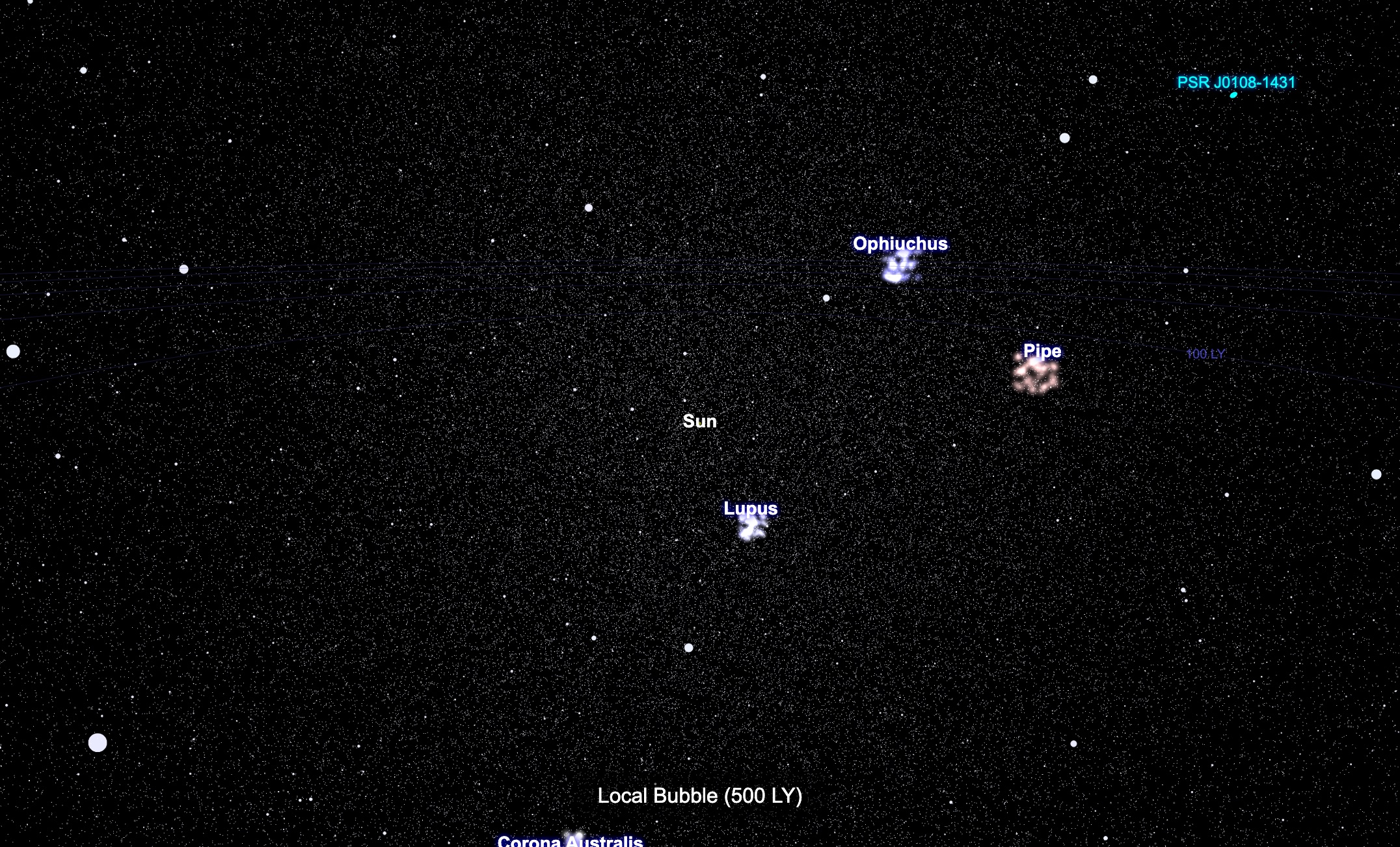
A pulsar is a highly magnetized rotating neutron star that emits beams of electromagnetic radiation out of its magnetic poles. This radiation can be observed only when a beam of emission is pointing toward Earth, similar to the way a lighthouse can be seen only when the light is pointed in the direction of an observer.
The Local Bubble is a cavity in the interstellar medium roughly 300 light-years across. It contains hot, diffuse gas and is thought to have been carved out by multiple supernovae millions of years ago.
Earth is the third planet from the Sun and the only astronomical object known to harbor life. With over 70%
of its surface covered by ocean, it supports a diverse biosphere and complex climate systems protected by a
magnetic field and atmosphere.
Diameter: 12,742 km
Day Length: 24 hours
Population: 8.2 billion
The Moon
Earth's Satellite
The Moon is Earth's only natural satellite. It is the fifth-largest satellite in the Solar System and the
largest among planetary satellites relative to the size of the planet that it orbits. Its gravitational
influence is the main driver of Earth's tides and very slowly lengthens Earth's day.
Diameter: 3,474 km
Distance: 384,400 km
Orbital Period: 27.3 days
Moon Surface
The Moon is a stark, airless world of ancient rock, its surface shaped by billions of years of
relentless impacts and volcanic activity. This natural satellite of Earth displays a dramatic
contrast between dark basaltic plains and bright, heavily cratered highlands, recording a visible
history of the early solar system. Locked in synchronous rotation, it exerts a profound
gravitational influence on Earth, governing ocean tides and subtly stabilizing the planet’s axial
tilt.
Lunar Rover
The lunar rover rests on a desolate expanse of gray regolith, its rugged metal frame and dust-coated
wheels standing as a testament to human engineering beyond Earth. In the pitch-black sky above, the
distant Earth glows in blue and white, a fragile oasis suspended in space, emphasizing the vast
scale of the cosmos and the quiet persistence of exploration on the Moon’s barren surface.
Earth
The Blue Marble
Earth is the third planet from the Sun and the only astronomical object known to harbor life. With over 70%
of its surface covered by ocean, it supports a diverse biosphere and complex climate systems protected by a
magnetic field and atmosphere.
Diameter: 12,742 km
Day Length: 24 hours
Population: 8.2 billion
The Moon
Earth's Satellite
The Moon is Earth's only natural satellite. It is the fifth-largest satellite in the Solar System and the
largest among planetary satellites relative to the size of the planet that it orbits. Its gravitational
influence is the main driver of Earth's tides and very slowly lengthens Earth's day.
Diameter: 3,474 km
Distance: 384,400 km
Orbital Period: 27.3 days
Moon Surface
The Moon is a stark, airless world of ancient rock, its surface shaped by billions of years of
relentless impacts and volcanic activity. This natural satellite of Earth displays a dramatic
contrast between dark basaltic plains and bright, heavily cratered highlands, recording a visible
history of the early solar system. Locked in synchronous rotation, it exerts a profound
gravitational influence on Earth, governing ocean tides and subtly stabilizing the planet’s axial
tilt.
Lunar Rover
The lunar rover rests on a desolate expanse of gray regolith, its rugged metal frame and dust-coated
wheels standing as a testament to human engineering beyond Earth. In the pitch-black sky above, the
distant Earth glows in blue and white, a fragile oasis suspended in space, emphasizing the vast
scale of the cosmos and the quiet persistence of exploration on the Moon’s barren surface.
Earth
The Blue Marble
Earth is the third planet from the Sun and the only astronomical object known to harbor life. With over 70%
of its surface covered by ocean, it supports a diverse biosphere and complex climate systems protected by a
magnetic field and atmosphere.
Diameter: 12,742 km
Day Length: 24 hours
Population: 8.2 billion
The Moon
Earth's Satellite
The Moon is Earth's only natural satellite. It is the fifth-largest satellite in the Solar System and the
largest among planetary satellites relative to the size of the planet that it orbits. Its gravitational
influence is the main driver of Earth's tides and very slowly lengthens Earth's day.
Diameter: 3,474 km
Distance: 384,400 km
Orbital Period: 27.3 days
Moon Surface
The Moon is a stark, airless world of ancient rock, its surface shaped by billions of years of
relentless impacts and volcanic activity. This natural satellite of Earth displays a dramatic
contrast between dark basaltic plains and bright, heavily cratered highlands, recording a visible
history of the early solar system. Locked in synchronous rotation, it exerts a profound
gravitational influence on Earth, governing ocean tides and subtly stabilizing the planet’s axial
tilt.
Lunar Rover
The lunar rover rests on a desolate expanse of gray regolith, its rugged metal frame and dust-coated
wheels standing as a testament to human engineering beyond Earth. In the pitch-black sky above, the
distant Earth glows in blue and white, a fragile oasis suspended in space, emphasizing the vast
scale of the cosmos and the quiet persistence of exploration on the Moon’s barren surface.
Earth
The Blue Marble
Earth is the third planet from the Sun and the only astronomical object known to harbor life. With over 70%
of its surface covered by ocean, it supports a diverse biosphere and complex climate systems protected by a
magnetic field and atmosphere.
Diameter: 12,742 km
Day Length: 24 hours
Population: 8.2 billion
The Moon
Earth's Satellite
The Moon is Earth's only natural satellite. It is the fifth-largest satellite in the Solar System and the
largest among planetary satellites relative to the size of the planet that it orbits. Its gravitational
influence is the main driver of Earth's tides and very slowly lengthens Earth's day.
Diameter: 3,474 km
Distance: 384,400 km
Orbital Period: 27.3 days
Moon Surface
The Moon is a stark, airless world of ancient rock, its surface shaped by billions of years of
relentless impacts and volcanic activity. This natural satellite of Earth displays a dramatic
contrast between dark basaltic plains and bright, heavily cratered highlands, recording a visible
history of the early solar system. Locked in synchronous rotation, it exerts a profound
gravitational influence on Earth, governing ocean tides and subtly stabilizing the planet’s axial
tilt.
Lunar Rover
The lunar rover rests on a desolate expanse of gray regolith, its rugged metal frame and dust-coated
wheels standing as a testament to human engineering beyond Earth. In the pitch-black sky above, the
distant Earth glows in blue and white, a fragile oasis suspended in space, emphasizing the vast
scale of the cosmos and the quiet persistence of exploration on the Moon’s barren surface.
Earth
The Blue Marble
Earth is the third planet from the Sun and the only astronomical object known to harbor life. With over 70%
of its surface covered by ocean, it supports a diverse biosphere and complex climate systems protected by a
magnetic field and atmosphere.
Diameter: 12,742 km
Day Length: 24 hours
Population: 8.2 billion
The Moon
Earth's Satellite
The Moon is Earth's only natural satellite. It is the fifth-largest satellite in the Solar System and the
largest among planetary satellites relative to the size of the planet that it orbits. Its gravitational
influence is the main driver of Earth's tides and very slowly lengthens Earth's day.
Diameter: 3,474 km
Distance: 384,400 km
Orbital Period: 27.3 days
Moon Surface
The Moon is a stark, airless world of ancient rock, its surface shaped by billions of years of
relentless impacts and volcanic activity. This natural satellite of Earth displays a dramatic
contrast between dark basaltic plains and bright, heavily cratered highlands, recording a visible
history of the early solar system. Locked in synchronous rotation, it exerts a profound
gravitational influence on Earth, governing ocean tides and subtly stabilizing the planet’s axial
tilt.
Lunar Rover
The lunar rover rests on a desolate expanse of gray regolith, its rugged metal frame and dust-coated
wheels standing as a testament to human engineering beyond Earth. In the pitch-black sky above, the
distant Earth glows in blue and white, a fragile oasis suspended in space, emphasizing the vast
scale of the cosmos and the quiet persistence of exploration on the Moon’s barren surface.
Scene: Pulsar
The Local Bubble is a cavity in the interstellar medium roughly 300 light-years across. It contains hot, diffuse gas and is thought to have been carved out by multiple supernovae millions of years ago.
Pulsar
PSR J0108-1431
A pulsar is a highly magnetized rotating neutron star that emits beams of electromagnetic radiation out of its magnetic poles. This radiation can be observed only when a beam of emission is pointing toward Earth, similar to the way a lighthouse can be seen only when the light is pointed in the direction of an observer.
Distance: ~424 light-years
Rot. Period: 0.808 s
Age: 166 Myr
Supernova
Explosive Death of a Star
A supernova is a powerful and luminous stellar explosion. This transient astronomical event occurs during the last evolutionary stages of a massive star or when a white dwarf is triggered into runaway nuclear fusion. The explosion expels much of the star's material.
Peak Luminosity: 10^9 Suns
Energy: 10^44 Joules
Remnant: Neutron Star / Black Hole
Superbubble
Local Bubble
A superbubble is a cavity hundreds of light-years across filled with hot, low-density gas, blown into the interstellar medium by multiple supernovae and stellar winds from massive stars. Our solar system is currently traveling through one known as the Local Bubble.