GW170817 was a gravitational wave signal observed by the LIGO and Virgo detectors on 17 August 2017. The signal originated from the elliptical galaxy NGC 4993, representing the first ever observation of a binary neutron star merger.
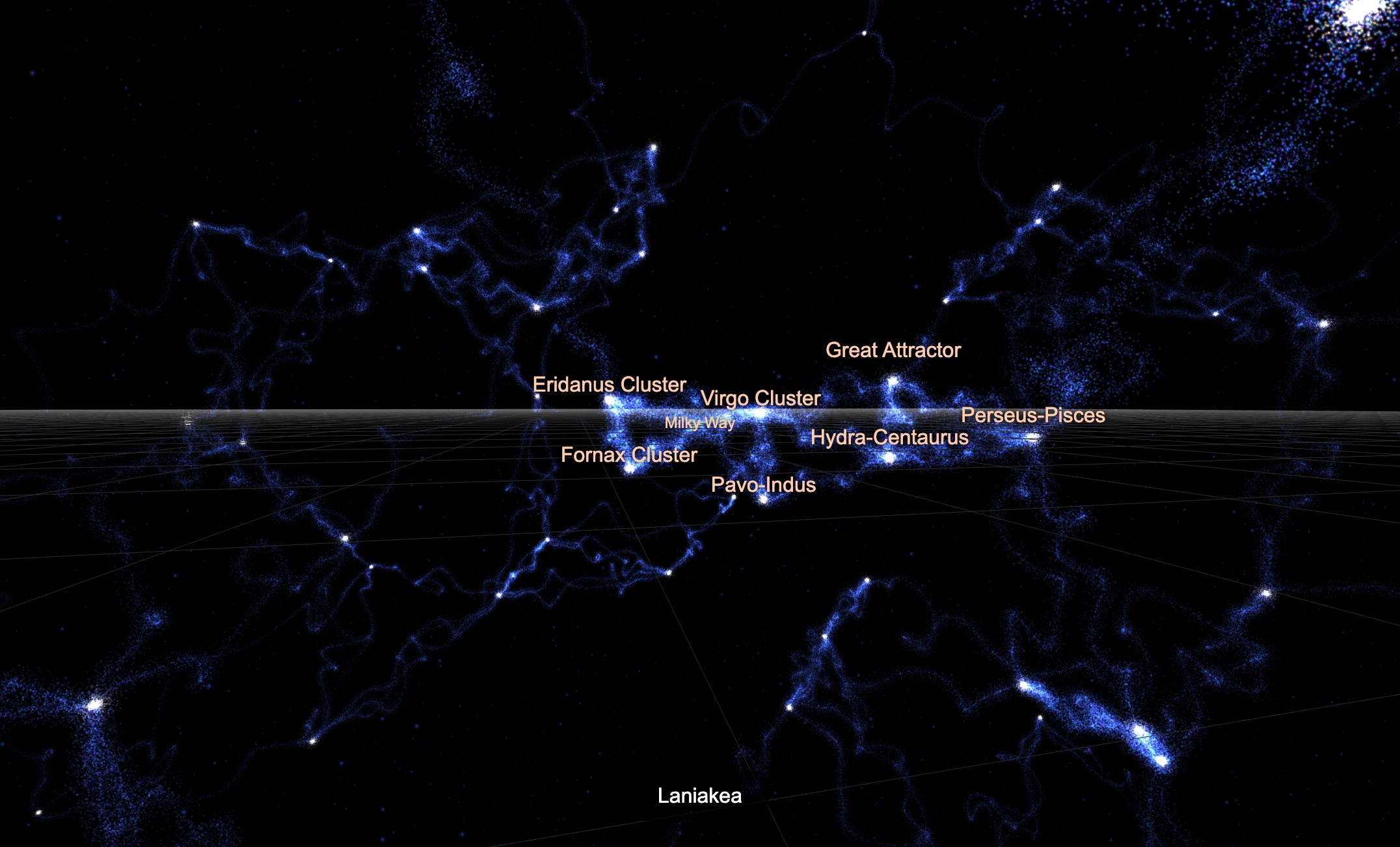
Laniakea is the galaxy supercluster that is home to the Milky Way and approximately 100,000 other nearby galaxies. It spans 520 million light-years and illustrates the large-scale structure of the universe.
Earth is the third planet from the Sun and the only astronomical object known to harbor life. With over 70%
of its surface covered by ocean, it supports a diverse biosphere and complex climate systems protected by a
magnetic field and atmosphere.
Diameter: 12,742 km
Day Length: 24 hours
Population: 8.2 billion
The Moon
Earth's Satellite
The Moon is Earth's only natural satellite. It is the fifth-largest satellite in the Solar System and the
largest among planetary satellites relative to the size of the planet that it orbits. Its gravitational
influence is the main driver of Earth's tides and very slowly lengthens Earth's day.
Diameter: 3,474 km
Distance: 384,400 km
Orbital Period: 27.3 days
Moon Surface
The Moon is a stark, airless world of ancient rock, its surface shaped by billions of years of
relentless impacts and volcanic activity. This natural satellite of Earth displays a dramatic
contrast between dark basaltic plains and bright, heavily cratered highlands, recording a visible
history of the early solar system. Locked in synchronous rotation, it exerts a profound
gravitational influence on Earth, governing ocean tides and subtly stabilizing the planet’s axial
tilt.
Lunar Rover
The lunar rover rests on a desolate expanse of gray regolith, its rugged metal frame and dust-coated
wheels standing as a testament to human engineering beyond Earth. In the pitch-black sky above, the
distant Earth glows in blue and white, a fragile oasis suspended in space, emphasizing the vast
scale of the cosmos and the quiet persistence of exploration on the Moon’s barren surface.
Earth
The Blue Marble
Earth is the third planet from the Sun and the only astronomical object known to harbor life. With over 70%
of its surface covered by ocean, it supports a diverse biosphere and complex climate systems protected by a
magnetic field and atmosphere.
Diameter: 12,742 km
Day Length: 24 hours
Population: 8.2 billion
The Moon
Earth's Satellite
The Moon is Earth's only natural satellite. It is the fifth-largest satellite in the Solar System and the
largest among planetary satellites relative to the size of the planet that it orbits. Its gravitational
influence is the main driver of Earth's tides and very slowly lengthens Earth's day.
Diameter: 3,474 km
Distance: 384,400 km
Orbital Period: 27.3 days
Moon Surface
The Moon is a stark, airless world of ancient rock, its surface shaped by billions of years of
relentless impacts and volcanic activity. This natural satellite of Earth displays a dramatic
contrast between dark basaltic plains and bright, heavily cratered highlands, recording a visible
history of the early solar system. Locked in synchronous rotation, it exerts a profound
gravitational influence on Earth, governing ocean tides and subtly stabilizing the planet’s axial
tilt.
Lunar Rover
The lunar rover rests on a desolate expanse of gray regolith, its rugged metal frame and dust-coated
wheels standing as a testament to human engineering beyond Earth. In the pitch-black sky above, the
distant Earth glows in blue and white, a fragile oasis suspended in space, emphasizing the vast
scale of the cosmos and the quiet persistence of exploration on the Moon’s barren surface.
Earth
The Blue Marble
Earth is the third planet from the Sun and the only astronomical object known to harbor life. With over 70%
of its surface covered by ocean, it supports a diverse biosphere and complex climate systems protected by a
magnetic field and atmosphere.
Diameter: 12,742 km
Day Length: 24 hours
Population: 8.2 billion
The Moon
Earth's Satellite
The Moon is Earth's only natural satellite. It is the fifth-largest satellite in the Solar System and the
largest among planetary satellites relative to the size of the planet that it orbits. Its gravitational
influence is the main driver of Earth's tides and very slowly lengthens Earth's day.
Diameter: 3,474 km
Distance: 384,400 km
Orbital Period: 27.3 days
Moon Surface
The Moon is a stark, airless world of ancient rock, its surface shaped by billions of years of
relentless impacts and volcanic activity. This natural satellite of Earth displays a dramatic
contrast between dark basaltic plains and bright, heavily cratered highlands, recording a visible
history of the early solar system. Locked in synchronous rotation, it exerts a profound
gravitational influence on Earth, governing ocean tides and subtly stabilizing the planet’s axial
tilt.
Lunar Rover
The lunar rover rests on a desolate expanse of gray regolith, its rugged metal frame and dust-coated
wheels standing as a testament to human engineering beyond Earth. In the pitch-black sky above, the
distant Earth glows in blue and white, a fragile oasis suspended in space, emphasizing the vast
scale of the cosmos and the quiet persistence of exploration on the Moon’s barren surface.
Earth
The Blue Marble
Earth is the third planet from the Sun and the only astronomical object known to harbor life. With over 70%
of its surface covered by ocean, it supports a diverse biosphere and complex climate systems protected by a
magnetic field and atmosphere.
Diameter: 12,742 km
Day Length: 24 hours
Population: 8.2 billion
The Moon
Earth's Satellite
The Moon is Earth's only natural satellite. It is the fifth-largest satellite in the Solar System and the
largest among planetary satellites relative to the size of the planet that it orbits. Its gravitational
influence is the main driver of Earth's tides and very slowly lengthens Earth's day.
Diameter: 3,474 km
Distance: 384,400 km
Orbital Period: 27.3 days
Moon Surface
The Moon is a stark, airless world of ancient rock, its surface shaped by billions of years of
relentless impacts and volcanic activity. This natural satellite of Earth displays a dramatic
contrast between dark basaltic plains and bright, heavily cratered highlands, recording a visible
history of the early solar system. Locked in synchronous rotation, it exerts a profound
gravitational influence on Earth, governing ocean tides and subtly stabilizing the planet’s axial
tilt.
Lunar Rover
The lunar rover rests on a desolate expanse of gray regolith, its rugged metal frame and dust-coated
wheels standing as a testament to human engineering beyond Earth. In the pitch-black sky above, the
distant Earth glows in blue and white, a fragile oasis suspended in space, emphasizing the vast
scale of the cosmos and the quiet persistence of exploration on the Moon’s barren surface.
Earth
The Blue Marble
Earth is the third planet from the Sun and the only astronomical object known to harbor life. With over 70%
of its surface covered by ocean, it supports a diverse biosphere and complex climate systems protected by a
magnetic field and atmosphere.
Diameter: 12,742 km
Day Length: 24 hours
Population: 8.2 billion
The Moon
Earth's Satellite
The Moon is Earth's only natural satellite. It is the fifth-largest satellite in the Solar System and the
largest among planetary satellites relative to the size of the planet that it orbits. Its gravitational
influence is the main driver of Earth's tides and very slowly lengthens Earth's day.
Diameter: 3,474 km
Distance: 384,400 km
Orbital Period: 27.3 days
Moon Surface
The Moon is a stark, airless world of ancient rock, its surface shaped by billions of years of
relentless impacts and volcanic activity. This natural satellite of Earth displays a dramatic
contrast between dark basaltic plains and bright, heavily cratered highlands, recording a visible
history of the early solar system. Locked in synchronous rotation, it exerts a profound
gravitational influence on Earth, governing ocean tides and subtly stabilizing the planet’s axial
tilt.
Lunar Rover
The lunar rover rests on a desolate expanse of gray regolith, its rugged metal frame and dust-coated
wheels standing as a testament to human engineering beyond Earth. In the pitch-black sky above, the
distant Earth glows in blue and white, a fragile oasis suspended in space, emphasizing the vast
scale of the cosmos and the quiet persistence of exploration on the Moon’s barren surface.
Scene: Gravitational Wave
Laniakea is the galaxy supercluster that is home to the Milky Way and approximately 100,000 other nearby galaxies. It spans 520 million light-years and illustrates the large-scale structure of the universe.
Gravitational Wave
GW170817 detected from NGC 4993
GW170817 was a gravitational wave signal observed by the LIGO and Virgo detectors on 17 August 2017. The signal originated from the elliptical galaxy NGC 4993, representing the first ever observation of a binary neutron star merger.
Date: 17 Aug 2017
Source: NGC 4993
Type: Neutron Star Merger
Galaxy Cluster
Largest Known Structures
Galaxy clusters are the largest known gravitationally bound structures in the universe, containing hundreds to thousands of galaxies, hot plasma, and a large amount of invisible dark matter. They are key probes of the large-scale structure and evolution of the cosmos.
Members: 100-1000+ galaxies
Diameter: 10-30 million ly
Mass: 10^14-10^15 M☉
Dark Matter
The Invisible Scaffold
Dark matter is a hypothetical form of matter that appears to account for approximately 85% of the matter in the universe. It does not interact with electromagnetic radiation, making it invisible, but its existence is inferred from its gravitational effects on visible matter.
Universe %: 27% of total
Detection: Gravity only
Type: Non-baryonic (unknown)
Dark Energy
The Universe's Accelerant
Dark energy is an unknown form of energy that affects the universe on the largest scales. It is the primary evidence for the observation that the expansion of the universe is accelerating. It is estimated to make up roughly 68% of the total energy in the observable universe.