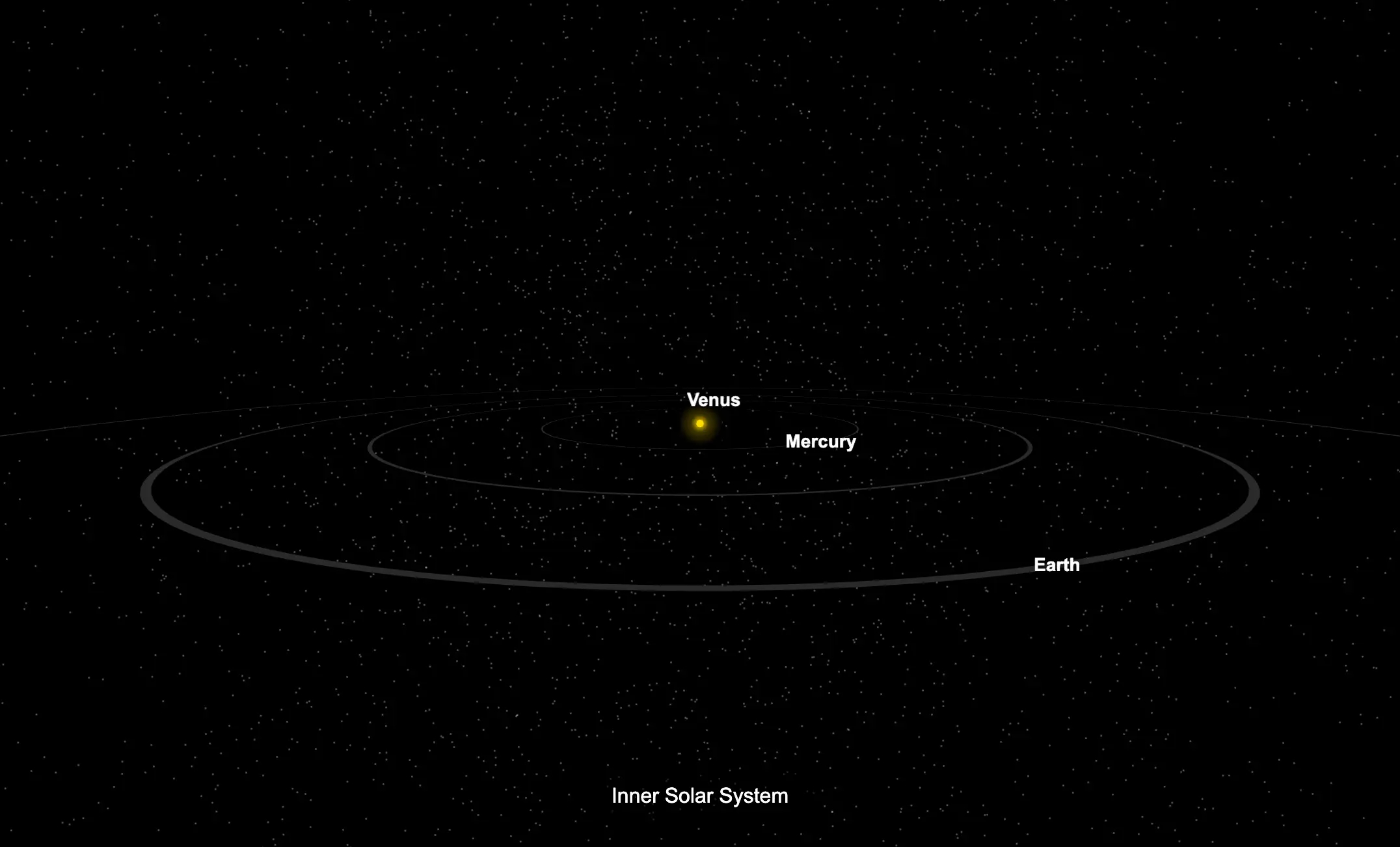
Parker Solar Probe — Seven Venus Gravity-Assist Flybys
Interactive gravity-assist simulation
This interactive experiment simulates NASA's Parker Solar Probe, launched on 12 August 2018, and the seven Venus gravity-assist flybys that carried it closer to the Sun than any spacecraft in history. Each Venus encounter bleeds a little orbital energy from the probe, lowering its perihelion (closest approach to the Sun) step by step until it grazes the solar corona. The visualization is driven by real Keplerian orbital mechanics, so the orbit, speed and solar distance evolve the way the actual mission did.
Use the timeline to scrub through the mission, adjust the simulation time rate, and toggle Mercury's orbit for scale. Live telemetry reports the probe's current and peak speed, its distance from the Sun in solar radii (RS), and the elapsed mission time.
- Launch: 12 August 2018
- Gravity-assist flybys: 7 Venus encounters
- Peak speed near the Sun: about 192 km/s — the fastest human-made object ever
- Mission duration modelled: roughly seven years toward the Sun
- Orbit model: Keplerian orbital mechanics