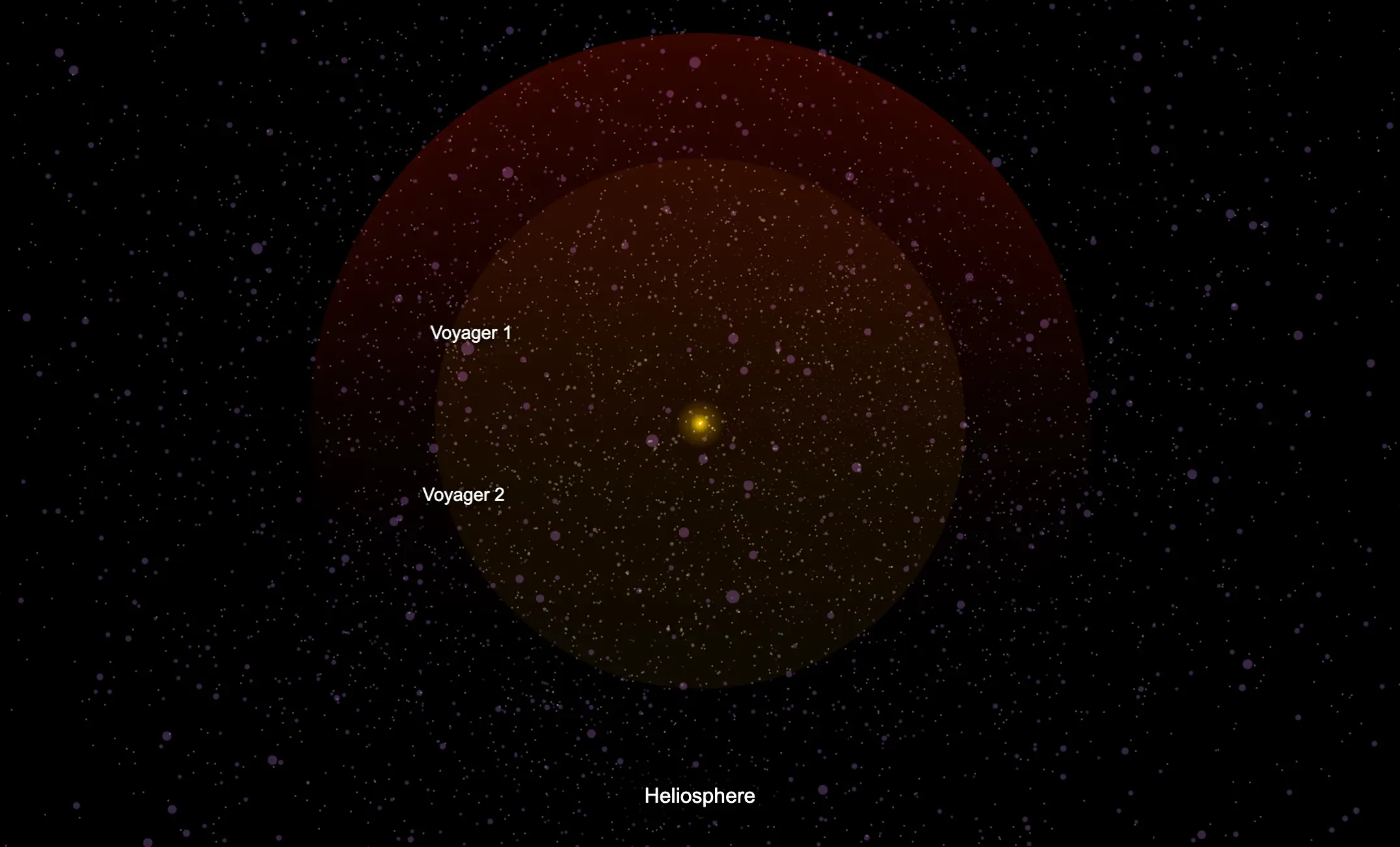
The Voyager program consists of two robotic interstellar probes, Voyager 1 and Voyager 2. Launched in 1977, they have provided invaluable data about the outer planets and are now exploring the interstellar medium, carrying the Golden Record as a message to potential extraterrestrial civilizations.
The Heliosphere is the vast, bubble-like region of space that encompasses the Solar System and is dominated by plasma emanated from the Sun, known as the solar wind.
Earth is the third planet from the Sun and the only astronomical object known to harbor life. With over 70%
of its surface covered by ocean, it supports a diverse biosphere and complex climate systems protected by a
magnetic field and atmosphere.
Diameter: 12,742 km
Day Length: 24 hours
Population: 8.2 billion
The Moon
Earth's Satellite
The Moon is Earth's only natural satellite. It is the fifth-largest satellite in the Solar System and the
largest among planetary satellites relative to the size of the planet that it orbits. Its gravitational
influence is the main driver of Earth's tides and very slowly lengthens Earth's day.
Diameter: 3,474 km
Distance: 384,400 km
Orbital Period: 27.3 days
Moon Surface
The Moon is a stark, airless world of ancient rock, its surface shaped by billions of years of
relentless impacts and volcanic activity. This natural satellite of Earth displays a dramatic
contrast between dark basaltic plains and bright, heavily cratered highlands, recording a visible
history of the early solar system. Locked in synchronous rotation, it exerts a profound
gravitational influence on Earth, governing ocean tides and subtly stabilizing the planet’s axial
tilt.
Lunar Rover
The lunar rover rests on a desolate expanse of gray regolith, its rugged metal frame and dust-coated
wheels standing as a testament to human engineering beyond Earth. In the pitch-black sky above, the
distant Earth glows in blue and white, a fragile oasis suspended in space, emphasizing the vast
scale of the cosmos and the quiet persistence of exploration on the Moon’s barren surface.
Earth
The Blue Marble
Earth is the third planet from the Sun and the only astronomical object known to harbor life. With over 70%
of its surface covered by ocean, it supports a diverse biosphere and complex climate systems protected by a
magnetic field and atmosphere.
Diameter: 12,742 km
Day Length: 24 hours
Population: 8.2 billion
The Moon
Earth's Satellite
The Moon is Earth's only natural satellite. It is the fifth-largest satellite in the Solar System and the
largest among planetary satellites relative to the size of the planet that it orbits. Its gravitational
influence is the main driver of Earth's tides and very slowly lengthens Earth's day.
Diameter: 3,474 km
Distance: 384,400 km
Orbital Period: 27.3 days
Moon Surface
The Moon is a stark, airless world of ancient rock, its surface shaped by billions of years of
relentless impacts and volcanic activity. This natural satellite of Earth displays a dramatic
contrast between dark basaltic plains and bright, heavily cratered highlands, recording a visible
history of the early solar system. Locked in synchronous rotation, it exerts a profound
gravitational influence on Earth, governing ocean tides and subtly stabilizing the planet’s axial
tilt.
Lunar Rover
The lunar rover rests on a desolate expanse of gray regolith, its rugged metal frame and dust-coated
wheels standing as a testament to human engineering beyond Earth. In the pitch-black sky above, the
distant Earth glows in blue and white, a fragile oasis suspended in space, emphasizing the vast
scale of the cosmos and the quiet persistence of exploration on the Moon’s barren surface.
Earth
The Blue Marble
Earth is the third planet from the Sun and the only astronomical object known to harbor life. With over 70%
of its surface covered by ocean, it supports a diverse biosphere and complex climate systems protected by a
magnetic field and atmosphere.
Diameter: 12,742 km
Day Length: 24 hours
Population: 8.2 billion
The Moon
Earth's Satellite
The Moon is Earth's only natural satellite. It is the fifth-largest satellite in the Solar System and the
largest among planetary satellites relative to the size of the planet that it orbits. Its gravitational
influence is the main driver of Earth's tides and very slowly lengthens Earth's day.
Diameter: 3,474 km
Distance: 384,400 km
Orbital Period: 27.3 days
Moon Surface
The Moon is a stark, airless world of ancient rock, its surface shaped by billions of years of
relentless impacts and volcanic activity. This natural satellite of Earth displays a dramatic
contrast between dark basaltic plains and bright, heavily cratered highlands, recording a visible
history of the early solar system. Locked in synchronous rotation, it exerts a profound
gravitational influence on Earth, governing ocean tides and subtly stabilizing the planet’s axial
tilt.
Lunar Rover
The lunar rover rests on a desolate expanse of gray regolith, its rugged metal frame and dust-coated
wheels standing as a testament to human engineering beyond Earth. In the pitch-black sky above, the
distant Earth glows in blue and white, a fragile oasis suspended in space, emphasizing the vast
scale of the cosmos and the quiet persistence of exploration on the Moon’s barren surface.
Earth
The Blue Marble
Earth is the third planet from the Sun and the only astronomical object known to harbor life. With over 70%
of its surface covered by ocean, it supports a diverse biosphere and complex climate systems protected by a
magnetic field and atmosphere.
Diameter: 12,742 km
Day Length: 24 hours
Population: 8.2 billion
The Moon
Earth's Satellite
The Moon is Earth's only natural satellite. It is the fifth-largest satellite in the Solar System and the
largest among planetary satellites relative to the size of the planet that it orbits. Its gravitational
influence is the main driver of Earth's tides and very slowly lengthens Earth's day.
Diameter: 3,474 km
Distance: 384,400 km
Orbital Period: 27.3 days
Moon Surface
The Moon is a stark, airless world of ancient rock, its surface shaped by billions of years of
relentless impacts and volcanic activity. This natural satellite of Earth displays a dramatic
contrast between dark basaltic plains and bright, heavily cratered highlands, recording a visible
history of the early solar system. Locked in synchronous rotation, it exerts a profound
gravitational influence on Earth, governing ocean tides and subtly stabilizing the planet’s axial
tilt.
Lunar Rover
The lunar rover rests on a desolate expanse of gray regolith, its rugged metal frame and dust-coated
wheels standing as a testament to human engineering beyond Earth. In the pitch-black sky above, the
distant Earth glows in blue and white, a fragile oasis suspended in space, emphasizing the vast
scale of the cosmos and the quiet persistence of exploration on the Moon’s barren surface.
Earth
The Blue Marble
Earth is the third planet from the Sun and the only astronomical object known to harbor life. With over 70%
of its surface covered by ocean, it supports a diverse biosphere and complex climate systems protected by a
magnetic field and atmosphere.
Diameter: 12,742 km
Day Length: 24 hours
Population: 8.2 billion
The Moon
Earth's Satellite
The Moon is Earth's only natural satellite. It is the fifth-largest satellite in the Solar System and the
largest among planetary satellites relative to the size of the planet that it orbits. Its gravitational
influence is the main driver of Earth's tides and very slowly lengthens Earth's day.
Diameter: 3,474 km
Distance: 384,400 km
Orbital Period: 27.3 days
Moon Surface
The Moon is a stark, airless world of ancient rock, its surface shaped by billions of years of
relentless impacts and volcanic activity. This natural satellite of Earth displays a dramatic
contrast between dark basaltic plains and bright, heavily cratered highlands, recording a visible
history of the early solar system. Locked in synchronous rotation, it exerts a profound
gravitational influence on Earth, governing ocean tides and subtly stabilizing the planet’s axial
tilt.
Lunar Rover
The lunar rover rests on a desolate expanse of gray regolith, its rugged metal frame and dust-coated
wheels standing as a testament to human engineering beyond Earth. In the pitch-black sky above, the
distant Earth glows in blue and white, a fragile oasis suspended in space, emphasizing the vast
scale of the cosmos and the quiet persistence of exploration on the Moon’s barren surface.
Scene: Voyager Spacecraft
The Heliosphere is the vast, bubble-like region of space that encompasses the Solar System and is dominated by plasma emanated from the Sun, known as the solar wind.
Voyager Spacecraft
Humanity's Farthest Explorers
The Voyager program consists of two robotic interstellar probes, Voyager 1 and Voyager 2. Launched in 1977, they have provided invaluable data about the outer planets and are now exploring the interstellar medium, carrying the Golden Record as a message to potential extraterrestrial civilizations.
Voyager 1: ~170 AU
Voyager 2: ~142 AU
Launched: 1977 AD
Voyager Spacecraft
Humanity's Farthest Explorers
The Voyager program consists of two robotic interstellar probes, Voyager 1 and Voyager 2. Launched in 1977, they have provided invaluable data about the outer planets and are now exploring the interstellar medium, carrying the Golden Record as a message to potential extraterrestrial civilizations.
Voyager 1: ~170 AU
Voyager 2: ~142 AU
Launched: 1977 AD
Solar Wind
Stream of Charged Particles
The solar wind is a stream of charged particles released from the upper atmosphere of the Sun, called the corona. This plasma creates the heliosphere, a vast bubble that surrounds the Solar System and protects us from significant amounts of cosmic radiation.
Speed: 400-750 km/s
Temp: 1 MK
Composition: e- & p+ mostly
Hydrogen Wall
Pile-up of Neutral Hydrogen
The hydrogen wall is a region between the bow shock and the heliopause where neutral hydrogen atoms from the interstellar medium slow down and pile up as they interact with the heliosphere. It represents one of the boundaries between our solar system and the rest of the galaxy.
Discovered: 1992 AD
Type: Scattering Region
Distance: ~120-150 AU
Cosmic Rays
High-Energy Particles
Cosmic rays are high-energy protons and atomic nuclei that move through space at nearly the speed of light. They originate from the Sun, from outside of the Solar System in our own galaxy, and from distant galaxies, often produced by energetic events like supernovae.